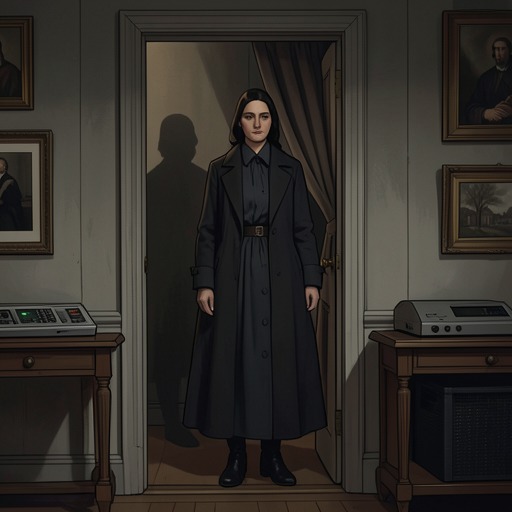
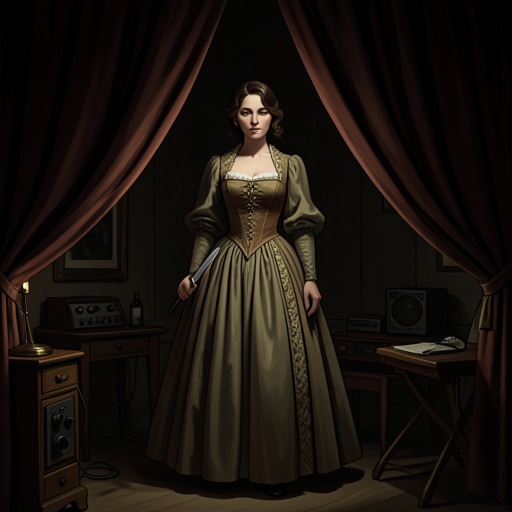
Clarisse kills Sheriff Hock and flees Argus
The Master Butchers Singing ClubClarisse kills Sheriff Hock and flees Argus after his search of her home turns into an unwanted personal advance. The killing follows a confrontation over a red glass bead that Hock has found in the floorboards, and Clarisse escapes the town by train with money and luggage. Her disappearance leaves Argus to absorb the murder into years of speculation, while her friend Delphine privately grieves both Clarisse’s absence and the secret connection between her and Cyprian.
Search and confrontation
After persistent efforts to secure a warrant from Judge Zumbrugge, Sheriff Hock searches Clarisse’s house for evidence. His meticulous approach contrasts with Clarisse’s untidy rooms: he examines the floorboards with a lamp and finds a red glass bead in a crack. The search carries the threat of criminal exposure, but Hock’s attention shifts from the evidence to Clarisse herself. He says that she must feel something for him, revealing that his pursuit is not simply official business.
Clarisse tells him to leave and warns him that she will hurt him if he stays. Hock dismisses the warning. He speaks of his steady employment and respectable habits, and argues that Clarisse’s work as an undertaker frightens other men away while he is willing to accept it. The gulf between his self-image as a suitable suitor and Clarisse’s refusal defines the encounter: what he presents as devotion is an insistence on access she has not offered.
The killing
Hock produces the bead he found and calls it evidence belonging to the state. When Clarisse reaches for it, he withholds it, puts it in his shirt pocket, opens his arms, and lunges. Clarisse responds with the knife she has kept behind her back. The action reverses the balance of the search: Hock had arrived with a warrant and an evidentiary claim, but his decision to press his advance brings the encounter to a fatal end.
Afterward, Clarisse checks that Hock is dead and takes the bead from the floor, swallowing it. She makes no attempt to conceal the body in the house. She covers him, cleans the knife, and draws a suitcase from beneath her bed. Her practical actions sit beside an immediate emotional rupture: she breaks into sobs, then deliberately turns to bathing and making plans. The shift from shock to organization governs the next stage of her escape.
Planning an escape
Clarisse plans to leave on the morning train after visiting the bank and preparing her luggage. Christmas makes the timing complicated: the funeral business might bring emergencies, but the holiday also gives her a plausible reason to withdraw money, since people are making unusual or extravagant purchases. She expects to attend Midnight Mass as usual, sleep for a few hours, and depart in the morning. Her plan treats flight not as a sudden disappearance from all routine, but as something to fit around the ordinary obligations and habits of her life.
Disappearance and aftermath
The town is shocked by the murder, and people search for explanations, but discussion eventually gives way to daily life. Hock’s body is removed from Clarisse’s house, wrapped and taken to the coroner in Fargo; the house is locked, and a deputy is appointed. In time, the violence becomes part of Argus’s local history, retold through talk and speculation rather than resolved by Clarisse’s capture.
Clarisse leaves openly, carrying a red hatbox and brown suitcase, and rides away on the train. She apparently gets off in Minneapolis, changes trains and names, and perhaps remakes her identity, but the account does not confirm where she goes. No one sees her again, and she is never captured.
Delphine and the silence left behind
Delphine knows more than the rest of the town. She does not volunteer the details of her Christmas morning visit to Clarisse, and no one asks her about it. Fresh snowfall has hidden her tracks, while the presence of Cyprian’s car near Clarisse’s house goes unnoticed. Delphine’s silence helps keep the connections among the three out of public view; even Fidelis asks only whether Cyprian has left the singing club, and accepts Delphine’s evasive reply.
For Delphine, Clarisse’s disappearance remains bound to the murder and to the concealed connection between Clarisse and Cyprian. She repeatedly examines what she knows about her friend but cannot make the loss intelligible. She misses Clarisse as a bodily absence, and the loss makes work harder and loneliness more distracting. The town can turn the killing into a story; Delphine continues to live with the private, unresolved absence behind it.