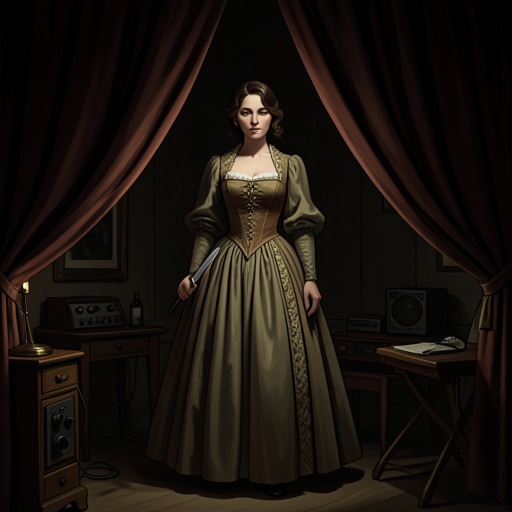
Clarisse's carving knife
The Master Butchers Singing ClubClarisse's carving knife begins as a carefully maintained kitchen tool and becomes the instrument with which she kills Sheriff Hock. Its passage from Clarisse's home to Step-and-a-Half's collection of discarded goods carries the episode beyond the immediate act: the knife survives as an ordinary object after the people and crisis that gave it meaning have passed from view.
A household tool prepared for use
Clarisse keeps her knives in a drawer in the kitchen, apart from the cigarettes stored above them, and regards the drawer as a place where sharp tools can be kept safely from children. She has no children in the house; her hands are the only little hands there. The knife she chooses is her favorite, a long, slender carving knife with a slight curve and a tempered blade. Its beauty and the routine of keeping it keen belong to her ordinary domestic order, not to a plan for violence.
After Sheriff Hock has intruded into her bedroom, Clarisse goes downstairs intending to take a cigarette. Instead, she opens the knife drawer. She tests the edge with her thumb and a whetstone, then sharpens it further when the blade does not draw blood. As she works, she thinks of how Hock and even her friend Delphine have underestimated her. Her stated intention is to frighten him into leaving, secure her home, and seek legal help; the knife gives her a means to resist, though she has not yet decided to kill him.
From warning to irreversible action
Clarisse returns to her bedroom with the knife hidden behind her back and tells Hock to leave, warning that she will hurt him if he does not. He remains and lunges after using a bead he has found as leverage in their confrontation. Clarisse thrusts with the knife. When the initial action does not immediately end the danger, she continues, acting with a steadiness that contrasts with the shock of the encounter. Hock dies, and Clarisse checks his pulse before covering him.
The knife's use changes the course of Clarisse's life. She washes it clean while preparing to leave, and she turns from the immediate aftermath to practical arrangements: taking money from the bank, packing, and planning a route. She still means to attend Midnight Mass before leaving on the morning train. The ordinary sequence of cleaning, packing, and making travel plans shows how quickly the knife's violence becomes inseparable from her effort to escape its consequences.
The knife after Clarisse's departure
Later, Clarisse's castoffs provide Step-and-a-Half with a regular source of usable and sometimes valuable goods. Just after dawn, Step-and-a-Half finds a trove on Clarisse's back porch that includes pots, pans, kitchenware, and a very good carving knife. She carries the finds to the small room behind her shop, scours the knife clean, and places it among her own cooking implements. The narrative does not explicitly identify this recovered knife as Clarisse's earlier weapon, but the matching description and its discovery among her belongings strongly connect the objects.
That association gives the knife an afterlife unlike its use in Clarisse's bedroom. In Step-and-a-Half's hands it is again a cooking implement, evaluated alongside pots and other practical goods. Its return to everyday use does not undo what it did; instead, the transition places the violence inside the novel's wider world of reuse, disposal, and incomplete knowledge. Step-and-a-Half suspects that some of Clarisse's castoffs may have belonged to the dead people she tended at Strub's basement, but the knife's precise history is not stated in her scene.
Narrative significance
The knife's meaning develops through a sharp contrast between maintenance and rupture. Clarisse first handles it according to familiar habits of storage and sharpening; the same discipline that makes it a reliable tool becomes part of her capacity to confront Hock. Afterward she cleans it, leaves it with her discarded possessions, and disappears from the household's immediate view. The object remains available for ordinary work, while the circumstances that turned it into a weapon remain largely hidden from its next user.
Its recovery also links personal violence to the book's attention to objects that outlast their owners' intentions. The knife is neither displayed as a lasting trophy nor publicly identified as evidence: it is cleaned and put among cooking utensils. The narrative therefore lets its significance depend on the reader's connection between Clarisse's act and Step-and-a-Half's later find, while preserving the gap between what an object has witnessed and what its new owner knows.