Cyprian Lazarre
The Master Butchers Singing ClubCyprian Lazarre is an Ojibwe veteran and balancing performer whose carefully disciplined body carries both the effects of war and the skills of his act. He travels and builds a life with Delphine Watzka, but their bond does not resolve into marriage: Cyprian’s same-sex attraction, his efforts to accommodate Delphine’s hopes, and her understanding of who he is shape a relationship grounded in affection without conventional certainty. In Argus, his composure and practical loyalty become consequential when he helps rescue Markus from beneath a collapsed hill fort.
Identity and Background
Cyprian is thirty-two when he and Delphine begin exploring whether they can earn a living through a traveling act. He has a powerful, gym-trained physique and conspicuous old war injuries. His discipline as a performer is not separate from his past: he enlisted in the United States Marine Corps, survived training and the Spanish flu, and fought at Belleau Wood. During the war, chlorine gas blinded him, a machine-gun accident nearly took his hand, and dysentery weakened him. He returned home before realizing that, as an Ojibwe man, he was not yet a U.S. citizen; during his recovery, he could not vote.
His identity is not immediately known to everyone around him. When asked directly about his background, he explains that he is Chippewa, also Ojibwe, and that his grandfather used the word Anishinaabeg, meaning “the humans.” His eventual openness about being Indigenous matters in a town where he and Delphine live openly together as though married. The disclosure also reframes the unease Fidelis Waldvogel has felt around him: Fidelis later recognizes that Cyprian is Indian, while also realizing that his own sudden hostility had another source in Delphine’s presence in their lives.
Performance and Work
Balancing is Cyprian’s central craft and a practiced form of self-command. Early in their partnership, he turns a chair into a performance apparatus, rising into a handstand on its bowed back. At the fair, he spins plates on poles held across his arms, shoulders, forehead, and teeth, then runs along a line of spinning plates while Delphine takes bets on how long he can sustain the feat. He balances audience-supplied loads, including crates of chickens and dishes, declines to attempt a washing machine, rides a bicycle across wires, and finishes by handstanding atop a flagpole. Delphine’s response to the act helps her accept that his need for her is real even when their intimacy does not match her expectations.
His abilities extend beyond the stage. He is good with engines and keeps his DeSoto in such clean running order that it purrs. Before leaving Argus, he checks the delivery car belonging to Eva Waldvogel, whose business is marked with the words “The Freshest. The Finest. Old World Quality.” Although he has a knack for mechanical work, he finds balancing more satisfying. Later, he declines Fidelis’s offer of work in the meat business, explaining that he has had enough of blood and guts from the war.
Cyprian instead makes money transporting liquor. He presents himself as a traveling salesman and carries an assortment of brushes in his car, both to support the appearance of legitimate trade and to answer questions from border inspectors and neighbors. His real customers include dangerous criminals from Minneapolis. Delphine dislikes the danger and the trade, but Cyprian is an adult and part-owner of the car; she also knows that he limits his own drinking because it could interfere with his balancing. Even while earning money in this way, he continues to practice small feats for the show he is developing.
Relationship with Delphine
Cyprian and Delphine’s partnership begins as friendship and shared work in theater in Argus, North Dakota, before they set out together to see whether a traveling act can support them. Their private relationship develops unevenly: a rare moment of mutual intimacy deepens their attachment, but it does not become a pattern they can reproduce. Cyprian’s affection and dependence on Delphine are genuine, even as his desire is directed toward men. The distinction between love and the kind of sexual partnership Delphine hopes for remains a central difficulty between them.
When Delphine later asks him to make love to her, Cyprian has prepared himself by imagining men, an accommodation he finds ethically troubling. He proceeds with urgency and little ease, then tries to attend to her afterward. The episode reveals how much effort he has invested in meeting her request, but also how little that effort can settle the underlying difference between them. Neither tells the other that, in the month afterward, each separately wondered whether Delphine might be pregnant.
As time passes, Cyprian wants a family and imagines teaching a child to count, balance, and understand where he came from. He also wants to remain with Delphine. Knowing she is not pregnant, he asks her to marry him with a solid gold wedding band. She says no. Later, he tells her that he would give up his attraction to men and be faithful if they married. Delphine cannot accept that promise as a true account of him: having witnessed his happiness with another man, she understands that what she saw was Cyprian himself. Their relationship remains loving, but marriage does not follow; Delphine eventually clarifies to Fidelis that she and Cyprian were never married.
Relationships and Conflict
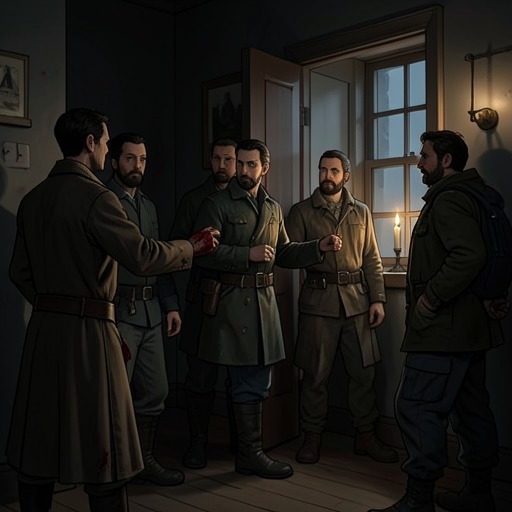
Cyprian’s ties to Delphine are not his only important relationships in Argus. His closeness with Fidelis begins under a strain neither man can readily name. During a conversation about hunting, Fidelis describes a guide nearly shot by a hunter as an “Indian,” and Cyprian freezes with his beer halfway to his lips. The two lock into a silent stare shaped by their different wartime training: Fidelis learned to hold his gaze through a rifle sight, while Cyprian learned to study an opponent as a boxer. Fidelis breaks the tension by smashing his bottle and cutting his hand. Cyprian answers a question about his war service by recalling Belleau Wood, where the wheat burned and the soldiers kept advancing; Fidelis then admits he was not there. The exchange exposes how combat experience remains active beneath their ordinary talk, and how a casual story can reopen it.
Fidelis later understands that Cyprian is Indigenous, but recognizes that this does not fully explain his own hostility. He also feels threatened or unsettled by Delphine’s place between them, though neither man articulates that tension directly. When Fidelis later tries to make amends for the hunting story, he approaches Cyprian with two beers and an attempt at friendly conversation. Their antagonism does not simply vanish, but the rescue of Markus transforms it: in the emergency, mutual reliance replaces suspicion. Cyprian restrains Fidelis from rushing into the unstable earth, then persuades him to withdraw by insisting that his own smaller body is better suited to reaching the boy. Fidelis obeys, and the two work together to bring Markus out.
Cyprian’s connection to Fidelis also takes shape through the ordinary life around the shop. He visits often, shares meals with Fidelis and Delphine, and joins the singing club despite having only an average, slightly singed baritone. One evening, after Delphine leaves the men together, their awkward silence turns to talk of flying and then hunting; the conversation’s pauses and sudden rupture reveal a closeness edged with rivalry. Later, Cyprian tells Delphine that the argument was about her. Fidelis, who thinks of Cyprian as her husband, is surprised when she finally tells him they were never married.
Rescue and Lasting Significance
The collapsed hill fort gives Cyprian a crisis in which his practiced balance becomes a means of survival rather than performance. When the boys’ underground chamber caves in around Markus, Cyprian stops Fidelis from shoveling recklessly at the blocked entrance, warning that further disturbance could bring down the remaining earth. He shows Fidelis how to use the boys’ tools and helps enlarge the tunnel with small, controlled movements, while the boys carry loosened dirt away on a canvas. In the unstable passage, Cyprian steadies Fidelis’s panic and persuades him to back out, arguing that Fidelis’s larger body could crush the trapped boy and that Cyprian is better suited to reach him.
Alone in the narrowing tunnel, Cyprian manages his own fear by concentrating on one breath at a time, as he does when balancing at dangerous heights. He finds Markus alive and frees him incrementally, removing earth by handfuls, turning the boy, and folding him through the small opening. When a board gives way, Cyprian shields Markus’s face; the tunnel holds, and the boy is brought out. The rescue changes Cyprian and Fidelis’s relation from unspoken antagonism to a powerful, practical loyalty: each trusts the other with the boy’s life, and Fidelis follows Cyprian’s instructions even under extreme strain.
Across these episodes, Cyprian’s defining discipline links apparently separate parts of his life. The performer who trains himself to hold steady on a flagpole applies the same measured attention inside a collapsing hill; the veteran’s experience of danger becomes neither a boast nor a cure for fear, but knowledge he can use to protect someone else. His relationship with Delphine remains affectionate without marriage, while his emerging bond with Fidelis is forged through shared work and rescue. Together, these strands make Cyprian a figure whose self-command is most consequential not when an audience watches, but when another person’s safety depends on it.