Erich's captivity as a German POW
The Master Butchers Singing ClubErich's captivity as a German POW places a surviving son and twin brother inside an American system of confinement while leaving him emotionally aligned with Nazi Germany. In the Minnesota woods, the food and supplies reveal the scale of Germany's defeat, but they do not undo the identity Erich has built through indoctrination, fear, and loyalty. When Fidelis and Markus come to see him, he recognizes them and keeps walking. His refusal makes captivity a test of belonging: the family can find Erich, but cannot simply call him back to them.
Capture and transport
Erich's capture follows the death of his twin, Emil, who is killed by a mine early in his brief wartime service. Erich continues fighting after the loss, exhausted and traumatized by sustained shelling. After four days and nights without sleep, he is captured. Though he understands English, he conceals that knowledge, in part because Nazi prisoners have threatened punishment for anyone who collaborates with the Americans. His silence begins as a means of avoiding danger and becomes part of a larger refusal to expose the American life he once knew.
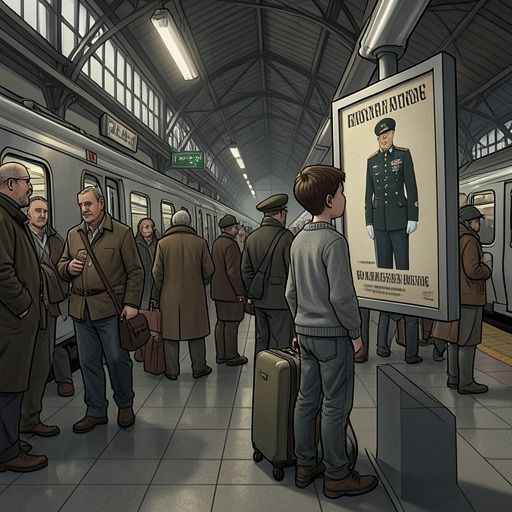
The prisoners travel north in a stripped-down train car. Erich cannot orient himself precisely, but the journey carries him toward the Great Lakes and through a country the men had been told to expect as devastated. Instead, they pass an increasingly lively and untouched landscape. The discrepancy between German propaganda and what he sees leaves Erich bewildered, his thoughts crowded with childhood memories and despair rather than a settled response to defeat.
The forestry camp
The train moves into pine country, where German prisoners who came from southwestern Germany recognize the forests as familiar. After leaving the train at a small station, the chained men walk for miles along a muddy road in early summer. Their chain makes even swatting at blackflies a collective movement. At the camp entrance, an American guard questions Markus much later about the possibility that one prisoner was born in America; the detail points to the divided history Erich keeps concealed.
The camp is enclosed by pine logs and several layers of wire, with barbed wire laid around the perimeter, yet the surrounding woods and open sky soften its appearance. The prisoners are assigned simple barracks and issued blue work clothes marked PW, coats, shoes, socks, underclothes, a wool shirt, a raincoat, blankets, toothbrushes, soap, and towels. Erich notices his own involuntary satisfaction at receiving them. The contradiction matters: he is a prisoner, but the basic provision of clothing and shelter unsettles the deprivation and destruction promised by German reports.
The camp's forestry work offers a demanding routine. The prisoners use crosscut saws on large trees and Swedish saws to trim branches, as well as chain drags and heavy trucks; mules named Max and Moritz help with remote timber. Erich welcomes hard, mindless labor as something his body craves. Its regularity gives him work to do without resolving the memories he carries, while the camp's provisions repeatedly confront him with the contrast between American resources and Germany's collapse.
Food, song, and isolation
The first meal is a particularly forceful revelation. Baked beans carry a combination of molasses, powdered mustard, and smoked pork fat that recalls food Erich had not tasted since childhood. The meal also includes creamed corn, a large baked potato, lard, and cornbread with syrup. The prisoners eat in silence, some pocketing food or finishing it before they reach the tables. To them, the amount and quality of the meal, delivered to a remote camp for prisoners, confirm that Germany has lost the war. Erich eats slowly, with reverence and shame, and thinks of Delphine.
A supervising soldier who speaks some German censors a small newspaper the prisoners produce on a hand-operated press. In the camp, Erich's voice, which developed in adolescence, becomes a resource for shared life: he begins singing to pass the time, and the men turn songs and changed lyrics into a nightly gathering. Music enters their dreams, but does not erase the distress audible in the barracks at night. Erich remains awake, listening to the pines and owls outside while the other men cry out, cough, snore, or moan in their sleep.
His private thoughts move between Ludwigsruhe, his grandfather, and memories of stealing sausages to share with Emil as children. Yet he deliberately numbs himself to his brother's death and shuts out thoughts of his family. Rumors that prisoners who become too friendly with Americans may be killed and secretly disposed of deepen his caution, although no one can verify the stories. The camp offers food, work, and an unexpected degree of ordinary care, but Erich experiences its social world through fear and suspicion.
Identity and refusal of assimilation
Erich's reserve is more than a temporary response to captivity. The story describes him as having become thoroughly German in the sense he has chosen to understand that identity: shaped by a new ideal of purity, belief, hatred of weakness, and an oath of death-loyalty. The pressure to prove his Germanness matters because he had an American upbringing before being sent to Ludwigsruhe. Captivity does not dissolve the transformation; it makes the contrast between his earlier childhood and his adopted political identity more visible.
His connection to Germany has become attached to things that cannot be reduced to birthplace: a map's boundary, a song, a piece of forest, and a street. He preserves that imagined homeland even as he lives among American guards and fellow prisoners in an American forest. The resulting conflict is not simply between two countries. It is between the lived ties of family and childhood and an ideological belonging that has absorbed Erich's sense of self.
Fidelis and Markus visit
Fidelis and Markus eventually locate the camp using a former guard's map and their own knowledge of the region. They arrive late in the afternoon and wait while the prisoners are out burning slash. When the work crew returns, they immediately recognize Erich: he remains strong and broad-chested, with the familiar gold in his brown hair, but wears POW clothing and worn civilian trousers. Erich recognizes them too. The shock in his eyes betrays him before he looks away.
As Fidelis and Markus call to him and try to approach, American guards keep them apart from the prisoners. Erich holds his profile rigid, puts his hands in his pockets when they begin to shake, and continues past them. Fidelis responds with anger and relief, shouting an old threat from Erich's childhood and then a family oath. The oath draws recognition from some other prisoners, but it does not make Erich turn around.
Erich interprets the meeting through the identity he has chosen to defend. He sees his father as aged and defeated, rejects the idea that the man before him can still command him, and remembers how childhood fears and occasional tenderness once bound the boys to Fidelis. He also believes that sentimental contact could put him in danger. Most painfully, he understands that Fidelis and Markus do not yet know Emil is dead. Erich keeps that fact from them, as he keeps himself from them, and walks back through the prison gates.
The visit ends without reconciliation. Fidelis and Markus leave in silence, carrying their worry and grief back through the forest. Erich's captivity thus concludes its central family encounter not with release or recognition openly returned, but with a deliberate separation: the family identifies him, while he insists that he is no longer the person they came to find.