Eva's flight with Franz
The Master Butchers Singing ClubFranz’s flight with Eva Waldvogel is at once a forbidden airplane ride, an act of filial devotion, and one of Eva’s last moments of exhilaration. Arranged in secret with the barnstorming pilot Pouty Mannheim, it briefly lifts the dying woman out of the confines of illness and gives her a language for imagining death as part of a design larger than any single life.
Background and Decision
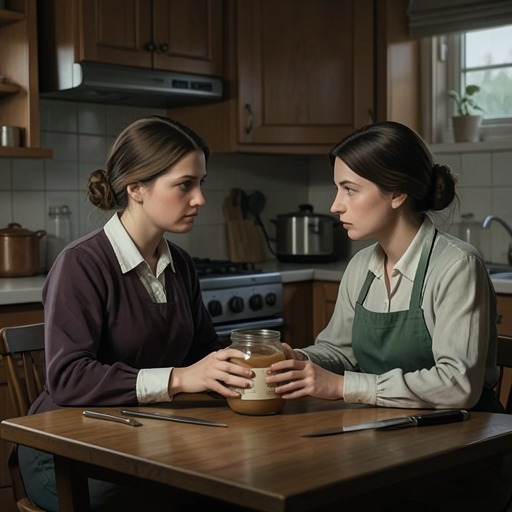
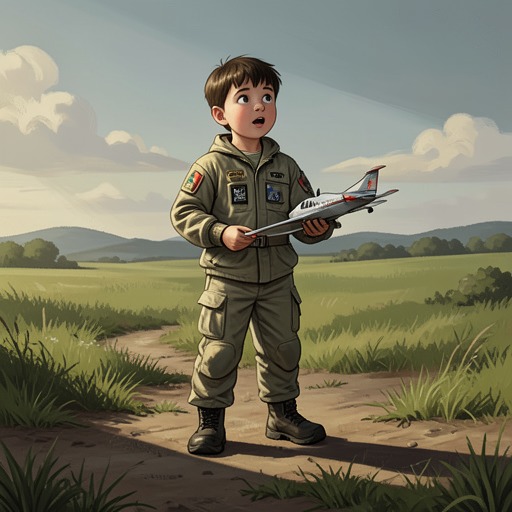
Franz’s fascination with aircraft had become a private world he shared most fully with his mother. After Pouty flew away, Franz would steady himself before facing other people; Eva was the one person he felt could understand what flight meant to him. He talked with her about aircraft designs and their advantages, drawing on newspapers and magazines, and read aloud about barnstormers when she was restless. His room displayed airplane pictures and his drawings, while a scrapbook Eva had given him collected newspaper photographs and handbills about stunt fliers. Aviation was therefore not a sudden diversion for Franz but a subject already binding mother and son through conversation and shared attention.
One afternoon Eva asked what it was like above the clouds. Franz answered by imagining that a person might step onto them and bounce. Her skeptical but proud response made him realize that he wanted to take her flying. He announced the plan, and her wondering pleasure turned his thought into a commitment: she had to go into the sky, and he had to accompany her. Though Fidelis had forbidden Pouty to take Franz on his flights, Franz decided this was different—a ride for a noble purpose. He could not yet explain how he would defend it to his father; he knew only that it had to happen.
Franz acted with urgency rather than waiting for a more convenient time. Pouty kept his plane in a barn north of town, so Franz borrowed Mazarine Shimek’s bicycle and rode there to find him. He pleaded and harassed the pilot while Pouty fetched a tool. Pouty’s first objection was that Eva was sick; he also pointed out that Fidelis would not allow the ride. Franz answered that this was precisely why Pouty must not tell him. Although Pouty was generally self-absorbed and had little experience of affection for his own mother, Franz’s behavior impressed him. After checking the controls and equipment and touching up the plane’s paint, he agreed.
The Secret Departure and Flight
Pouty landed behind the shop early on a delivery day, when the weather was warm and the sky clear. Eva had dressed for the outing in a gauzy white housedress printed with roses. Her hair had been damaged by treatment, and she was weak, but she had put on lipstick and used lilac water to gargle. She disliked the foul breath that her illness sometimes brought and took pains to keep herself clean. The signs of her fragility made the preparations more than a change of scenery: the flight had to be carried out while she could still make the journey.
When Eva asked Franz to help her, he steadied her as she sat up and rose. Delphine had been let in on the plan and was distracting the other boys at the front of the store. As Eva tried to walk across the side yard, Franz swept her up in his arms and carried her into the field. She laughed in surprise and put an arm around his neck. At the airplane, he carefully settled her into the seat behind the pilot. In that vulnerable moment she thought of Johannes, who had been not much older than Franz when she knew him, and reflected on how much had happened since his death. She wondered whether Johannes and the other dead would meet her in heaven, how old he would be, and what would happen when Fidelis eventually arrived there too. Her anticipation of flight was already entwined with questions about death, memory, and the people she had loved.
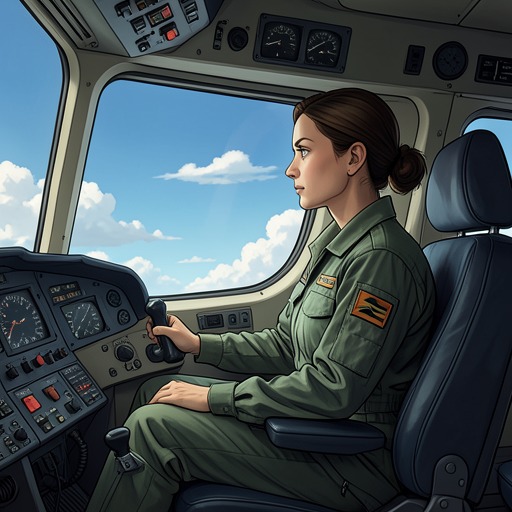
Pouty climbed into the front while Eva turned her face toward the sun. Franz spun the propeller until the engine caught and the plane shuddered. He jumped into the space behind her seat and wrapped his arms around her waist. Pouty shouted to ask whether he was holding her in; Franz yelled back that he had her. The aircraft lurched forward, gathered speed, and bounded into the air. For the first time Franz flew, holding on to his mother.
The climb seemed impossibly steep before Pouty leveled off and headed west with the sun behind them. He followed the river, hoping to show Eva herons and fish hawks, and flew over an oxbow and low across a farm whose occupants he knew. From above, the river became a gleaming gray line, the trees dusty-green puffs, and the roads dark threads in drought-stricken fields. They bounced over hot currents of air and stayed aloft until Pouty called out that he was low on fuel and had to return. The journey was limited by the plane’s fuel, but it carried Eva through a landscape transformed by height and motion.
Joy, Pain, and Eva’s Vision
Pouty had come to imagine that flying might do more than cheer Eva: he believed it could even cure her. The outcome is more complex. Eva had hoped that the thrill would make her pain disappear; it did not. In some ways the pain intensified, but so did the joy—not only the physical pleasure of being in the sky, but the mental exhilaration she later described to Delphine. The ride offers no medical reversal. Its consequence is instead a brief expansion of experience, felt alongside rather than in place of suffering.
After they returned, Franz carried Eva back to bed. Propped among pillows and sipping water, she was shuddering with happiness and pain. She told Delphine that in the sky her mind had been gulping new air, thinking with extraordinary speed, and seeing things. What she had seen was not a literal explanation of the afterlife but a conviction that a vast plan exceeded the rules people lived by. She compared it to something larger than church candles, confession, or the Sacred Host, while admitting that she did not know what the plan was.
Eva then had Delphine call her sons into the room. She told them not to take religious observances as the whole measure of existence: they could practice them if they needed to, but the plan was greater. Raising her pinkie as a concrete emblem of its smallest scale, she said that the design accounted both for the immense and for a little fingernail. If she died, she urged her sons not to take it too hard. Death, she said, belonged to things larger than they could imagine; humanity was only beginning to learn what it could do, as the new possibility of flight showed. She would remain part of the pattern, made of things and continuing in what things were made of.
Her face flushed with the rosy color Pouty had imagined the flight would give her. She drank water, coughed, and abruptly closed her eyes. Franz feared she might have died and touched her face, but he concluded that she was sleeping. He gently sent his younger brothers out. From the doorway, Delphine considered how dramatically Eva’s death would have followed the flight, but the scene does not establish that Eva died then: she recovered enough to sit up later. The moment’s force rests on the uncertainty of her condition and on the family’s awareness that a temporary sleep could be mistaken for an ending.
Significance
The ride turns Franz’s love into action. He takes a risk with his father’s rule, recruits Pouty by force of insistence, and physically carries Eva from her room to the plane and back again. His arms around her waist make his participation literal: he is not merely arranging a spectacle for his mother but holding her secure through the first flight of his own life. The secret plan’s success creates a brief space in which their private understanding of aviation can become shared experience.
The flight also separates exhilaration from cure. Pouty hopes that the airplane may restore Eva, and Eva herself wishes the thrill would silence her pain, yet neither expectation is fulfilled in a straightforward way. Instead, pleasure and pain intensify together. The episode’s emotional reversal is not that illness disappears, but that Eva gains a moment in which suffering does not monopolize what she can feel or think.
Finally, Eva’s account links the airplane’s new technology to an older, more expansive idea of continuity. She does not claim to know the design’s full nature; her assurance lies in being included in it. Flight becomes both a real physical experience and an image for human possibility, while her pinkie makes her argument intimate and exact: the vast plan includes the smallest part as well as the whole. In this scene, Franz’s gift is not a cure or an answer to death. It gives Eva a lived occasion for wonder, and gives her sons a final reassurance that her death will not remove her from the pattern of life.