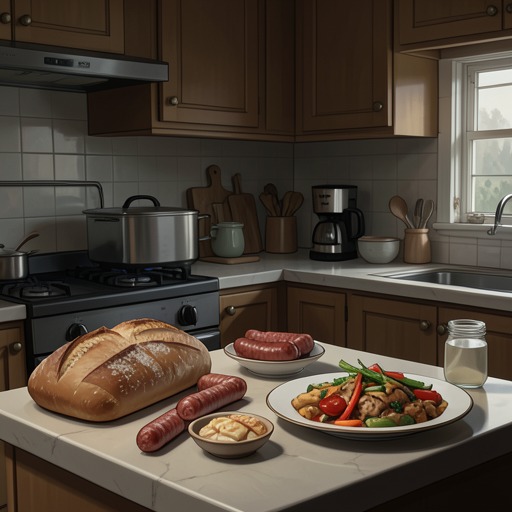
Federis brought the incense sausage
The Master Butchers Singing ClubFidelis Waldvogel’s smoked sausages are the practical and emotional cargo of his migration: made through inherited craft, carried across the Atlantic, and sold along the route to North Dakota, they help turn a journey undertaken with almost nothing into a new life in Argus. They are not merely food for the traveler. Their value lies in his refusal to eat them, the skill condensed in their making, and the work they make possible after he arrives.
Making and Inheritance
The sausages embody a trade Fidelis learned from his father, whose mastery of butchery involved exacting knowledge of spices, sausage varieties, timing, and the grain of meat. His father had passed on the family’s methods before Fidelis left Germany. The governing principle was to use the finest available ingredients, down to fresh garlic, good salt, clean casings, and exceptionally fresh meat. In this tradition, a sausage is not an interchangeable commodity: its quality records the attention and judgment behind its making.
The family’s view of butchery also shaped what the food represented. The work transformed an animal through practiced skill into a finished form that Fidelis regarded as more satisfactory. The sausages he carried therefore joined practical nourishment to a family inheritance of disciplined labor. They were made from wild boar poached with Fidelis’s carefully kept rifle and bullets, resources preserved through the privations that followed the war.
The Journey Across the Atlantic
In 1922, Fidelis stepped off the RMS Mauretania in New York City with a suitcase holding the smoked sausages. His family had paid for his passage by selling its remaining valuables, including cufflinks and its best woolens; Fidelis, in turn, carried what remained of the family’s wealth in the form of food intended for sale. The sausages were his ticket west, not a store of provisions he could freely consume.
At the immigration and arrival procedures, he endured long lines, inspections, paperwork, and hunger. The stillness he had learned during the war helped him bear the delays, while the craft and patience associated with his father’s work offered a model of composure. He had rehearsed the price he would ask for the sausages during the voyage. Once he reached a selling place, he opened the suitcase and stood with it for hours, waiting for customers; he sold seven sausages and then, as dusk returned, counted what he had earned.
His first plan was to sell enough to continue west. When he had made more than half the money he needed, he adapted: rather than wait until he could pay for the whole trip, he bought a ticket into the beginning of the Middle West and intended to sell to passengers aboard the train. The change makes the sausages active instruments of the journey. Each sale replenished his means of travel, and each remaining link carried him farther from the port where he had arrived.
Sale, Arrival, and Work in Argus
The sausages took Fidelis through Minneapolis and across the prairie into North Dakota, where he sold the last link. He left the train at Argus with only thirty-five cents. The sale marked the end of the food’s immediate role as travel capital, but not the end of the craft it represented: soon after reaching town, Fidelis found work with Pete Kozka, the local butcher, and also took jobs in nearby towns and at farms where he was summoned to butcher.
Fidelis brought his father’s sausage-making knowledge into this work. His skill helped increase the Kozkas’ trade, and the family method of taking care with every ingredient connected the sausages in his suitcase to the livelihood he built after the journey. The distinction matters: the food did not simply buy transport and disappear from the story. Its making carried a transferable expertise that made it possible for Fidelis to earn a place in the local economy.
Bread, Memory, and Shared Food
The sausages belong to a wider contrast in the novel between food made by hand and food changed by new systems of production. Shortly after marrying Eva, Fidelis saw a precisely sliced loaf of machine-made bread in the public square of Ludwigsruhe. The unfamiliar sight helped convince him to go to America, where such everyday goods seemed to point toward inventive production. Years later, a piece of soft, square-sliced white bread appears in a different setting: after Fidelis has reached North Dakota, familiar food at a forestry camp prompts him to think of Delphine. His hunger does not prevent him from eating slowly, and the meal carries both memory and shame.
A later meal brings another contrast into focus. Fidelis and his companion eat a sandwich made with fresh country bread, real butter, and carefully cured and smoked ham, alongside dill pickles. Its quality recalls the standards of his family’s trade: attention to freshness, preparation, and the cut of the food. Across these episodes, bread and meat are not generic symbols detached from daily life. Their origins, handling, and availability distinguish migration from home, scarcity from a meal shared in gratitude, and factory slicing from the skilled preparation that Fidelis learned from his father.
The sausages’ full significance thus emerges through their changing use. They begin as the product of inherited expertise, become saleable cargo that finances Fidelis’s passage across America, and lead into the butchery work by which he establishes himself in Argus. Their story binds material need to memory and family knowledge: a food made for exchange also carries the labor and standards that survive the crossing.