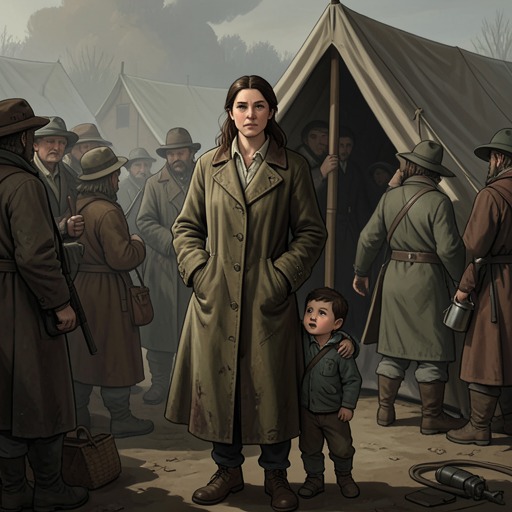
Fidelis Waldvogel
The Master Butchers Singing ClubFidelis Waldvogel is a German-born butcher and veteran whose life is shaped by promises to the dead, the demands of family, and the discipline with which he meets hardship. After returning from war to an impoverished Germany, he marries Eva, his fallen friend Johannes’s betrothed, then emigrates to America with the Waldvogel family’s remaining wealth packed into a suitcase of sausage. In Argus, his craft becomes the foundation of a business and a household; beneath his quiet competence, however, persist war memories, grief, and forms of care that are rarely spoken aloud.
Identity and Background
Fidelis returns from the Great War in late November 1918, having walked home in twelve days. He sleeps for thirty-eight hours in his childhood bed, beneath the family’s white eiderdown, then wakes to the uncertainty of postwar Germany and the immediate question of what there may be to eat. The border changes drawn by Clemenceau and Wilson place him only a few centimeters from becoming French, but that political fact matters less to him than the scarcity confronting his family. His attention is practical, trained on food and survival.
His stillness is one of his defining resources. In 1922, stepping from the RMS Mauretania into the confusion of New York City, he makes his way through the crowded arrival by remaining quiet and concentrating on what he needs to do. He knows only the English he has learned aboard ship, chiefly words useful for his next steps. The voyage has cost the family its remaining valuables and best woolens; the sausages he carries, made from a wild boar he poached with hoarded ammunition, represent both his trade and the means by which he hopes to begin again. Even his knives, which he had tried not to sell, belong to the portable equipment of a life rebuilt through skilled work.
War, Promise, and Marriage
Johannes had twice saved Fidelis during the war: once by dragging him from a pile of dead after a bullet rendered him senseless, and once by shooting an approaching French soldier when Fidelis’s rifle jammed. Johannes died in the war’s final days. Fidelis stayed beside him for two days and nights in a ruined aristocratic house where wounded and dying men had been brought. The friendship therefore survives not as an abstract memory but as a promise Fidelis must carry into the life that follows.
Fidelis recognizes Eva from the small portrait in Johannes’s locket, which he has kept. When he meets her, his practiced immobility gives way under her searching gaze. He has come to tell her what happened to Johannes, but his visit leads him to act on a commitment he already understands: he will marry her. Eva agrees, and their first kiss holds both the grief Fidelis bears for his friend and the distinct beginning of his own bond with her. His marriage is thus rooted in loyalty, but it is not only an extension of that loyalty; he recognizes Eva as a person and a partner in a future they choose together.
Eva later reveals that Franz’s biological father was Johannes Grunberg, not Fidelis. Fidelis has known this without speaking of it. The secret complicates the outward certainty of their family’s relationships, yet his silence and continuing place as Franz’s father show that biological paternity does not displace the life he has undertaken with Eva and her son.
Craft, Migration, and Work in Argus
Fidelis finds work with Pete Kozka, the local butcher, and also takes jobs in surrounding towns. When farmers fetch him, he butchers animals at their farms; later, he owns a succession of delivery trucks. The Kozkas’ trade grows after he joins them because he has inherited his father’s talent for sausage-making and learned the family’s methods. His father’s governing principle is exacting rather than grand: even humble ingredients must be the finest available. Fidelis applies that standard from his first batches, making craftsmanship a form of continuity between his German upbringing and his American livelihood.
His arrival in Argus does not end the pressures that have shaped his migration. During the aftermath of war, he has been forced into a dangerous black market to get by. Across the ocean, the family’s property has been converted into a ticket and the food he carries. In America, however, work offers a way to establish himself by applying knowledge that can be used wherever people need animals butchered. The movement from a family home in Germany to customers’ farms and a shop in Argus is a change of country, but not a departure from the practical discipline through which he understands responsibility.
Fidelis also misses the singing club he belonged to in Ludwigsruhe. After singing with Doctor Heech, he sees that an American club need not be restricted to master butchers, as the old German one had been. He begins what becomes a town institution. The change in membership makes the club a small but telling counterpart to his work: in the shop, skill draws customers; in song, a shared practice can bring people together across occupations.
Family Responsibility and Household Labor
In Argus, Fidelis’s authority rests not only on earning a living but on the daily work of keeping a household going. During the heat and drought, the shop’s practical routines become precarious: the killing-room floors are bleached each day, the meat cases run at full cold yet remain lukewarm, and a generator powers the packed meat locker. Milk spoils during the drive to the store, cream turns despite Eva’s efforts to use it in cooking, and the family stores almost no butter or lard. The boys sleep outside on the roof in their undershorts, while Eva brings up a mattress and sheets and sleeps beside them; Fidelis sleeps downstairs. The scene makes visible a division of labor in which Eva tends the children and domestic comforts while Fidelis remains bound to the shop and its failing equipment.
His care for the children also appears in quiet, repeated acts rather than declarations. After working through the night during the drought, with his knee aching and supported by a leather brace made to a design from Doctor Heech, he wakes the boys for the day. He rouses Franz with a shake, but only needs to touch Markus or his bedpost; Emil and Erich require more care because they fall asleep again so readily. In the kitchen he prepares watery chocolate, warms milk, sets oats to cook, and makes coffee, then falls asleep at the table before the morning is underway. The scene joins physical exhaustion to parental routine: even when his body can no longer sustain attention, he has begun the work of feeding and preparing his sons.
That responsibility is tested when Tante proposes taking the boys, except Franz, back to Germany. Her plan is to raise them with their grandmother for a year or two, while Fidelis stays in America and continues building the business. She argues that the arrangement would ease the strain of caring for them and eventually leave the boys old enough to help. Fidelis is persuaded far enough to consider the separation, but Delphine objects directly: she believes Tante cannot care for the boys properly and insists that sending them away is wrong. The dispute exposes the difference between a plan that promises economic relief and the emotional and practical judgment required to raise the children.
Fidelis does not conceal the limits behind his decision-making. He tells Delphine that he cannot watch the boys enough and that he no longer has money to pay her. His admission connects household care to the business’s finances: supervision cannot simply be willed into existence, and the person who has helped provide it cannot be retained without wages. Delphine’s objection to Tante’s plan therefore comes from her experience of the children’s needs, while Fidelis faces the constraint of trying to meet those needs while keeping the family economically afloat.
War Memory and Self-Control
Fidelis and Cyprian Lazarre never discuss the war they shared, though its presence remains a constant between them. Each carries memories into ordinary days: a sound, picture, or word can interrupt the present, forcing an inward struggle before conversation resumes. The other recognizes the disturbance and answers without demanding an explanation, with a joke or a long drink of beer. Their silence is not evidence that the war has passed; it is a tacit form of recognition between men who know how often it returns. The image of trenches covered over and tunnels collapsed beneath grass gives their friendship a landscape of buried violence: apparently settled, yet still present underfoot.
Fidelis’s discipline can contain that pressure, but it does not make him invulnerable. During a confrontation with Cyprian, both men prepare themselves carefully, each assessing the other’s strength and considering how to use his own. Fidelis then breaks from discipline in a sudden fury over wasted beer and lunges at his friend. The episode makes the limits of his practiced control visible: anger can seize him before calculation catches up, and the habits that serve him in work and hardship do not erase the force of what he feels.
Care, Loss, and Restraint
Fidelis’s devotion to Eva becomes especially legible through what Delphine witnesses. Trying to distract Eva from her illness, he makes a strained effort to lift a grown man by the belt with his teeth. Delphine sees the exertion and understands that Fidelis is attempting something foolish because he loves Eva and wants to turn her attention away from sickness. The effort also exposes the helplessness beneath his strength: against her illness, he can do little. Care here is neither a cure nor a speech. It is an improvised act whose failure makes his attachment more, not less, apparent.
After Eva’s death, Fidelis and Delphine maintain a deliberately strict distance while working together. He understands that her impersonal manner is meant to prevent a closeness she considers impossible; he answers in kind, keeping their conversations to the business and the children. They live and work alongside one another as strangers, with an invisible boundary that both know must remain intact. When an unusually candid exchange leaves them exhausted, the tension is followed by a return to clipped, necessary speech. Their apparent rudeness gives them safe ground on which to continue sharing responsibility without acknowledging the danger of a deeper attachment.
That reserve changes after Delphine has left the household. Fidelis comes to her house on foot on a sharp spring night, bundled against the wind and mud; her first fear is that something has happened to Markus. Months later, after the two have drawn together, Delphine keeps her courthouse job but reduces her hours and returns to the shop each afternoon to be near Fidelis. She resumes tending the kitchen and, when time permits, doing the boys’ laundry, while Fidelis has learned to iron his own shirts with soldierly precision. Their changed routine registers a new domestic closeness in practical choices rather than a sudden abandonment of work or obligation.
When Delphine says she will keep her own house and sometimes stay there, Fidelis answers without words, opening and closing his fist as they sit in silence. He then rises and carries her to her bedroom. The scene marks a change in their relationship, but not a simple erasure of the boundaries and separate lives they have built: Delphine retains her house, and her statement makes clear that staying with Fidelis will remain a choice rather than a total surrender of independence.
Business, Community, and the Changing Economy
Fidelis’s work in Argus develops beyond individual butchering into an institution that helps organize the town’s social life. He begins at Pete Kozka’s shop, takes jobs in surrounding small towns, and travels to farms when customers summon him to butcher their animals. His expertise increases the Kozkas’ trade, and he carries forward the standards taught by his father: the salt must be right, the garlic fresh, and even the casings clean and exquisitely fresh. The principle that no ingredient is too humble makes quality a daily practice rather than a claim of prestige. As his livelihood grows, a succession of delivery trucks extends the reach of his work beyond the shop.
The business is repeatedly exposed to forces no craft can control. During the severe heat, the meat cases run at full cold but remain lukewarm, a generator powers a locker packed with food the family fears losing, and milk can sour on the drive to the store. In later dry years, the cattle arrive so lean that they are scarcely worth butchering. Yet Fidelis continues working through the night when farmers bring animals in late, using torches to finish the slaughter and cutting before dawn. When his knee gives out, a leather brace designed by Doctor Heech helps him remain at work. The shop’s history is therefore not a smooth ascent: it is skill exercised under conditions of spoilage, drought, exhaustion, and uncertain supply.
Fidelis also turns a personal inheritance of song into a public institution. He misses the singing club he belonged to in Ludwigsruhe, where membership was limited to master butchers. After singing with Doctor Heech, he recognizes that an American club need not keep the same occupational boundary and begins the group that becomes a town institution. The change echoes his migration: a practice brought from Germany is retained, but its membership and local purpose are remade in Argus.
War, Memory, and Contained Anger
The war remains a continuing presence in Fidelis’s life and in his friendship with Cyprian Lazarre, although the two never speak directly about what they experienced together. Memories enter through an image, sound, or word; one man pauses to manage the inward disturbance, while the other understands enough to offer a joke or take a long drink rather than demand an explanation. Their silence functions as recognition, not forgetfulness. The trenches and tunnels of their past have been covered by grass, but the image of buried ground captures how the conflict persists beneath ordinary life.
Fidelis’s self-command is powerful but not absolute. In a confrontation with Cyprian, the men remove their hats and jackets, roll up their sleeves, and assess one another’s different strengths. Fidelis abruptly abandons his usual discipline, overcome by anger at the waste of beer, and lunges at his friend. The moment places his working precision beside a less governable force: control helps him endure and provide, but it cannot prevent feeling from breaking through.
Love, Loss, and the Limits of Care
Fidelis’s attachment to Eva is made visible in an effort to distract her from her illness. He strains to lift a grown man by the belt with his teeth, and Delphine sees the attempt as an act of devotion: Fidelis is trying to give Eva something else to watch and think about. The gesture cannot alter her sickness. Its importance lies in the contrast between the strength he can summon and the helplessness he feels against what is happening to her.
After Eva’s death, Fidelis and Delphine maintain a carefully managed distance while sharing work and responsibility. He understands that Delphine avoids personal kindness because she believes a closer relationship between them is impossible; he likewise keeps his words to the shop and the children. Their impersonal, sometimes clipped exchanges provide a way to continue living and working together without crossing a boundary neither is ready to abandon. When a conversation briefly carries them beyond those safe terms, both are left exhausted, and they retreat to necessary business talk.
The arrangement eventually changes through practical choices as well as moments of intimacy. After Delphine leaves the household, Fidelis walks to her home on a sharp spring night; months later she cuts back her courthouse hours and returns to the shop each afternoon to be near him. She resumes helping with the kitchen and the boys’ laundry when she can, while Fidelis irons his own shirts with soldierly precision. When Delphine says she will keep her house and sometimes stay with him, he remains silent before carrying her to her bedroom. Her separate home remains part of the arrangement, so their growing closeness does not erase the independence she has chosen to preserve.
Character and Narrative Significance
Fidelis’s life is organized around acts that can be performed even when words fail: honoring Johannes’s promise, making food to exacting standards, singing with others, and attending to his children. His composure is neither emotional absence nor invulnerability. It is a method for carrying grief and responsibility into work, though war memories, anger, and love repeatedly disclose what that discipline cannot settle. The movement from postwar scarcity in Germany to a butcher shop and singing club in Argus gives his craft and community-making a shared meaning: he builds a life from what can be carried, practiced, and offered to others, while the losses that preceded it remain part of the ground beneath that life.