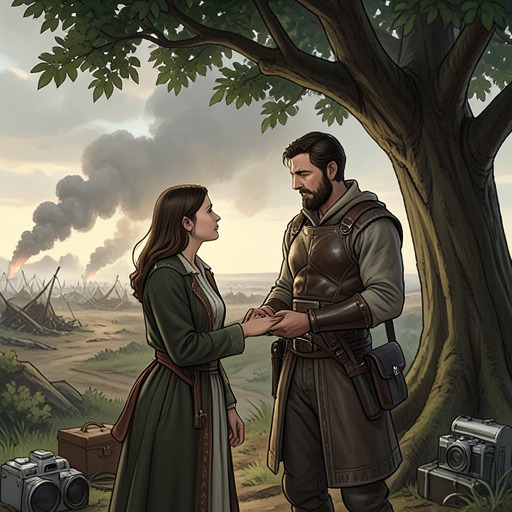
Fidelis marries Eva Kalb
The Master Butchers Singing ClubFidelis marries Eva Kalb after arriving at her home to tell her that her fiancé, Johannes, has died. The marriage fulfills a promise to his closest friend and gives Eva and her unborn child a future, but it is not merely an arrangement: through Eva, Fidelis begins to understand that he is meant to love. Their union turns a moment of devastating loss into the beginning of a family, while the later divergence between their marriage and Cyprian and Delphine’s relationship complicates any simple expectation that intimacy must culminate in conventional domestic life.
Background and the news of Johannes’s death
Fidelis comes to Eva’s house carrying both an obligation and an image: he has kept the locket containing her picture, which belonged to his best friend. At the entrance to her home, the untended walkway and the neglected papers disturb him, especially against the meticulous order of the surrounding neighborhood. He fears the signs may mean that another death has occurred. When Eva opens the door, he recognizes her from the miniature portrait; the reality of her searching gaze breaks through the trained immobility that has helped him endure the war.
Eva asks for the truth before he can explain at length. Fidelis tells her that Johannes, her betrothed and intended husband, is dead. She takes in the news and collapses toward him. As Fidelis catches her and carries her inside, he realizes that she is pregnant. The scene binds the marriage’s beginnings to two losses at once: Eva has lost her intended husband, and the child she carries has lost its father before birth. Fidelis’s response is immediate physical care, followed by the decision he understands as already promised.
A promise becomes a marriage
Fidelis waits until Eva’s mother comes to investigate, then lays Eva on a faded rose-pink sofa. He decides to marry her, honoring what he had promised Johannes. Eva later agrees and kisses him. Fidelis experiences the kiss as carrying distinct meanings: grief for Johannes, whom he had kissed in death, and an intimacy with Eva that feels familiar without being the same. The marriage therefore begins neither by erasing Johannes nor by pretending that Fidelis and Eva’s feelings have the same history. It makes room for grief and a new attachment at once.
Their wedding is poor and hastily assembled. Eva is heavily pregnant with a child conceived during the war’s final, desperate season; the priest knows the circumstances and blesses them. Their first night together takes place in Fidelis’s small bedroom, where his toy soldiers still stand on the windowsills. That juxtaposition places his childhood and wartime past beside the adult family life beginning with Eva. The child’s movement confirms the pregnancy in the intimacy of the scene, while the marriage makes Fidelis responsible for a future that began before he entered Eva’s life.
From survival toward love
Before the marriage, Fidelis has lived with a deepened stillness shaped by the war. Nearby shells, cries, and danger do not readily disturb his sleep; he maintains his rifle carefully and follows a daily routine that includes tasting honey from his mother’s home before handling the weapon. The habits suggest how thoroughly survival has narrowed his attention. Returning from war has not supplied him with an easy purpose, and his emotions have at times made him feel exposed rather than relieved.
His experience with Eva changes the meaning of that survival. In the account of their marriage, physical closeness marks his movement away from the dangerous quiet in which he has been living and toward the difficult knowledge that he is meant to love. This does not undo his grief for Johannes or the violence he has witnessed. Instead, the marriage gives him a relation to the living that can exist alongside those burdens. The shift is especially significant because Fidelis does not arrive at it through a sudden rejection of the past: his fidelity to Johannes is part of what brings him to Eva.
Marriage, family, and divergent futures
The book places Fidelis and Eva’s marriage beside the more uncertain course of Cyprian and Delphine. Cyprian explains to Delphine that his attraction to men is not a consequence of wartime experience; he has understood this about himself for a long time. Delphine comes to feel a particular kinship with him, but accepts that they will not be lovers. Their intimacy continues in another form, shaped by affection, companionship, and care rather than a conventional marriage.
Later, Cyprian and Delphine privately imagine having a child, each hoping and hesitating without directly asking the other. Cyprian eventually proposes marriage with a solid gold wedding band; Delphine says no. Her decision does not cancel their bond, but it does prevent their shared affection from resolving into the same kind of household that Fidelis and Eva establish. Delphine also concludes that Cyprian’s turn toward Clarisse is, despite the shock, a solution to the impasse between them. These contrasting relationships distinguish the promise at the heart of Fidelis and Eva’s marriage from a universal rule: in the novel, commitment, desire, and family can take different forms, and not every close relationship becomes a marriage.
The marriage’s continuing significance
Fidelis and Eva’s union is founded on an act of loyalty, but the narrative gives it emotional substance beyond duty. Fidelis arrives as the bearer of Johannes’s death and leaves the encounter committed to Eva and her child; the wedding then makes that commitment a shared life. The sequence gives the marriage a double inheritance: it carries the memory of the dead friend while opening a future for a child and two people whose relationship began in mourning.
That future is not presented as a simple cure for wartime loss. Fidelis’s altered understanding is a movement from numb survival into the possibility of love, not an escape from what he has endured. Set against Cyprian and Delphine’s refusal of marriage despite their affection and their unspoken hopes for a child, his union with Eva underscores the book’s wider attention to the different ways people form families. The marriage is at once a promise kept to the dead and a bond made with the living.