Garbage as a record of personal history
The Master Butchers Singing ClubGarbage as a record of personal history is a way of seeing people through what they discard rather than through the public appearance they maintain. In Argus, Step-and-a-Half reads scraps as evidence of habits, conflicts, resources, and private losses. Her work makes the town’s refuse an informal archive: objects that seem worthless acquire meaning through the lives that handled, abandoned, or recovered them.
Reading the Town Through Its Discards
Step-and-a-Half approaches streets and households from the perspective of a junker. Instead of judging residents by their clothing or tidy front steps, she knows them through alleys, burning garbage, and the rags left on back porches. The distinction is both practical and interpretive: what people discard can disclose what their public self conceals. In her view, scraps do not merely accumulate; they tell stories.
The clues are specific and often intimate. Bottles in Gus Newhall’s bin point to the source of his income during the bootlegging years. The Bouchards’ broken plates record the arguments that accompany the collapse of their marriage: fragments can be fitted together, in a pointed contrast, more successfully than the couple can remain together. Pouty Mannheim throws away both socks when one wears through, rather than mending the damaged one or keeping its mate. Step-and-a-Half respects this bachelor habit, but also reads his wastefulness as a warning about his eventual business failure. His mother’s candy wrappers reveal a concealed fondness for sweets; despite her slimness, her teeth fall out, a consequence that Step-and-a-Half does not find surprising.
These readings make refuse a record of repeated behavior, not a collection of isolated curiosities. A bottle, a pair of socks, or a broken plate gains significance from the pattern it belongs to: income, a household’s way of handling conflict, or a person’s habits of use and waste. Step-and-a-Half’s knowledge comes from noticing those patterns where others might see only discarded things.
What Waste Preserves
The archive is not limited to clues about character. Step-and-a-Half finds both troubling remnants and objects that remain useful: animal remains, torn love letters, bedding associated with death and illness, and also books, sheet music, and toys children have lost. She keeps the books and music even though she does not read them, and cleans the toys before setting them on windowsills. Her collecting therefore preserves materials that the town has rejected, while distinguishing between objects that testify to distress and those that can be returned to use or display.
Some finds resist ordinary classification. A prosthetic wooden hand and a glass eyeball register absence through objects made to substitute for parts of the body. A tin of strange blue seeds becomes something different when Step-and-a-Half plants them in a coffee can of dirt: one grows into a large white flower. The episode shows discarded matter passing from observation into care. What was found among refuse can be given soil and a chance to grow, even when its origin is unknown.
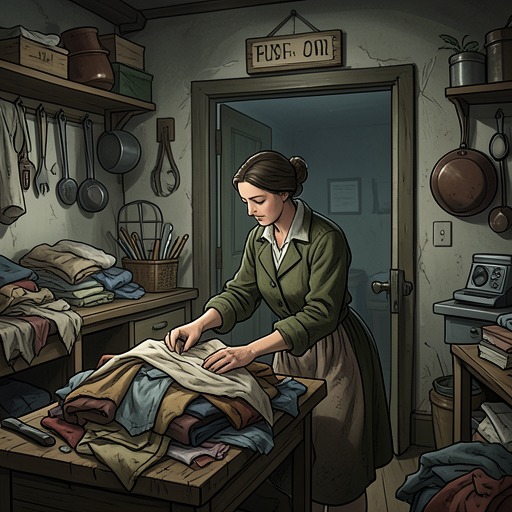
Other recovered goods have immediate material value. She finds razors that can be sharpened, tires that can be repaired, engine parts, and clothing she sells as rags. That resale pays for flour, which makes the bread she eats, and sometimes for grease to spread on it. A pot roast, foil-wrapped chocolates, six new bars of soap, peppermints, crackers, and pillows with only a little mildew also turn up among the discarded objects. Her scavenging joins interpretation to subsistence: she reads the town’s waste, but she also depends on what can be salvaged from it.
The Outhouse Find and Its Consequences
The narrative singles out as Step-and-a-Half’s most remarkable discovery something recovered from the hole of Mrs. Shimek’s outhouse. That find stands apart from the ordinary objects in her inventory and connects her life as a scavenger to the abandoned newborn she rescues and cares for. The refuse site is not simply a background for her work; it becomes the setting for an event that will shape her relationship with the child.
This connection gives the idea of garbage as personal history a human consequence beyond the decoding of residents’ habits. Discarded things can expose what has been hidden, but the act of finding can also lead to responsibility. In Step-and-a-Half’s story, her attention to what others leave behind is inseparable from the possibility that something or someone treated as unwanted may still be taken into care.
Food, Memory, and the Value of What Is Kept
The novel places this salvage economy alongside other, contrasting forms of attention to food. In the Waldvogel family’s trade, Fidelis regards butchery as a learned craft requiring precision, timing, and careful knowledge of ingredients. His father’s sausage-making rule insists on using the finest available materials, including fresh garlic, good salt, meat, and clean casings. Step-and-a-Half’s food, by contrast, can depend on recovered grease and flour purchased with the proceeds from rags. The contrast does not make one kind of food meaningless: it shows how skill, resources, work, and need shape what people are able to eat.
Food also carries memory in scenes of sharing and return. Fidelis first becomes persuaded to travel to America after seeing a machine-sliced loaf in Ludwigsruhe, a commonplace food transformed by a method unfamiliar to him. Much later, white bread cut into a soft square accompanies the baked beans that remind him of childhood, and he thinks of Delphine while eating. In another meal, a freshly baked country loaf, butter, smoked ham, and dill pickles make a sandwich that Fidelis and his companion eat with gratitude. These moments set bread and other food apart from Step-and-a-Half’s salvaged provisions, while keeping both within the novel’s larger attention to how food gathers associations of work, memory, and care.
Objects as an Archive of Memory
Step-and-a-Half’s finds include things whose value emerges slowly: a pocket watch, a radio, a music box playing a tune Eva identifies as Mozart, and sheet music that the collector herself cannot read. Their significance does not depend solely on practical use. A discarded object can preserve a trace of someone’s taste or household, just as a scrap can reveal a habit; a fragment may acquire a new place in the life of the person who recovers it.
That relation between objects and memory becomes especially clear in Step-and-a-Half’s later life. In a small room behind her shop on an Argus side street, she has increasingly little strength for walking. The long walks that once temporarily soothed her old torment become occasional, while more of her time is spent resting. Each afternoon she goes upstairs to nap beneath a quilt made from her best fabric finds—velvets, satins, and silk gathered through her years of wandering. As she falls asleep, memories return as vivid scenes she had thought finished. The quilt physically assembles the materials of her past, while the scenes that come back beneath it show that collecting cannot simply put experience away. Her archive preserves both useful remnants and unresolved memory: what people discard may tell a story, but what is kept can continue to tell it anew.