German POWs’ prohibition on collaboration
The Master Butchers Singing ClubGerman POWs’ prohibition on collaboration is an informal but dangerous code among the prisoners that forbids cooperation with their American captors. It makes Erich conceal his fluency in English and his American upbringing, while linking the threat of violence to the intensely German identity he has built through wartime indoctrination and loyalty.
The Code and Its Enforcement
After surrender, Erich hides that he understands English perfectly. Fervent Nazis among the prisoners have vowed to punish anyone who collaborates with the Americans, so he adopts a suspicious, withdrawn silence. His concealment is not simply a matter of avoiding conversation: revealing his knowledge or making use of his American upbringing could expose him to danger within the prisoner group.
The code is sustained by rumors of what happens to men who become too friendly with their captors. Prisoners whisper that such men have been sawed to pieces, burned, and scattered through the woods by the Heiligen Geist. No one can verify the stories: no prisoner has known, seen, or spoken to anyone who could confirm them. Yet the absence of proof does not dissolve the threat. Older prisoners use the rumors to instill dread in those whose loyalty to Germany might falter, turning uncertainty itself into a means of enforcement.
Captivity and the Evidence of Defeat
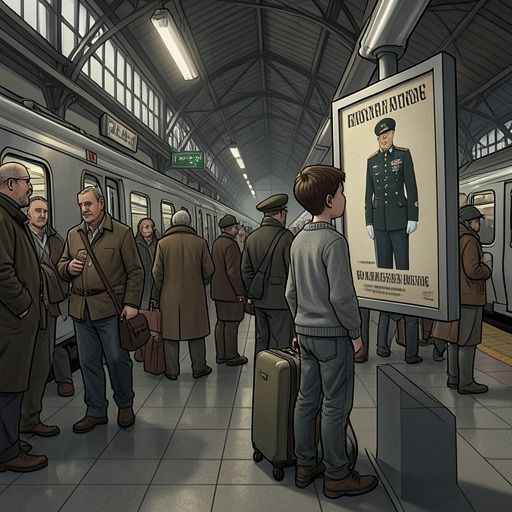
As Erich and two hundred other prisoners travel north in a stripped-down American train car, they expect to see the devastation German radio reports have promised: bombed cities, ruined countryside, blackened crops, and dead farms. Instead, the train passes through a country that appears cheerful, populous, and spectacularly untouched. The prisoners watch in bewilderment, but Erich is too consumed by memories and despair to settle on the excuses some of the others later invent.
At the remote camp, the food makes the defeat unmistakable. Each man receives creamed corn, a huge baked potato, cornbread drenched in Karo syrup, and a portion of lard; the hall fills with silence broken by tin spoons and the sounds of hungry men eating. The prisoners understand from the quality and quantity of the meal, and from the fact that it has been brought to this distant place for them, that Germany has lost the war. The code persists even when the world it was meant to defend has been decisively overturned.
Erich’s Silence and German Identity
Erich’s silence is reinforced by more than immediate fear. He has become, in his deepest self, thoroughly German—or, more precisely, what he takes Germanness to mean. The intensive training and years of formation have replaced his childhood with an ideal of purity, belief, loyalty unto death, and hatred of weakness. He lives by a consuming oath, making collaboration seem not merely risky but incompatible with the identity he has chosen.
That choice carries a private cost. Erich longs for Ludwigsruhe, his beloved grandfather, and the sausages he once stole at night to share with Emil in their bed. He thinks of his brother with deliberate numbness and shuts out thoughts of his family. His American upbringing and childhood memories remain present, but the rules of the prisoner group and his allegiance to an imagined purity keep them from becoming resources he can safely claim.
Songs, Memory, and the Limits of the Code
In the camp’s beautiful forest setting, Erich discovers that his adolescent voice has matured into a rich sound. He begins singing to pass the time; other prisoners join him, exchange song lyrics, and turn the singing into a nightly practice. The songs enter their dreams, while Erich remains awake listening to the men and to the pines and owls outside the bunkhouse. Their shared music offers a form of collective expression within captivity, but it does not erase his guardedness or draw him out of the German oath.
The prohibition on collaboration therefore operates on two levels: threats and unverifiable rumors discipline the prisoners from outside, while Erich’s adopted convictions discipline him from within. His silence protects him from a feared betrayal by fellow POWs, but it also leaves him cut off from the American part of his own past. The contrast between the generous camp meal and his inward allegiance underscores the distance between what captivity reveals and what he is prepared to acknowledge.