Germany
The Master Butchers Singing ClubGermany is both the place Fidelis Waldvogel comes from and the measure of what migration costs him. In the aftermath of war, he returns to a homeland organized around scarcity and family memory; he later leaves with the means to begin again in America, while the work of sustaining his new household keeps him from returning to those he misses. Decades afterward, a visit with Delphine exposes the emotional and linguistic distance between his American life and the family world he left behind.
Homeland After the War
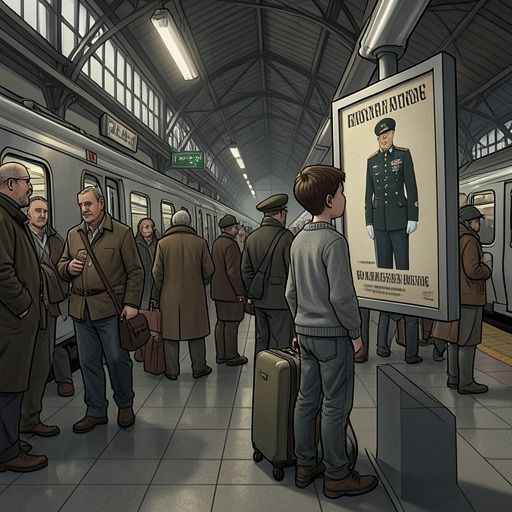
In late November 1918, Fidelis walks home from the war in twelve days and sleeps for thirty-eight hours in his childhood bed. He wakes in Germany to the uncertainty of what might be available to eat. The map has been redrawn so that he is only a few centimeters from becoming French, but that political change scarcely matters beside the immediate question of food. His mother has aired and restuffed his white eiderdown each spring since he was six; a faint, old stain remains on its cover. The bed, the family care it represents, and the meager prospect of a meal set the scale of his return: home offers familiarity, but not security.
The family’s circumstances are shaped by postwar deprivation and economic upheaval. Fidelis’s later recollection of his mother’s account of inflation in Germany gives a stark measure of collapse: she once had to take wheelbarrows of reichsmarks to the baker to pay for loaves. He recognizes a disturbing recurrence when the Depression threatens the life he has built in America: after leaving one Depression, he has encountered another. Germany is therefore not simply a lost home in memory; its economic hardship becomes a comparison through which he understands instability across borders.
Eva and the Decision to Leave
Fidelis’s path out of Germany is bound to his friend Johannes and Johannes’s intended bride, Eva. He visits Eva carrying a miniature portrait he has kept in his breast pocket, the keepsake making his connection to his dead friend tangible. When she opens the door, he recognizes her from that picture. Her direct demand for the truth breaks through the trained immobility that had helped him endure the war, and he tells her what he has come to say about Johannes. The scene makes departure inseparable from an act of fidelity: Fidelis’s later life with Eva begins in the space left by his friend’s death and in the truth he brings to her.
Not long after marrying Eva, Fidelis becomes convinced that he must travel to America after encountering a slice of machine-cut bread in the public square of Ludwigsruhe. The bread has arrived from distant relatives in a coastal city, and its precise, uniform form suggests a different scale of production and possibility. What catches his attention is an ordinary food made unfamiliar by machinery and distance. The episode turns an everyday object into a practical sign of another world, connecting the German experience of scarcity to his decision to seek a future elsewhere.
Migration and the Work of Starting Over
In 1922, Fidelis steps from the RMS Mauretania into the crowded arrival scene in New York City with a suitcase full of his father’s smoked sausage. The sausage is not incidental luggage: it represents the family’s remaining resources and becomes the means by which he enters a new country and trade. The family has sold its trinkets and best woolens to pay for his passage, while Fidelis has kept his knives rather than sell them. He brings the skills and tools of his former life into the uncertain work ahead.
Before emigrating, he has endured the privations of postwar Germany and entered a dangerous black market. The hunting and preparation of wild boar for the sausages he carries connect that difficult period directly to his passage across the ocean. His arrival in America is thus neither a clean break nor a simple escape: the new beginning has been financed by the old household’s sacrifices and made possible by knowledge acquired under hardship.
Once settled in North Dakota, Fidelis buys a farmstead and opens a shop. He works eighteen hours a day skinning steers and butchering hogs in order to bring Eva, their son Franz, and later Tante to live with him. The labor that makes family reunion possible also takes him away from his parents, his brother, and the family business in Germany. He reads the letters that arrive from home, but sets them aside before they can reach the still center of his attention, where loneliness becomes perceptible. Distance is maintained not by indifference but by the relentless work required to keep his American household going.
Family Ties Across the Atlantic
Germany continues to make claims on Fidelis through letters and news from his family. Tante sends a flurry of letters there, and replies are propped on the cash register as a challenge for him to ignore. He reads them and tightens his face, but says little. In his clothing drawer, a cigar box holds his medals, including an Iron Cross: a compact reminder of military service carried into the immigrant household, alongside the daily business of the shop.
The letters also bring news that his parents have recovered a piece of property at a moment when circumstances in America are deteriorating. Their good fortune complicates the pull of home. Fidelis misses his parents and the brother who now shares the family business, yet sees no possibility of leaving even to visit them. The narrative places letters beside work, and remembered German hardship beside American economic collapse, so that belonging appears as an obligation he cannot fully answer rather than a sentiment he can simply act upon.
Return and Estrangement
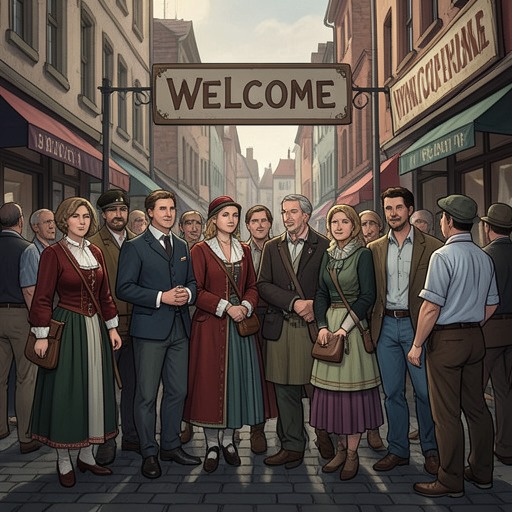
Years later, Fidelis and Delphine make a visit to Germany that they had imagined as a long-delayed honeymoon. The journey becomes something else when Fidelis suffers mysterious pains on the way; an X-ray reveals an enlarged liver and a threatened heart. Delphine sits among Tante, Fidelis’s brother and sister-in-law, their grown children, and Erich with his new bride. She cannot understand the fast-moving speeches. Her repeated amiable nodding and smile become the outward signs of her isolation in a family gathering that is intimate to her husband but linguistically inaccessible to her.
The scene’s attention to clothes, handbags, chairs, and sharply defined shadows gives Delphine’s estrangement a concrete setting without making her a mere observer of unfamiliar customs. The people around her are present in precise visual detail, yet the language of the speeches passes over her. Germany, which Fidelis carries through memory, letters, and family attachments, is not automatically home to Delphine. Their visit reveals that even a return undertaken together can divide experience: he is among his relatives, while she must read the room from its visible surfaces.
A dream of knocking makes the journey’s emotional stakes clearer. Delphine wakes beside Fidelis on a narrow mattress in Germany and understands the sound as Eva asking for him. She remembers hearing the same knocks in a dream in Argus when she knew Eva was dying, and now believes she must return Fidelis to Eva very soon. The remembered sound links the German visit to the earlier loss in America; for Delphine, Germany is also the place where the living husband’s presence and the dead woman’s continuing claim meet.
Fidelis’s return voyage begins under the pressure of failing health. Stepping from the USS Bremen into New York’s crowd, he is exhausted by a tiredness that has grown beyond his control. The illness had begun years earlier, amid the family’s losses, and the journey home does not restore him to health. Germany remains essential to his identity and family history, but the novel gives no simple homecoming: the Atlantic crossing has made him an immigrant, and the return trip brings him back to America with the bodily cost of years of labor and grief foregrounded.
Narrative Significance
Germany functions in the story as an origin that is never merely past. The childhood bed and its carefully maintained cover preserve a family history; the bread in Ludwigsruhe turns scarcity into a reason to imagine departure; and the letters, medals, and relatives keep the homeland active in Fidelis’s American life. These details make migration a sequence of continuities as well as separations: the work, craft, and habits carried abroad remain tied to people who cannot all follow.
The later visit shifts the meaning of return. It brings Fidelis back among his family, but illness and Delphine’s inability to follow the speeches prevent reunion from becoming uncomplicated belonging. Germany is at once a remembered home, a source of family obligation, and a place from which the life built in America has grown partly apart. The novel’s movement between the two countries makes that distance visible in practical things—food, work, letters, language, and the body—rather than resolving it as a choice between two homes.