Hiroshima bomb
The Master Butchers Singing ClubThe atomic bomb is introduced not as a battlefield scene but as news spread across a kitchen table. Its arrival changes the meaning of the war’s ending for the people gathered to read about it: the weapon’s scale is difficult to absorb, while the words that confirm the war is over bring an emotion Fidelis has rarely allowed into the room. In the novel, the bomb is both a historical fact and a pressure point where public catastrophe, private memory, and ordinary life meet.
The Bomb Arrives as News
Delphine first hears of the bombing from a customer, who has heard it on the radio that morning. By night, an evening edition from Fargo is on the table. The headline declares that an atomic bomb has hit Japan, and the family pore over a front page that places the weapon alongside a jumble of other reports: a claim that it has 2,000 times the blast of a conventional blockbuster, a story about scientific power, a prediction of a combined household appliance, an account of a quadruple amputee, and a murder-suicide at a homecoming party.
The newspaper’s format matters. The bomb is presented as news that must be read, compared, and reread, not as an event anyone in the kitchen has witnessed. Its significance has to be approached through headlines and reported figures. At the same time, its proximity to domestic invention gives the page an unsettling scale: the power to harness the universe appears beside the promise of a machine that might wash clothes and peel potatoes. The contrast does not make the bomb less consequential; it makes the ordinary world around it seem startlingly small and unfinished.
Reading for Scale
Fidelis leans forward and insists that Delphine read everything on the page. When she reaches the account of the bomb’s scientific force, the report describes an explosive charge of exceedingly small physical size that harnesses the basic power of the universe. The contrast between the bomb’s compactness and its claimed reach gives the weapon a disturbing material logic: an object small enough to describe in a few words is presented as capable of consequences beyond familiar measure.
The article offers another comparison in terms closer to home. Delphine reads that one bomb amounts to 1,228 pounds of TNT for every man, woman, and child living in Fargo. The figure converts an immense, distant weapon into a local arithmetic of potential destruction. Fidelis asks her to return to the bomb story, but Mazarine, holding her baby, tells her to stop. Their responses mark the difficulty of absorbing the report: one reader presses for more information, while another draws a boundary against hearing more.
The same page keeps interrupting any single, settled response. Delphine points out the projected combination washer, potato peeler, and dishwasher; Mazarine asks how people can claim to have harnessed the universe while still failing to perfect the potato peeler. The paper also carries the account of a couple’s fatal argument at a homecoming party. These details do not equate household inconvenience or private violence with atomic warfare. Rather, their coexistence reveals how the newspaper places extraordinary destruction inside the same frame as ordinary aspirations and familiar human tragedies.
The End of War, Felt at Home
After the report is read, Fidelis says softly that the war is over. The statement is brief, but the emotion in his voice surprises the others. The news has shifted from a series of technical claims and startling quantities into a personal recognition: the conflict that has occupied his life and memory has ended. The bomb’s announcement therefore carries a double force in the scene. It confirms an ending, but the means by which that ending has arrived makes relief inseparable from horror.
Delphine puts the paper down, and the three sit absorbed in thought. The novel turns from the printed page to the small sounds around them: the refrigerator humming, a fly striking the screen, water dripping into the sink, and sparrows calling in the grape arbor. For Delphine, these ordinary noises seem to form a pattern, a script of daily pursuits whose connections she longs to understand. Her thoughts swing between horror and relief; she feels that she ought to weep and also wants to shout. The bomb has not supplied a clear emotional resolution. Instead, it has made the fragile continuance of everyday life newly legible.
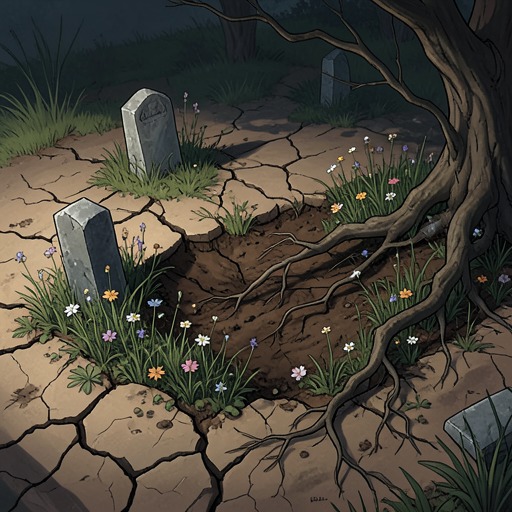
Delphine leaves the kitchen and works in the garden, pulling weeds until her hands hurt and her thoughts settle into a weary hum. When she finds a bone among the roots, her mind connects it with earlier deaths and with the repeated return of remains to the earth. The moment does not turn the garden into a direct image of the bombing; it extends the scene’s wider movement between destruction and continuation. The bomb’s announcement has entered a world where the dead, the living, and the tasks of the day remain entangled.
A War That Ends Without Erasing Memory
The kitchen scene gains further resonance from the novel’s account of how war persists after fighting stops. Fidelis and Cyprian never speak openly of the war they shared, yet memories surface in passing thoughts, sounds, and words; each may pause in an inward struggle while the other registers the change and lets conversation resume. Against that background, Fidelis’s quiet declaration that the war is over is not proof that its effects have vanished. It names the historical ending while leaving the inward burden of memory intact.
The family’s news-reading scene also stands against other forms of remembrance. When Delphine considers the political developments in Germany and the violence emerging after 1934, she fears that Fidelis and Tante have let prosperity and national strength eclipse the slaughter. Later, in 1954, the master butchers gather at the unveiling of a monument to the victims of the bombing of Ludwigsruhe; their singing, as Delphine experiences it, becomes inseparable from the town’s history of burning and destruction. These episodes place the atomic bomb within the novel’s larger concern with what public accounts announce, what communities choose to remember, and what violence continues to inhabit private life.
The bomb is thus more than the new weapon named in a newspaper. It marks the war’s close in a way that is at once factual, intimate, and morally disquieting. Its immense force sits beside the unfinished potato peeler, the domestic sounds of the kitchen, and the remains uncovered in the garden. That juxtaposition refuses a clean division between historical catastrophe and ordinary existence: the world goes on, but it does not become innocent of what has happened.