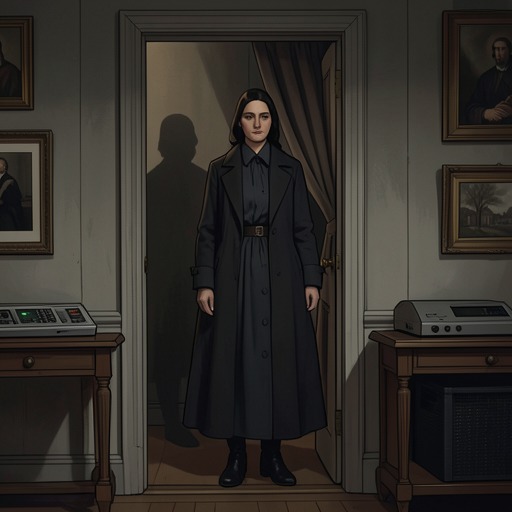
Hock searches and coerces Clarisse
The Master Butchers Singing ClubHock searches and coerces Clarisse is the confrontation in which Sheriff Hock brings a warrant to Clarisse’s home, ostensibly to search for evidence, but also uses the search to exert personal pressure. The scene’s tension comes from the collision between his official authority and his fixation on her: while he inspects the floor for a bead that could implicate her, he speaks of friendship and then presents the bead as evidence, leaving Clarisse to face both the threat of a murder charge and his unwanted advances.
Warrant and Search
After repeatedly pressing Judge Zumbrugge, Hock obtains a warrant to search Clarisse’s house. He is methodical about his own belongings and surroundings, and he brings that meticulousness into the search. The contrast is pointed: Clarisse keeps her home untidy, though she is precise in her work, and she has already swept the floor since Delphine removed the dress from her closet. Hock examines the gaps between the floorboards with a lamp and a careful eye, looking for a trace that might connect Clarisse to the dress.
He begins with formal courtesy, saying the search will be brief and apologizing for intruding on her privacy. Clarisse answers with open hostility and tells him to leave. Hock replies that she has already put him in hell, then claims he has always felt that they could be friends. The language of friendship sits uneasily beside the search: Clarisse believes he will find a bead, thread, or scrap of cloth and use it to corner her between him and a murder charge.
Official Authority and Personal Pressure
The search is not only an attempt to locate evidence. Hock’s attention to Clarisse is personal, and the scene shows how his position as sheriff lets him bring that pressure into her private space. He continues searching despite her demand that he leave, and his manner—described as self-righteous and menacing—makes the encounter feel less like a neutral procedure than an assertion of control.
Clarisse warns him that he must leave or she will hurt him. Hock does not withdraw. Instead, he answers with a warning of his own and makes a case for himself as a prospective partner: he points to his good job, sobriety, and fidelity, while suggesting that Clarisse’s work as an undertaker frightens other men away. His pitch turns her occupation into a reason she should accept him, as though his willingness to overlook it entitled him to her attention. Clarisse does not accept that framing; she remains firm that he must go.
The Bead and the Escalation
Hock eventually takes a piece of paper from his pocket and reveals a red glass bead, saying that he found it in Clarisse’s house and calling it state’s evidence. The object gives his search an immediate consequence: it is no longer only a threat that he might discover something, but a claim that he has already found a clue with which to implicate her. Clarisse disputes the claim and reaches for the paper to inspect it.
Hock withholds the bead, folds it back into the paper, and puts it in his shirt pocket. He then opens his arms and lunges toward Clarisse. The sequence sharply clarifies the imbalance in the encounter: he has invoked legal evidence while ignoring her repeated demand that he leave, and now uses the apparent discovery as part of a confrontation that is also personal. Clarisse’s response follows immediately, setting in motion the violence that carries the scene beyond the search itself.
Consequence and Significance
The episode links the investigation of Clarisse to Hock’s coercive pursuit of her. His warrant gives him entry into her home; his claim about the bead raises the prospect of criminal accusation; and his insistence on personal access makes the search a direct threat to her autonomy. Clarisse’s fear that he can force a choice between him and a murder charge is not resolved by his display of the bead. Instead, his refusal to leave and his lunge precipitate her action against him.
The bead therefore works on two levels in the scene: as purported evidence in the case and as leverage in Hock’s attempt to corner Clarisse. The official search and the personal confrontation become inseparable. Hock’s insistence that he could be her friend is undercut by his refusal to respect her boundary, while Clarisse’s warning marks the moment when a search conducted under legal authority becomes an immediate physical crisis.