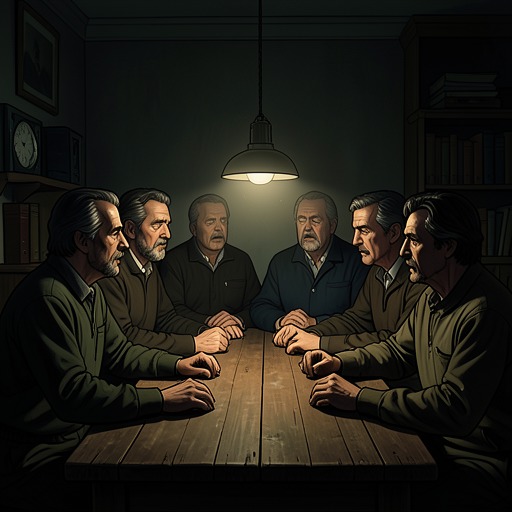
How close the dead are. One song away from the living.
The Master Butchers Singing Club“How close the dead are. One song away from the living.” names the intimacy with the dead that Step-and-a-Half finds in song. The phrase joins her remembered Ghost Dance shirt to the living voices of Argus: music does not undo death, but it lets the living approach those they have lost and find comfort in their presence.
Meaning and Context
Step-and-a-Half recalls keeping a scrap of the Ghost shirt, a piece of yellowed muslin with tattered fringe. Its faded painting shows a crow with bright eyes and an open beak, alongside a white moon. Touching the image, she remembers the shirt given to her long ago by a Sioux woman. The cloth is not merely a keepsake: Step-and-a-Half understands it as a means of connection to the dead.
She rejects the claim that the Ghost dancers were stupid or deluded for believing their shirts could protect them from bullets. In her understanding, they knew that the cloth could let its wearer visit the dead and draw comfort from their singing. The phrase about the distance between the dead and the living condenses that belief into a measure of closeness: one song is enough to cross it.
Memory and Song
The thought arises through a specific memory of sound. Before the great guns sounded, soldiers sang drinking songs in the freezing December air. Step-and-a-Half recalls the mellow harmonies of “Aura Lee” and “Auld Lang Syne,” then the mournful sweetness of a mother crooning a lullaby to her baby. Her recollection places songs of soldiers beside a song of care, making music a human presence threaded through danger and loss.
The shirts’ connection to the dead is therefore auditory as well as symbolic. Step-and-a-Half’s remembered cloth promises not a return to life, but the comfort of hearing and being near those who are gone. The phrase gives that possibility its stark, compact form: separation remains, yet it is not absolute.
From Private Memory to Communal Music
The passage carries Step-and-a-Half from the remembered songs of the past to singing heard in her present. Outside, women keening and men exercising their voices fill Argus with music. French, German, Indigenous, and American songs mingle with ballads, anthems, lullabies, hymns, and counting rhymes. Their sounds move through fields and along telephone wires, then enter streets, buildings, alleys, and chimneys.
This movement turns the phrase into more than an account of personal remembrance. The songs do not belong to one singer or one tradition; voices answer one another across the town, and the air carries them onward. Step-and-a-Half hears that music in sleep, sinking into a tune assembled from the worn language of itinerants, hunters, lovers, and the natural world. The dead are near through remembered song, while the living keep singing songs that travel and return.