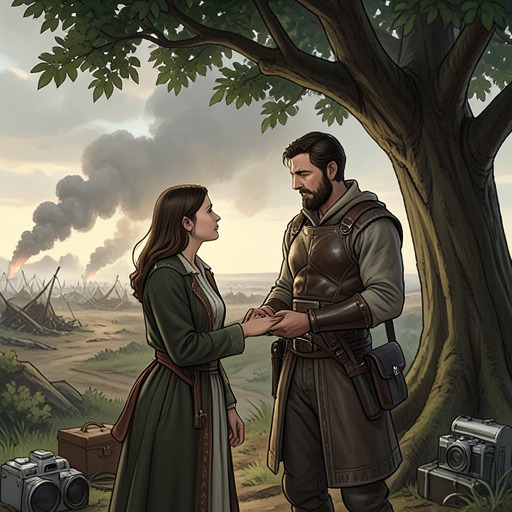
Johannes’s wartime rescues of Fidelis and death
The Master Butchers Singing ClubJohannes’s wartime rescues of Fidelis and death are the defining acts of a friendship forged in battle: Johannes saves Fidelis twice, then dies amid the retreat in the war’s final days. Fidelis survives, carries the loss without speaking of it, and eventually tells the story to Delphine. His account joins comradeship, mourning, and the burdens that remain unspoken long after the fighting ends.
Rescues in the War
The first rescue came after a bullet struck Fidelis in the jaw and left him senseless among the dead. Johannes pulled him from the pile. Later, when Fidelis’s rifle jammed and a French soldier advanced, Johannes shot the soldier, saving his friend again. These moments establish the practical, immediate character of their bond: Johannes repeatedly acts when Fidelis cannot protect himself.
Their friendship belongs to a war that neither man could simply leave behind. Fidelis and Cyprian Lazarre never discussed their shared wartime experience, though memories returned in stray pictures, sounds, or words. When one of them paused under the force of a memory, the other registered the change and let the moment pass, sometimes answering with a joke or a drink. The silence did not mean the war was absent; it had become a persistent presence between them.
Johannes’s Death
Johannes died during the final days of the war, after the two men reached a ruined aristocratic house used as a stop on the retreat. Wounded and dying men were crowded into the building, while shelling continued nearby. Fidelis stayed upstairs with Johannes for two days and nights rather than seek shelter in the cellar, where the wounded were being smothered during bombardments.
Johannes’s condition had several possible causes: a serious wound, dysentery, or the exhaustion of the retreat. As he weakened, he asked Fidelis to sing to him. Fidelis sang in the freezing room, amid the continuing shelling. After Johannes died, Fidelis laid him out and wrapped his face in a silk scarf his mother had given him for luck. He could not remain to bury his friend. Instead, he walked on through the retreat and its further scenes of death and disorder.
What Fidelis Carries Home
Fidelis’s account places Johannes’s death at the beginning of a journey back to his childhood home, where his mother, father, sister, books, and Eva awaited him. He tells Delphine that Johannes had been Eva’s baby’s father and explains that he married Eva so the child, Franz, would have a father. The account thus connects wartime bereavement to the family life that followed, while also showing that Fidelis’s explanation of the marriage does not contain all his feelings for Eva.
The telling itself matters. As Fidelis drives with Delphine, he begins with Johannes, hoping that telling the whole story may offer a way forward. Yet the memory remains difficult to explain: remembering tightens around him, and he has to breathe deliberately. His account makes the past speak, but does not make it simple or complete.
Memory, Silence, and Commemoration
Years later, the war’s effects still shape Fidelis and Cyprian’s companionship. Their shared knowledge stays largely below the surface, like trenches covered over and tunnels collapsed, while occasional memories interrupt ordinary conversation. The narrative presents silence not as forgetting but as a way of living beside experiences that remain painful to recall.
In 1954, Fidelis returns to Ludwigsruhe for the unveiling of a monument to those killed in the bombing. He practices with the surviving master butchers, who gather to sing at the ceremony. Their music brings the war dead into a public ritual, but the contrast between the commemorative gathering and Delphine’s vision of smoke and ash emerging from the singers’ mouths suggests how memory can persist beneath ceremony. The novel’s acknowledgment also notes that, in the oral history of Wounded Knee, two people from the north—Cree or Ojibwe—are said to have died with Big Foot’s people. That question of who is remembered echoes the story’s attention to lives carried forward through uncertain records, family memory, and song.
Johannes’s brief, decisive rescues and his death become part of the history Fidelis carries home. The story gives no account of a burial or a final resolution between the friends; instead, it preserves the last request to sing, Fidelis’s act of remembrance, and the silence that follows him into later life.