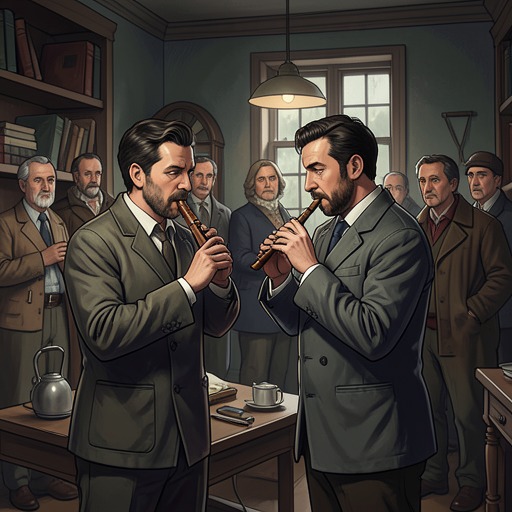
Kozka’s Meat Market
The Master Butchers Singing ClubKozka’s Meat Market is Pete Kozka’s butcher shop in Argus, where the newly arrived Fidelis Waldvogel begins his American working life. It is both the workplace that introduces Fidelis to the town’s trade and the starting point of a long, complicated rivalry: when he opens his own shop across town, competition between the two butchers becomes entangled with their opposing ideas about dogs, waste, and what a rival may be made to endure as a joke.
Establishing a Trade in Argus
Fidelis finds work with Pete soon after reaching Argus, a railroad town that has grown into the county seat. He also takes jobs in nearby towns and travels to farms to butcher animals when people fetch him. At first he has no car. Working for Pete nevertheless gives him a foothold in the local trade, and Pete’s business increases as Fidelis puts his inherited skill to use. His father had taught him how to make sausage, insisting on the finest ingredients, from fresh garlic and good salt to clean, exceptionally fresh casings. Fidelis applies that standard to Swedish sausages for Scandinavian customers, seeking the best local potatoes for the filling rather than making do with whatever is available.
Thursday becomes Fidelis’s sausage-making day. Customers gather to buy links hot from the kettle, even before they have been smoked; the heavier unsmoked sausages also please Pete, since they weigh more. Fidelis lives frugally while he saves: he makes his own beer, washes his shirts and aprons, and eats sausage ends, bruised fruit, stale cookies, and questionable trimmings. His labor at Kozka’s Meat Market is part of a larger plan. With his savings and a windfall from his parents, he brings Eva and her young son Franz across the ocean to join him.
From Employer to Competitor
Pete is the man who first hires Fidelis, then becomes his principal—and eventually his only—competitor in Argus. He is good-natured but humorless, and his economical management means that employees often leave and he is frequently short of help. His shop is also a local curiosity: after a tornado touches down there, pennies from the change drawer are found driven neatly into the plaster wall, drawing visitors who come simply to see the damage.
The rivalry initially remains amicable, built on practical competition, boasts, and pranks. Fidelis has never concealed that he intends to establish an independent business, and Pete accepts his departure with a stoic shrug. When Fidelis does leave, Argus appears to have enough customers for both shops; the town’s apparent growth even raises the possibility of a much larger future. Fidelis takes care to buy an old farmstead on the opposite side of town, as far from the Kozkas as he can remain while still living in Argus. He pays with a bank loan and the proceeds from selling his share of a family building in Ludwigsruhe. The distance is a gesture of consideration that initially helps avert resentment.
The new shop gains an unintended commercial advantage when the main highway is rerouted past the storefront Fidelis adds to the farmhouse. But the text distinguishes this business advantage from the deeper source of the feud. The rivalry worsens over a more personal disagreement, one that centers on what a dog’s loyalty means and on what should happen to the remnants of a butcher’s work.
Hottentot and the Dispute Over Waste
Pete and his wife, Fritzie, raise purebred chow dogs, known for their coal-black tongues and fierce temperaments. Their prized stud, Hottentot, is the father of their line. Fidelis is skeptical of canine devotion, judging that a dog’s apparent affection depends more on its stomach than its heart. Pete, by contrast, believes that dogs are capable of exceptional fidelity and that their loyalty is personal. Hottentot’s behavior turns that difference of opinion into a recurring provocation: after Fidelis opens his own shop, the dog starts appearing at the back loading plank of Waldvogel’s Meats, where scraps can be found.
The butchers also differ over how to handle offal and other waste. Pete keeps even the smallest remnants—including the tips of tails—in a locked freezer barrel and sells them monthly to a guts dealer. Fidelis distributes his leftovers instead. That practice attracts people who live on little, including dogs, itinerants, and poor residents of Argus. Hottentot, a greedy and suspicious animal prone to snapping and biting, is among the regular visitors. To Fidelis, the dog’s eagerness to fawn on whoever might have a bone, and his contempt for those who cannot feed him, seems to confirm Fidelis’s view of canine affection. Pete and Fritzie are popular in town despite charging for soup bones and extending no credit, so Hottentot’s behavior is not simply treated as a reflection of his owners.
The prank war turns consequential when bones that Hottentot has been guarding outside the Kozkas’ shop become an appalling public mess. Fritzie, seeing that potential customers are avoiding the entrance and that the couple have become a laughingstock, packs the bones into a sack and orders Pete to dispose of them. Pete drives to Fidelis’s shop intending to leave them on the stoop. Finding it closed and deserted, he assumes that Fidelis is prosperous enough to take a vacation, and envy and a sense of betrayal push him beyond his original plan.
Argus residents generally do not lock their doors. Pete enters the Waldvogel home, goes into Fidelis and Eva’s bedroom, pulls down Eva’s immaculate white eiderdown and embroidered sheets, and hides the moldy bones beneath them. Their smell and residue soak into the mattress and bedding. The retaliation reaches beyond the shop floor into the most intimate space of Fidelis and Eva’s home; afterward, Eva responds by locking the doors each night and buying bolts for the inside.
Escalation, Accommodation, and Town Division
Fidelis does not abandon the joke after Pete’s retaliation. He remains committed to carrying it through as though it were a story or a piece of art that must be finished, and he also thinks Hottentot’s agitation is partly responsible for the sow’s crazed behavior. When the dog next slips its leash and appears at the back of the shop, Fidelis gives it a braid of chicken feet he has been saving for a month. Hottentot carries the gift home past Sal Birdy’s drugstore, where onlookers see it and wonder where in the Waldvogel house the foul, scaly offering will end up.
Pete has intended his bedroom prank to end the exchange, but Fidelis’s decision to continue as if it has not changed the terms of their joke frustrates the Kozkas into a form of acceptance. They build a wire pen for Hottentot, who thereafter escapes only rarely. The accommodation does not dissolve the anger. Whenever Hottentot gets loose and brings home another piece of carcass from Waldvogel’s, Pete vows to get even. Eva, meanwhile, tells women around town that she holds the dog responsible for Fidelis having to wear a brace and undergo painful adjustments to his injured knee; she even considers appealing to the law.
For a time, the rivalry divides Argus along with the town’s two principal butcher shops, much as the Catholic and Lutheran churches divide it. The conflict is therefore more than a contest over market share. The shops become opposing local centers, and a dispute about scraps and a dog’s habits hardens into a public estrangement, even as the original rivalry had begun with enough mutual tolerance to accommodate jokes and boasts.
Significance in the Local Economy
Kozka’s Meat Market marks the point at which Fidelis turns his craft into a livelihood in America. Its early success depends on what he has brought from his father: exacting standards, practical knowledge, and the patience to make each batch carefully. The shop’s Thursday crowds show the immediate value of that expertise, while Fidelis’s austere savings reveal the cost of using it to build a future for his family.
The contrast between Pete’s locked barrel and Fidelis’s distribution of scraps gives the rivalry a material and social dimension. Waste is not merely a by-product to be sold or discarded: one butcher contains it and profits from it, while the other lets it circulate among people and animals living close to the edge. Hottentot crosses between those systems, drawn by food and turned into the focus of competing interpretations of loyalty. As Fidelis’s own shop rises opposite Pete’s, the original employer’s market remains the measure against which the new business—and the strained relationship between its owner and Fidelis—is defined.