Machine sliced bread
The Master Butchers Singing ClubMachine-sliced bread is a small but consequential object in Fidelis Waldvogel’s story: its first appearance in Ludwigsruhe gives physical form to his idea of America, while later scenes place bread within the family’s changing experiences of work, migration, scarcity, and care. At first, the loaf is an unfamiliar artifact; over time, bread becomes part of ordinary meals and a measure of what circumstances allow people to share.
The loaf that made America imaginable
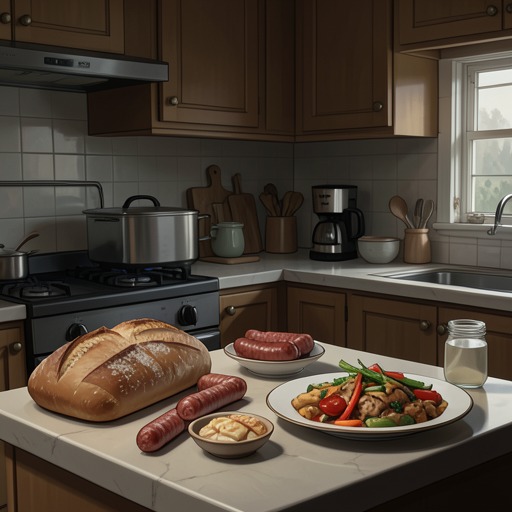
Shortly after marrying Eva Waldvogel, Fidelis crossed the public square in Ludwigsruhe and found a group gathered around a neighbor known to his parents. The man had received a white, square object from distant relatives in a far coastal city. Fidelis initially took it for a picture. When he recognized it as bread, he joined the circle to examine it.
The loaf had been kneaded and baked by machines, then cut into slices. Its exact shape and even browning struck Fidelis as evidence of an order very different from the world he knew. He studied its texture, wondered about the yeast, and noted the sharpness of the cut. Rather than treating bread as an ordinary staple, he regarded this specimen as an astonishing product of technique and organization.
The object acquired meaning through both its material qualities and its provenance. Later that day, Fidelis asked the neighbor where it had come from and copied the place name onto a scrap of paper. He kept the note for months. What began as the source of a small marvel gradually became an actual destination: the unfamiliar bread helped make America imaginable enough to pursue.
Craft, migration, and livelihood
The machine-made loaf stands in contrast to the Waldvogel family’s understanding of butchery as a learned craft. Fidelis’s father had spent a lifetime mastering the profession, which required exact timing, knowledge of spices and many kinds of sausage, and an intuitive command of the knife. For Fidelis, skilled work transformed an animal into a more ordered form. That inherited standard also governed the food he would make after leaving home.
Before Fidelis departed, his father gave him the family’s sausage-making principle: use the finest available ingredients, including fresh garlic, good salt, meat, and clean, exceptionally fresh casings. In America, Fidelis found work with Pete Kozka and also took jobs in nearby towns and at farms that summoned him. His sausage-making helped increase the Kozkas’ trade. The contrast with the sliced loaf is not simply between old and new methods: the bread first signifies an industrial world that draws Fidelis across the ocean, while his own livelihood depends on preserving exacting standards of craft within that new country.
In 1922, Fidelis arrived at New York City aboard the RMS Mauretania carrying smoked sausage made from wild boar poached in Germany. The ticket had cost the family its remaining trinkets and best woolens; Fidelis had kept his knives rather than sell them. The bread’s earlier promise of American abundance thus meets the material costs of reaching America. Food travels in both directions in the story: the machine-sliced loaf points toward a distant possibility, while Fidelis carries the products and skills of his family’s old life with him.
Bread amid scarcity and shared meals
Bread’s later appearances place it in settings where food expresses practical knowledge and economic constraint. Delphine Watzka advises a customer to use inexpensive lard for fish, explaining how to settle the cracklings and pour off the fat. Her advice treats food not as a symbol detached from daily life but as something people manage carefully, making limited ingredients useful. Elsewhere, during the Depression, she adapts the meat business to customers’ means, trading with farms, stocking dried beans and peas, and finding ways to serve both wealthy buyers and people who could rarely afford meat.
Wartime shortages bring a sharper contrast between the abundance suggested by the first loaf and the rationed provisions available in Argus. Orders increase, including requests for custom kosher work from synagogues in Minneapolis, but gasoline is scarce even with a C sticker for the delivery truck. Coffee disappears, butter is requisitioned, and Delphine sells oleomargarine with yellow dye; canned goods decline in quality, while eggs are powdered for soldiers. Against this altered food supply, machine-sliced bread’s precise, soft square shape returns in a meal of baked beans, where it is used to wipe the plate. The image recalls Fidelis’s first encounter with American bread, but now bread belongs to a meal marked by hunger, memory, and the effort to eat with care.
A later meal offers a different measure of plenty. Fidelis and another person share a prewar sandwich made with fresh country bread, sweet butter, and a generous slab of smoked ham, accompanied by dill pickles. The scene’s abundant ingredients and slow gratitude contrast with the shortages of wartime and the earlier hardships of migration. Across these appearances, bread is never only a technical novelty: its form and setting register what food means under different conditions, from distant promise to everyday sustenance and shared abundance.
Narrative significance
The square slice connects the novel’s attention to food with the movement of people and skills across borders. Its manufactured regularity first seems almost impossible to Fidelis; the exact cut and even crust make a distant place tangible. Yet the object does not simply celebrate industrial modernity. Fidelis’s own work rests on patience, inherited expertise, and careful selection of ingredients, while Delphine’s business depends on responding to uneven resources and customers’ needs.
As bread reappears beside rationed substitutes, remembered flavors, and generous meals, its meaning changes with the conditions of its use. The original slice helps set migration in motion, but the later food scenes show that belonging and survival are made through labor, adaptation, and sharing—not by novelty alone. The loaf remains memorable because it carries both a promise of abundance and the question of how food is produced, valued, and made available to others.