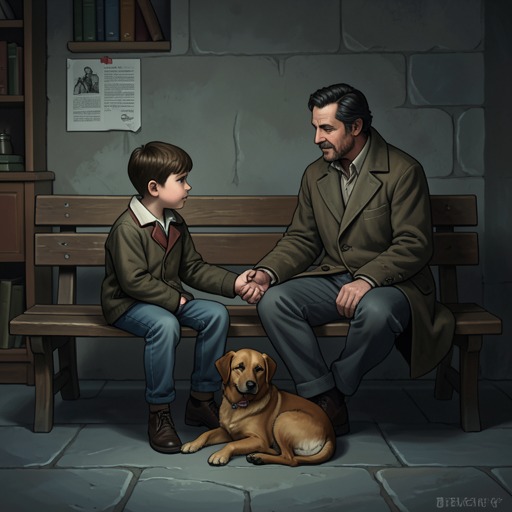
Markus joins the U.S. Army
The Master Butchers Singing ClubMarkus’s entry into the U.S. Army marks a painful turn in his relationship with Delphine: the boy she has fed, taught, and protected is about to leave for military service, and her practical knowledge of war collides with his hope that he will be spared its worst. His enlistment becomes not a battlefield scene but a domestic reckoning over fear, care, and what a family can do when one of its young men chooses to go.
The Care Behind Delphine’s Warning
Delphine’s concern grows out of years of mothering Markus without being his biological mother. When he was small, she scolded him for losing his mittens and knitted replacements; she tried different ways of feeding him because he was thin. As he grew, she helped him study, celebrated his school awards, and tried to make him wear eyeglasses, secretly hoping they would keep him from qualifying for the Army. She believed he had cheated on the vision tests to get in.
By the time Markus tells her, Delphine is ready for the news. She asks him to sit with her at the kitchen table, knowing he may not listen or believe her but determined to make him understand what enlistment means. Her appeal reaches beyond her own fear: she asks him to consider Eva and his father as well as the woman who has raised him, while acknowledging that she is not his blood mother.
Delphine’s Appeal and Markus’s Answer
Delphine warns Markus that war is not as neatly represented in films as he might think. Men can be badly harmed, she tells him, and their own side can kill them by mistake. Her fear is also directed at the reassuring public image surrounding military service. She points to advertisements that suggest a tube of toothpaste or a stick of gum can meet soldiers’ needs, and angrily objects to the way consumer goods are presented as an answer to the realities of war.
Markus first responds with patronizing surprise when she speaks of men being mangled, asking where she learned this. Delphine answers that she has read and used common sense. Her attempt to make him see through the advertisements leaves her nearly in tears, but it also changes his manner: he puts his hands on her shoulders, pats her gently, and speaks quietly. He promises to be careful and says he is not like Franz, who had entered service as a trained pilot. He expects he may not even be sent overseas. He means to comfort Delphine, though she can tell that he also thinks and hopes that his service will lead further.
The scene does not resolve their disagreement. Delphine recognizes that Markus wants to be elsewhere and, after wiping her face, tells him to go out on his last night at home. Markus replies that there is nobody left to tear up the town with; he plans instead to walk, buy a newspaper, and read himself to sleep. His quiet answer brings the conversation back to the ordinary habits of home, without making the impending separation feel less real.
A Last Night at Home
After his walk, unable to sleep, Markus turns to the toy armies his brothers had once played with. He has long outgrown them, but the display remains in his room: little soldiers and horses, wooden trees and rocks made from lumberyard scraps, armored vehicles with rubber treads and tin flags. On his last evening at home, he rearranges the figures and reconstructs a battle, setting cavalry against modern military forces. The play is sentimental, and he knows it is foolish, but he becomes absorbed in it.
The toys give the night a double perspective. Markus is a young man about to join an actual army, yet he ends his time at home among miniature armies that can be arranged and rearranged by hand. The contrast does not suggest that he understands what will happen to him; it underscores how little control Delphine can exercise over the danger she fears, and how the household’s earlier games accompany a departure into adult military life.
Service, Reassignment, and the Meaning of His Work
Delphine’s fear eases when Markus later writes that he has failed the vision test and will probably spend his service doing desk work at officer candidate school. She feels as though some reparation has been granted and begins, at last, to sleep. His outcome is not the combat duty she dreaded, though his reassurance before leaving could not have established what assignment he would receive.
Markus writes far more often than Franz. In time, he can explain the work that fills his days: he writes condolence letters to the parents of dead soldiers from lists supplied by commanding officers. He has never known the men whose deaths the letters describe, nor how they lived or died, and he calls the work an art of creative fiction that he hates. His service thus places him at a distance from combat but close to its human consequences. The young man Delphine had urged to understand the realities hidden by cheerful advertisements becomes responsible for writing to families about losses he cannot personally reconstruct.
Narrative Significance
Markus’s enlistment is shaped by a tension between intention and outcome. Delphine has tried to protect him through everyday acts of care, including the hope that his eyeglasses might disqualify him; he nevertheless joins, and her warning cannot decide what kind of service he will perform. The later vision-test failure brings relief, but not an erasure of war’s costs: his desk assignment turns him into a writer of letters for bereaved families.
The episode also develops Delphine’s maternal bond with Markus through action rather than blood. She speaks from affection, experience, and fear; he responds with tenderness, even while holding on to his own hopes. His last night with the toy soldiers and the later discovery that he writes to the parents of the dead connect childhood play, military service, and the labor of representing losses that the writer himself cannot fully know.