News of the atomic bombing reaches Argus
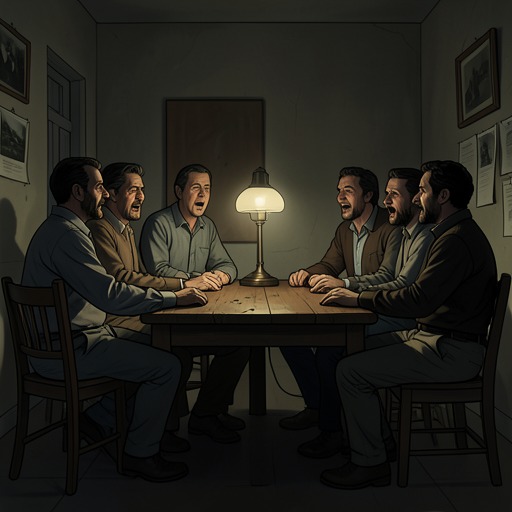
The Master Butchers Singing ClubThe news of the atomic bombing reaches Argus as a newspaper report read aloud around the Waldvogel kitchen table. The scene brings the end of the war into the household not as an abstract announcement but as a collision between reports of unprecedented destructive power and the ordinary sounds and work of daily life. Fidelis asks to hear everything, Mazarine asks for the reading to stop, and the war’s end leaves the family suspended between relief and horror.
How the News Arrives
Delphine first hears of the bombing from a customer who has heard it on the radio that morning. By night, an evening edition from Fargo has arrived, carrying the headline “ATOM BOMB HITS NIPS.” Delphine, Fidelis, and Mazarine spread the paper across the kitchen table and read its front-page stories together. The news enters the family’s life through a chain of ordinary transmission—radio, customer, newspaper—before the scale of the reported event becomes clear.
The page sets the bomb beside stories about a prospective combination household appliance, a quadruple-amputee serviceman using artificial limbs, and a domestic murder-suicide. Delphine reads Truman’s warning that Japan faces “a rain of ruin from the air the like of which has never been seen on this earth,” and the report that the explosive harnesses “the basic power of the universe.” The newspaper’s juxtaposition does not isolate the bomb from other events: world-historical violence shares the page with technological promises and private tragedy.
Reading the Bomb’s Scale
Fidelis leans forward and tells Delphine to read everything on the page. When she reaches the report describing the bomb’s power, he asks her to return to that material. Delphine then reads the paper’s comparison: one bomb equals 1,228 pounds of TNT for every man, woman, and child living in Fargo. The statistic gives the distant attack a local measure, making its destructive capacity imaginable through a familiar city and its population.
The reading is interrupted by Mazarine’s response to the contrast between harnessing the universe’s power and failing to perfect the promised potato peeler. She is dazed and sways her baby as she speaks. Her observation keeps the paper’s promise of domestic convenience beside its account of mass destruction: the same page can imagine a more efficient household while reporting a weapon of devastating force. When she finally says to stop reading, the family’s encounter with the news gives way to silence rather than further explanation.
The War’s End at Home
After the reading stops, Fidelis says softly, “The war’s over,” with a surge of emotion that surprises the others. His words name the news as a turning point, but the scene does not reduce that turn to uncomplicated celebration. Delphine, Fidelis, and Mazarine sit absorbed in their own thoughts, listening to the refrigerator, a fly striking the screen, water dripping into the sink, and sparrows in the grape arbor. These commonplace sounds become newly charged for Delphine, as if they were signs of a larger pattern she cannot quite decipher.
Delphine experiences both horror and relief and feels she should weep or shout. She leaves the kitchen for the garden and works there, pulling weeds until the physical labor occupies her attention. Beneath a dandelion root she finds a bone. The discovery joins the newspaper’s account of mass death to the deaths already present in the household’s surroundings: animals and small creatures, as well as the dead whose remains have been buried or hidden. She continues working until her hands hurt and her thoughts quiet. Her response does not resolve the news; it places the newly reported catastrophe within a continuing cycle of life, death, and return.
War, Memory, and Ordinary Life
The scene’s force comes from its movement between scales. The bomb is described in terms of universal power and a numerical comparison to Fargo, while the people receiving the report remain seated in a kitchen among familiar household sounds. The newspaper itself holds together public catastrophe, domestic invention, and private violence; the family’s reading makes those neighboring accounts part of one uneasy present.
The news also arrives in a household already shaped by wartime absences and anxieties. During the war, Delphine has managed shortages and rationing while worrying about the boys, and letters from Markus describe the limited food available to him. The announcement that the war is over therefore carries more than a change in public events: it touches the family’s prolonged waiting and the possibility that loved ones may come home. Yet the report of the atomic bomb prevents relief from becoming simple closure. The quiet ending—three people listening, Delphine returning to work in the garden—holds the contradiction in place: the war has ended, but its violence continues to press on the living.