Pete Kozka
The Master Butchers Singing ClubPete Kozka is a butcher in Argus, first Fidelis Waldvogel’s employer and later his principal business rival. Their rivalry begins amicably, but Fidelis’s teasing over Pete’s dog, Hottentot, makes it personal: Pete comes to believe that Fidelis has stolen not only customers but also the dog’s affection. The breach gradually heals when Pete joins Fidelis’s singing club, and the two butchers sing together again.
Identity and Background
Pete is described as good-natured but humorless, a solid, practical man whose business methods are cheap enough that he is often short of help. A tornado once drove pennies from his shop’s change drawer into the plaster wall, an odd local curiosity that people visited to see. Despite the difficulties of running his business, Pete and his wife, Fritzie, are well-liked in town.
Pete’s conviction about dogs sharply contrasts with Fidelis’s. Fidelis considers canine devotion largely a matter of appetite, while Pete believes dogs are capable of exceptional loyalty grounded in personal affection. The difference becomes consequential through Hottentot, the champion chow Pete and Fritzie cherish as the progenitor of their line of purebred dogs.
Rivalry with Fidelis
Pete first hired Fidelis at Kozka’s Meat Market. Fidelis had never concealed his intention to establish his own business, and when he did, Pete accepted the move with a stoic shrug. Fidelis bought an old farmstead on the opposite side of Argus, using a bank loan and money from the sale of his share in a family building in Ludwigsruhe. The distance between their shops seemed a considerate way to limit competition. Later, a rerouted highway passed directly by Fidelis’s storefront, bringing him business, but the rivalry’s deeper trouble did not arise simply from the customers he gained.
The disagreement over how to handle butchery waste supplied the setting for the conflict. Pete saved even small remnants, locking them in a freezer barrel until a guts dealer bought them each month. Fidelis instead distributed scraps to dogs, itinerants, and poor residents. Hottentot began appearing at the back of Fidelis’s shop, where he could get food. Pete was particularly troubled because he saw the visits as evidence that the dog he loved had been turned against him.
At first, Fidelis treated Hottentot’s visits as a joke. He gave the dog scraps and a large cow bone, then kept escalating the gifts to skulls, femurs, ribs, and finally a heifer’s spinal column. Hottentot carried the remains through town and took them to Pete’s shop, making the prank difficult to ignore. Pete tried to keep the dog from returning, first tying him up and then chaining him, but Hottentot escaped both restraints and went back to Fidelis for more food.
The joke crossed into a more serious dispute when Pete tried to take an oozing boar’s skull from Hottentot and the dog bit him. Pete needed Doctor Heech to treat the injury. Although the doctor advised him to shoot the dog, Pete did not blame Hottentot. In his view, the dog’s loyalty had been corrupted by Fidelis. That belief turned a prank between rival butchers into a perceived betrayal by a former employer: Pete resolved to get even with the man who had once hired him.
Music and Reconciliation
Fidelis’s singing club offered Pete a way back into the circle he felt excluded from. Pete shared a passion for song and complained to Fritzie that he might start his own club, except that Fidelis had already recruited all the town’s men with good voices. The club’s appeal to Pete shows that the rivalry never erased the affinities between the two men; singing was something he wanted to share, not another ground for competition.
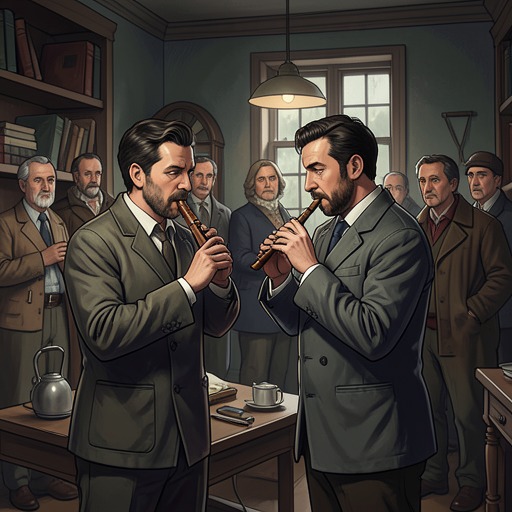
Eventually Pete arrived at one of the club’s gatherings as if the quarrel had not happened. Fidelis made no display of the reconciliation, and once the two butchers sang together, the conflict was almost settled. Their damaged friendship resumed through participation rather than argument: the shared activity allowed Pete to rejoin the group without requiring either man to make a formal declaration of peace.
Character and Narrative Role
Pete’s conflict with Fidelis turns on competing ideas of loyalty. Fidelis reads Hottentot’s behavior as proof that dogs follow food, while Pete reads the same visits as a distortion of a personal bond. The misunderstanding grows because Fidelis continues the prank after its consequences are clear, and because Pete interprets the dog’s repeated returns as a theft of affection. Yet Pete’s refusal to blame Hottentot, even after the incident that required medical care, also shows the depth of his attachment to the animal.
The rivalry is ultimately reversible. What begins in business competition and hardens through a dispute over the dog is eased by the singing club, where Pete’s own enthusiasm brings him back into Fidelis’s company. The town continues to tell stories about the butchers’ rivalry, but its rancor fades into an old topic. Pete’s arc therefore links comic conflict to communal repair: the dog’s allegiance divides the men, while their shared music helps restore their friendship.