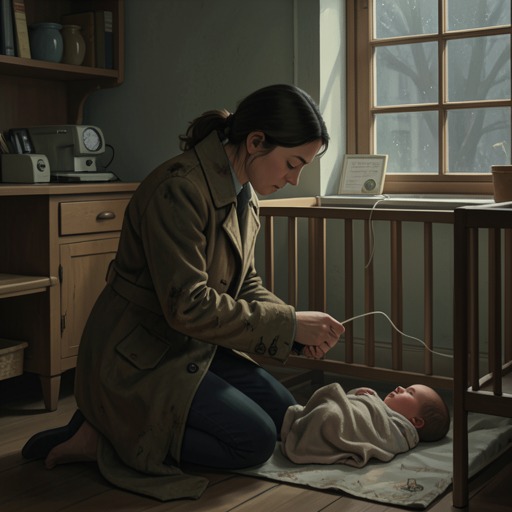
Step-and-a-Half entrusts Delphine to Roy’s care
The Master Butchers Singing ClubStep-and-a-Half entrusts Delphine’s survival to Roy Watzka by bringing the newborn to his house and directing him to help care for her. The episode begins with an infant rescued from an outdoor privy and turns on a practical handoff: Step-and-a-Half supplies the child’s immediate care, Roy responds with shelter and milk, and together they keep her alive. The arrangement does not end Step-and-a-Half’s wandering. Instead, it establishes a durable, unconventional caregiving bond in which Roy raises Delphine while Step-and-a-Half returns to support the child in her own way.
From rescue to handoff
Step-and-a-Half brings the baby to a temporary den in a barn and then to the house of Roy Watzka, a bachelor farmer on the edge of Argus. Roy has fallen in love with her and proposed marriage, imagining a settled life that includes a milk cow, a ring, a wagon, a horse, chickens, and even learning to play the hand organ. He asks her to stop wandering. She knows, however, that she will bring the baby to him, and she does so even though she does not intend to stay.
The infant is alive but in difficult condition when Step-and-a-Half arrives. Roy is bewildered by the baby and calls out to Step-and-a-Half, whom he nicknames Minnie. Her response is immediate and directive: she tells him to stoke the fire and milk his goat. This is the central turn in the handoff. Roy’s house and resources will sustain the child, but Step-and-a-Half sets the first tasks and remains responsible for carrying them out with him.
Establishing the child’s care
Roy goes to the goat while Step-and-a-Half heats water. She uses one pot to sterilize a rag and another to warm water for washing the baby. Because there is no bottle, she feeds the infant by repeatedly dipping a rag twisted into a teat into the goat’s milk. Afterward she cleans the child, fastens a clothespin to the remaining umbilical cord, and wraps her in a torn flannel pillowcase. These successive acts turn the house into a place of care through ordinary materials and improvised work.
Roy asks to hold the baby. At first he feels awkward arranging himself to support her, but he manages it and rocks her in a chair whose joints need repairing. While he holds the child, Step-and-a-Half washes herself. The scene places them in parallel but distinct roles: Roy is already physically caring for the infant, while Step-and-a-Half attends to herself after the rescue. He does not ask her to stay, and she does not promise that she will.
A chosen caregiving arrangement
Step-and-a-Half knows from the outset that Roy’s house is where she will leave the baby. The decision does not arise from a settled domestic plan: Roy’s marriage proposal and elaborate vision of a shared household do not persuade her to give up wandering. Rather, she entrusts the child to him while preserving her own freedom to leave. The separation is therefore also a beginning: Roy takes on the sustained responsibility of raising Delphine, while Step-and-a-Half remains part of the child’s life without becoming a permanent member of Roy’s household.
In later years, Step-and-a-Half returns repeatedly. She gives Roy money to keep Delphine secure and sometimes tries, awkwardly, to tend the growing girl. She had not foreseen how often she would come back or that she would contribute materially to the child’s upbringing. The original handoff thus does not erase her connection to Delphine; it creates a continuing, intermittent form of care alongside Roy’s daily parenthood.
Significance in Delphine’s life
The episode establishes that Delphine’s upbringing begins within a network of chosen responsibility rather than a conventional household formed by marriage. Roy becomes the parent who receives the infant into his home, while Step-and-a-Half makes the rescue and initiates the practical work that keeps the child alive. Her subsequent visits and financial help preserve her place in Delphine’s life even as she continues to walk away.
The later account of Step-and-a-Half’s memories gives the arrangement a second meaning. She recognizes that Delphine’s life repeatedly escaped danger by a narrow margin, and the first margin was the distance between the infant’s precarious beginning and the care Roy could provide. The handoff is neither a simple abandonment nor a promise of settled domesticity: it is an imperfect but lasting allocation of responsibility, shaped by Step-and-a-Half’s need to keep moving and Roy’s willingness to raise the child.