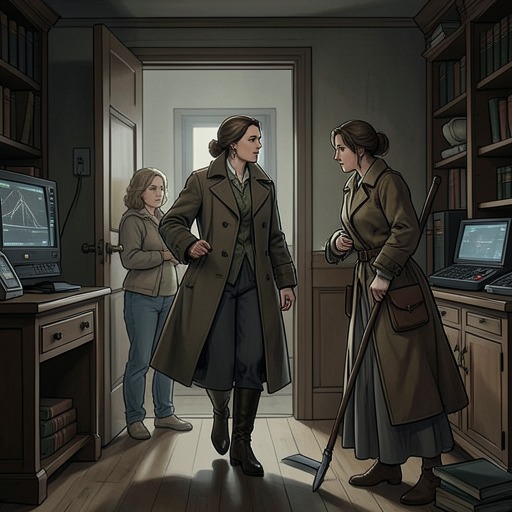
Tante Maria Theresa
The Master Butchers Singing ClubTante Maria Theresa, usually called Tante, is Fidelis Waldvogel’s sister and an important antagonist within his household. She presents herself as a guardian of Lutheran faith and family respectability, but her convictions also make her hostile to Delphine and lead her to obstruct Eva’s pain relief. Fidelis’s decision to make Tante leave his home marks the decisive rupture: he chooses to restore Delphine to his life, while Tante responds by trying to turn the wider family against him.
Identity and Family Authority
Tante’s influence comes from her position as Fidelis’s sister and from her ties to the local Lutheran community. She prays that Fidelis’s Catholic wife will abandon what Tante regards as idolatry and saint worship and return the boys to Lutheran ways. Her religious commitments are not merely private; she treats the boys’ upbringing as a family matter over which she has a claim to act.
That claim gives Tante power in the household even when she is not present in every scene. Delphine recognizes that Tante is among the people who can provide morphine quickly, and her access to the medicine makes her capable of affecting Eva’s comfort. Tante’s authority thus spans both the family’s religious disputes and the practical circumstances of illness.
Conflict over Eva’s Medicine
During Eva’s acute suffering, Delphine goes to Tante’s house to ask for the medicine. Tante challenges the premise of the request: she says that people are calling Eva addicted and that the possibility is a disgrace to the wife of her brother. Her concern is framed through shame and family standing rather than through Eva’s immediate pain.
Tante tells Delphine that she has thrown the morphine down the sinkhole. Delphine then sees the washed vial and morphine bottle drying beside the porcelain sink, evidence that Tante has not disposed of them as she claimed. Delphine compels Tante to return to the house and help nurse Eva. The confrontation exposes the gap between Tante’s professed concern for her brother’s family and her withholding of the medicine; it also shows how, in a crisis, Delphine’s direct intervention can override Tante’s attempt to control access.
Opposition to Delphine
After Fidelis brings Delphine back into his household, Tante’s hostility becomes entangled with public reputation. She regards Delphine as a Catholic, a Pole, the daughter of the town drunk, a former performer, and a woman whose marriage to Cyprian is disputed by local gossip. She also suspects that Delphine befriended the sick Eva in order to gain a place with Fidelis, a widower with a business and four sons.
These judgments reveal Tante’s habit of turning uncertainty into accusation. The qualifications and rumors surrounding Delphine’s marital status do not soften Tante’s view; they become further grounds for distrust. Her portrait of Delphine reflects a defense of religious and social boundaries, but it also puts Tante at odds with the woman who has entered the household’s daily work and care.
Fidelis’s Decision and Its Consequences
When Fidelis tells Delphine that he has told his sister to leave, Delphine understands the choice as a substantial sacrifice. He has placed his relationship with her ahead of his bond with Tante, and Delphine anticipates that his sister will now be a more implacable enemy. She also worries that the choice may create an expectation that she owes Fidelis something in return, though his weary manner offers no evidence that he means to demand it.
Tante does not simply disappear from the family’s affairs after being sent away. She writes a flurry of letters to Germany, and replies arrive quickly; she places them on the cash register as a challenge to Fidelis to disregard them. He reads the letters but says nothing, already burdened by the collapse of the life he has worked to build. Tante’s campaign therefore extends the domestic conflict across distance, using family correspondence to press her claims even after losing her place in the home.
Narrative Role
Tante’s conflict with Delphine helps distinguish formal kinship from the care that sustains a household. She is Fidelis’s sister and claims responsibility for the boys’ religious formation, yet Delphine’s work and advocacy place her at the center of everyday family life. The contrast is clearest in the morphine episode: Tante invokes family shame while Eva is suffering, whereas Delphine acts to secure care.
The rupture also tests Fidelis’s loyalties. His decision to send Tante away does not erase their sibling connection or the wider family’s influence; the letters from Germany show that the conflict persists beyond the household. Tante’s role is thus not only to oppose Delphine, but to make visible the cost of choosing a family organized around practical care and personal attachment over inherited authority and communal respectability.