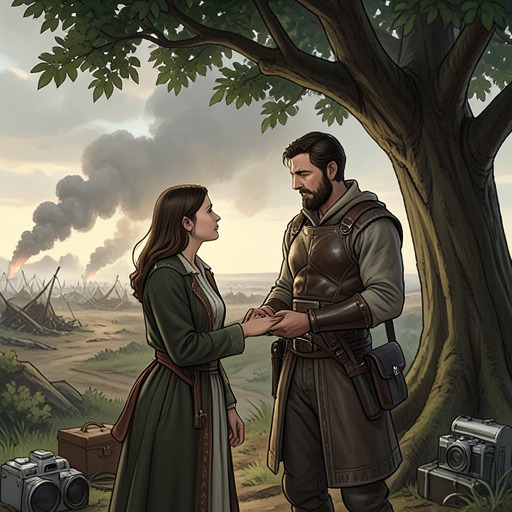
The Death of Johannes
The Master Butchers Singing ClubJohannes’s death is a defining loss in Fidelis’s wartime past: after Johannes has twice saved his life, Fidelis remains with his dying friend in a shell-damaged house during the war’s final days. He sings at Johannes’s request, then leaves without burying him. For years, the event survives not as an openly shared account but as part of the unspoken history linking the two men.
Causes and Background
Johannes and Fidelis are comrades in World War I. Johannes saves Fidelis twice: first by pulling him from a pile of dead after a bullet renders him unconscious, and later by shooting an advancing French soldier when Fidelis’s rifle jams. The exchanges establish their closeness through acts of survival, but the friendship is also marked by the larger violence that surrounds them.
Johannes’s final illness comes during the retreat in the war’s last days. He and Fidelis are in an elegant, ruined aristocratic house where wounded and dying soldiers have been left. Fidelis avoids the cellar, where the wounded are being smothered as they seek shelter, and stays upstairs with Johannes. The narrative does not settle on a single cause of death: it may be dysentery, a contaminated wound, or the exhaustion of the retreating men.
What Happens
Fidelis remains with Johannes for two days and nights as shelling continues nearby. The shattered windows tremble between impacts; Fidelis recalls their broken glass as a faint, chime-like sound. The war’s noise forms the setting for an intimate final exchange rather than a rescue: Johannes asks his friend to sing to him.
Fidelis sings in the freezing room. After Johannes dies, he lays him out and wraps his face in the silk scarf his mother had given him for luck. He does not have the courage to stay and bury him. Instead, he continues walking through the retreat’s further chaos and deaths, eventually returning to his childhood home and family.
Delayed Telling and Aftermath
The account reaches Delphine years later, when Fidelis tells it during a drive through the evening. He begins with Johannes because he sees a repetition between the earlier loss and the present: Delphine, like Johannes once was, may be able to help him and his sons. Telling the story offers Fidelis a possible way to make sense of the pattern, though it does not erase the grief attached to it.
The death had long remained largely outside conversation. Fidelis and Cyprian, who also shared the war, never discussed it directly, even though memories of the conflict repeatedly surfaced in their daily lives. A sound, picture, or word could interrupt either man; the other sensed the disturbance, and a joke or a drink often took the place of explanation. Their silence is not presented as forgetfulness: both men remember the war constantly, while rarely giving those memories words.
Memory and Significance
Johannes’s death shapes the way Fidelis understands friendship, survival, and later responsibility. He had walked away from Johannes’s body without burying him, then returned to a home that held his family and Eva. In telling Delphine the story, he connects that earlier abandonment and loss to the possibility that someone else might now rescue his family. The account makes this connection explicit without treating the two situations as identical.
The story also places private grief beside public memory. In 1954, at a memorial unveiling in Ludwigsruhe, surviving master butchers gather to sing for the victims of the bombing. Fidelis practices with the remaining survivors, and his voice joins the public commemoration. The ceremony does not specifically commemorate Johannes, but it echoes the song Fidelis once sang beside his dying friend: in both scenes, singing gives form to loss that ordinary speech cannot readily contain.
The narrative’s delayed disclosure makes Johannes’s death more than a battle episode. Its particulars emerge inside a story Fidelis has withheld, while the wider war persists in silences, involuntary memories, and ritual song. The account preserves the uncertainty of Johannes’s precise cause of death and Fidelis’s unresolved inability to bury him; it offers testimony, not a neat closure.