The bodies are discovered in Roy Watzka’s cellar
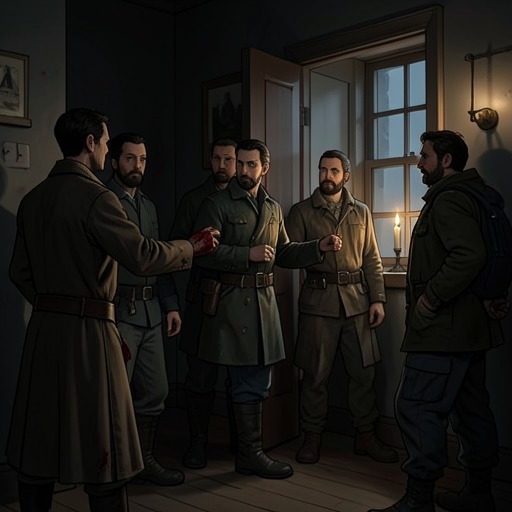
The Master Butchers Singing ClubThe bodies are discovered in Roy Watzka’s cellar is the grisly turning point that transforms a household chore into a public investigation. Delphine Watzka and Cyprian Lazarre uncover the remains of Doris and Portland “Porky” Chavers and their child beneath a sealed floor hatch; the dead are not merely hidden but grotesquely changed by time and decay. Their discovery forces Roy Watzka’s past into the open, draws Sheriff Albert Hock into the house, and leaves Delphine and Cyprian bound to the case as witnesses.
The sealed cellar
Delphine and Cyprian set out to reach a ring in the floor, first breaking through a seal made from shattered jars of canned peaches, dog excrement, and handfuls of red beads set into the peach juice. They hammer at the stuck ring, but daylight fades before they can finish. After stopping to fill a lantern with kerosene, Cyprian trims and lights its wick; then they use a crowbar and a can opener to pry up the hinged hatch. The slow, improvised work makes the eventual discovery feel less like an ordinary opening of a door than a breach in the house’s buried history.
The smell that meets them is not the odor they had been struggling against. Delphine later recognizes the earlier smell as only an olfactory shadow: the hatch releases the real source. Both rush out through the back door and collapse in the rough backyard grass, dazed. They cannot even agree at first whether the hatch actually came up. Their confusion and physical recoil hold the bodies out of view for a moment longer, allowing dread to precede the full revelation.
The dead are identified
After they recover enough to return, Delphine and Cyprian look into the cellar and flee outside again without breathing. Asked whether what they saw was a person, Cyprian answers that they were monsters. The description is literal in its horror: the bodies are bloated, green, pop-eyed, with enlarged tongues, their surfaces iridescent with fungal growth and inhabited by many creatures. They have been propped upright in the cellar among empty bottles. The scene’s shock comes from the collision of the familiar domestic cellar with remains so altered that the dead initially resist recognition as people.
Cyprian insists that they must tell Roy and learn more before deciding what to do. When Delphine says there are dead people in the cellar, Roy is too distraught to respond steadily. He has become tangled in his bedsheets and mistakes his predicament for an attempt to restrain him; his remembered delirium-treatment in a sanitarium, where he was pinned into a cold wet sheet, returns as a frightening parallel. Delphine and Cyprian struggle to keep him from grabbing the whiskey. Once they can describe a black suit, Roy recognizes the dead as Doris, Porky, and their little boy.
Roy explains that the Chaverses had been guests at a funeral party for Clarisse Strub’s father. He had arranged a party rather than conventional funeral proceedings because the deceased was a Strub and had wanted a celebration. Roy presents the gathering as an act of mercy, but that account does not explain how the guests came to die in his cellar. The discovery therefore exposes their identities and establishes the occasion on which they were last known to be present, while leaving the central question of what happened unresolved.
From private shock to public inquiry
The revelation reaches beyond Roy’s household. Roy remembers that Pete Kozka, Fidelis Waldvogel, Pouty Mannheim, and Betty Zumbrugge had wondered where the Chavers family went. Porky had not appeared at the singing club; the family’s house had been left behind, and even their dog returned and would not leave the pantry. Roy and the others had assumed that the family had gone to Arizona. His recognition of the bodies overturns that explanation and turns an absence long absorbed into town gossip into evidence of a death no one had understood.
Delphine and Cyprian initially consider burning the house, but Cyprian argues that a fire would invite the sheriff and fire chief, make them appear to suspect foul play, and might not destroy what was in the cellar. His use of “we” matters to Delphine: he could have left her to manage her father, the house, and the bodies alone, yet he stays and takes responsibility for the next step. His practical judgment and loyalty reshape how she sees him, even as the immediate danger makes their circumstances far from ordinary.
After a tense, morose breakfast, the three go to Sheriff Hock’s office. Delphine and Cyprian recount the discovery in turn, carefully supplying the sequence and details they can remember while Hock records their account in a moss-green record book. His patient attention draws out specifics including the time of day, the sources of light, the force of the odor, their theories, and their concern for Roy. Reporting the scene makes their private, confused experience part of an official record; their effort to describe it accurately becomes the beginning of the investigation.
Investigation and consequences
Hock gathers the tools of his office, leaves a detailed note for his deputy, and takes Roy with him to the house, with Delphine and Cyprian following. He wears a quarantine mask as he enters, opens the cellar hatch, and makes preliminary notes. Afterward, he tells Roy that he cannot allow him to live in the house again until he has interviewed the other guests from the fatal night. He also informs Delphine and Cyprian that, because they may have seen and destroyed evidence of foul play, they must remain in town as potential witnesses.
The discovery thus produces an immediate reversal: the cellar is no longer simply part of Roy’s home, and the three who found the bodies cannot simply leave the matter behind. Roy walks toward the river seeking solitude, while Delphine points out that he habitually hides a bottle among the riverbank tree roots. She and Cyprian pitch a tent upwind and far from the house; she sends Cyprian to keep Roy from going swimming while drunk and drives into town for supplies. The grotesque remains have made the house uninhabitable, exposed the fatal night behind the Chaverses’ disappearance, and set a formal inquiry in motion, although responsibility for their deaths has not yet been determined.