The boys’ hill fortress
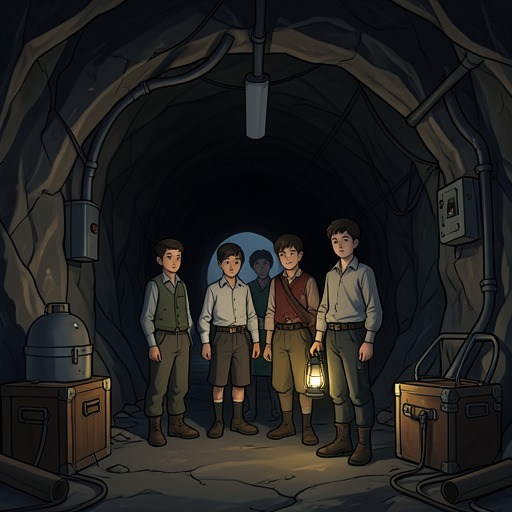
The Master Butchers Singing ClubThe boys’ hill fortress is an underground clubhouse dug into a mound of earth behind an abandoned construction site. For Markus, its quiet, enclosed chamber is more than a children’s hideout: it offers a temporary shelter from grief after Eva’s death. When the mound collapses with Markus still inside, that refuge becomes a dangerous enclosure, and the adults must carefully excavate him from the earth.
Site and Discovery
A year after Eva’s death, Markus became fascinated by excavation and found the site while wandering with a slingshot and a pocketful of stones. A grand house had been planned there, but its prospective owner ran out of money after the basement was dug. No boards had been put in place, and a rotting shed still stood in the yard. The dug-out earth had been piled into a high mound behind the trees, its bare surface sprouting only coarse weeds.
Markus explored the unfinished basement, struggled to climb out of its muddy bottom, and searched the broken-roofed shed. Among rusted cans and mouse nests he found an ax head with a broken handle, which he carried to the mound. Lying on top of the fresh earth, he felt what seemed like a small movement beneath him. The sensation of the ground as something living pleased him, though it did not come again. Alone there, he also let himself cry, as he often did during that first year of mourning.
Construction and Interior
The boys gradually made the mound into a shared project, though many of the original group drifted away. The core crew included Markus, the twins, Emil and Erich, Grizzy Morris, and Roman Shimek. They reinforced the entrance with the bed of an old wagon box and nailed a horseshoe to a lintel made from a beam salvaged beneath the sagging shack. Boards taken from the shack strengthened the first stretch of tunnel.
The passage narrowed into a belly-wriggling crawl about twenty feet long before reaching the room. The boys used a hoe blade to scrape out the chamber and a stolen square of canvas to drag the excavated dirt away. Markus worked with particular intensity, digging and hauling even when the others rested outside or experimented with making cigarettes from rust-brown plants wrapped in newspaper. He did not insist that they keep working beside him; the digging itself had absorbed him.
For Markus, the chamber’s appeal lay in its inwardness. Crawling through the entrance and into the hill’s black center, he could hear his blood and heart in a silence that felt almost electrically alive. Leaving the fort, he felt calm and a little foolish, and for the first time since losing Eva he slept through the night. The earth’s enclosed quiet gave him relief that ordinary company and activity had not provided.
Collapse and Rescue
As the boys continued improving the fort, Markus stayed inside to fit one last board into the ceiling. He said he would come home once that section was reinforced. The others had gone back toward the broken shed to retrieve another board when they felt something soundless but palpable and turned toward the mound. Its high dome sagged with a dull internal whomph. Only after several minutes did the boys remember that Markus was still beneath it.
The collapse left Markus wedged under two buckled boards. He was unable to move but was not injured, and he felt sleepy rather than immediately afraid. In his confused, dreamlike state, the packed earth recalled the comfort of being held and rocked by Eva as a small child. What had been a chosen shelter now enclosed him without his consent, joining the fort’s comforting darkness to the danger of burial.
Fidelis rushed toward the blocked entrance and began shoveling with desperate strength, but Cyprian restrained him, warning that careless digging could bring down the rest of the mound. Using the boys’ tools, including the broken hoe, the two men carefully scratched away the earth and carried it out on the canvas. The boys helped remove the dirt, while the gathered members of the singing club waited with lanterns, unable to do more than watch, speculate, and endure Fidelis’s cries as the rescue proceeded.
Meaning in the Story
The fortress gives physical form to the tension between refuge and confinement. Its silence steadies Markus in the aftermath of loss, but the same earth that makes privacy and calm possible can close over him. The collapse changes the boys’ private construction into a public emergency, drawing their community to the hill and requiring careful cooperation rather than force.
The mound also links Markus’s grief to the novel’s recurring attention to earth, burial, and memory. Before the fort becomes a clubhouse, Markus senses the ground moving beneath him and cries alone on its surface; inside it, he finds a shelter that recalls his mother’s embrace; when it collapses, that remembered comfort returns in distorted form. The place is therefore both a child-made room and an unstable boundary between safety and burial.