Turtle Mountain Band of Ojibwe
The Master Butchers Singing ClubThe Turtle Mountain Band of Ojibwe is a present-day Indigenous community invoked in the novel through Louise Erdrich’s own biographical identification and through characters’ accounts of Indigenous ancestry and history. Its brief but significant presence connects Cyprian’s self-understanding to a longer story of Native survival, while the account of Minnie’s family places the violence at Wounded Knee within a network of kinship, displacement, and memory.
Identity and References
The author’s biography identifies Louise Erdrich as a mixed-blood member enrolled in the Turtle Mountain Band of Ojibwe. The novel also gives Cyprian language for his Indigenous identity: he describes himself as Chippewa and Ojibwe and says that his grandfather used the word Anishinaabeg, meaning “the humans.” His disclosure makes explicit an identity he had not previously told Delphine, although the two live together openly as a couple in town.
The references distinguish between a specific community affiliation and the broader Indigenous identities discussed in the story. Cyprian’s account concerns his Ojibwe heritage; Roy’s later narrative concerns a Cree father and his daughter Minnie, who become caught up in the flight of Lakota people. The book brings these histories into relation without treating them as interchangeable.
Cyprian’s Disclosure
Cyprian’s conversation with Delphine makes ethnic identity part of their intimate understanding of one another. He names his ancestry only after she asks what else he is besides French. His answer is an admission with particular weight in the town where they live together as though married.
The disclosure also sits alongside Cyprian’s explanation of his attraction to men. He tells Delphine to ask herself why she likes being with men, suggesting that his own answer is the same. Delphine comes to feel a kinship with him grounded in her understanding of womanhood and emotional experience. She accepts his explanation while recognizing that they will not be lovers in the conventional sense. Their bond therefore exceeds a simple romantic classification, even as the conversation leaves their practical future uncertain.
Minnie’s Family and the History of Wounded Knee
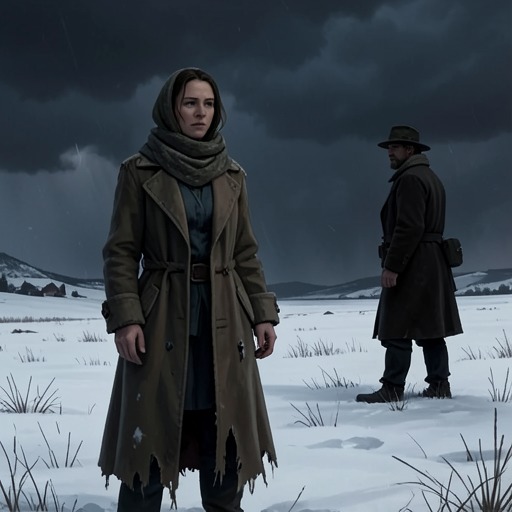
Roy recounts the story of Minnie’s father, a Cree man sent by his people to learn whether the Ghost Dance could bring the dead back. He travels with his youngest daughter, first joining Hunkpapa Lakota people and then a Minneconjou group moving through the Badlands. As the displaced people run short of food and shelter, they reach Medicine Root Creek and encounter Major Samuel M. Whitside of the Seventh Cavalry, who persuades them to proceed under a white flag of surrender to the military camp at Wounded Knee.
Roy’s account emphasizes both the people’s desperate material circumstances and their efforts to care for one another. Minnie’s father shares their last piece of bannock; a woman offers a gingerbread figure divided into crumbs. The next morning, that woman prepares a root tea for Minnie. A shot is fired as the girl drinks, and the violence that follows kills her father and the woman, whose baby is still nursing. Minnie receives her father’s final message, escapes through the ravine, and walks through the snow by following the tracks of other refugees until she reaches a mission.
Memory, Violence, and Belonging
The account reaches the reader through Roy’s telling to Delphine, rather than through a detached historical summary. He frames the story as painful and long kept from others, and his narration connects Minnie’s childhood experience to her later inability to be controlled by him. Personal testimony thus makes history consequential within family life: the past is not a distant episode but part of the explanation of who Minnie became.
The story also juxtaposes the military control imposed on Native people at Wounded Knee with another form of confinement: German prisoners of war are transported in chains to a guarded camp in the northern forests. The situations are not equated, but the contrast places different experiences of military authority and restricted movement beside one another. Across these references, Indigenous identity is conveyed through self-naming, family history, and remembered violence, rather than reduced to a single generalized label.