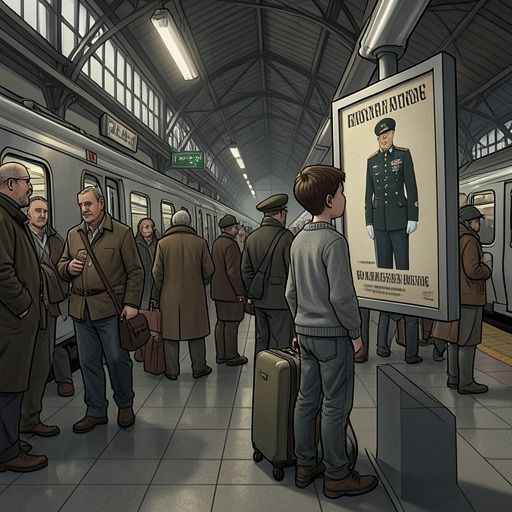
United States Army
The Master Butchers Singing ClubThe United States Army is a decisive presence in the novel’s account of the Second World War, although the Army’s role reaches the reader through sharply different experiences rather than through a single institutional viewpoint. It takes Markus into service and assigns him work writing condolence letters; it receives Erich as a German prisoner of war after his battlefield capture; and, in the broader family story, wartime mobilization and scarcity reshape the lives of those left at home. Military service does not mean the same thing for the two brothers: Markus is kept from combat by a failed vision test, while Erich’s capture follows the death of his twin, Emil, and the collapse of the beliefs with which he entered the war.
Enlistment and the family left behind
Markus leaves for Fort Snelling after entering the United States Army. His departure is emotionally consequential at home: Delphine bakes through the night, reads without absorbing what is on the page, and dreams of the people who died in her cellar. She knows that her anxiety concerns more than Markus’s absence. The younger boys’ situation in Germany is uncertain, and the war has placed another of the children for whom she cares beyond her reach.
The household and its business feel the war as an economic force as well as a personal one. Orders arrive in a sudden rush, but shortages make ordinary work harder. Though Fidelis has a coveted C sticker for the delivery truck, gasoline remains scarce; coffee disappears; the government requisitions butter, and Delphine sells oleomargarine with small pats of yellow dye. Her distributor’s canned goods fall to the lowest grade and then vanish, while eggs are powdered for soldiers. The Army is not shown directing the shop’s daily operations, but military demand is written into what the family can buy and sell, and into the powdered eggs that Markus reports eating.
Markus’s service and its cost
Markus fails the vision test and is expected to do desk work at the Officer Candidate School for the duration. Delphine receives the news with relief, as if the family has been granted a measure of reprieve. His assignment keeps him from the combat she fears, but it does not remove him from the war’s losses. In his letters he describes his task: officers give him lists of names, and he writes to the parents of dead servicemen he never knew. He calls these “ghost letters by ghosts, written for ghosts, about ghosts,” a description that captures the distance between the Army’s administrative duty and the particular lives that duty must represent.
The work changes Markus’s understanding of military service. He says he is becoming skilled at inventing lives for the dead in condolence letters, but hates the task because he does not know who the men were, how they lived, or how they died. When he returns, he is neat, thoughtful, and professorial, with a tired face and a quick laugh. His father and he struggle to speak easily with each other, so Delphine joins them and asks about his work. The letters thus become one of the few explicit ways the family can hear what military service has made of him.
Emil’s death and Erich’s capture
Erich’s path into American custody begins in Germany, where he and Emil are taken with their school class as the Army becomes desperate for reinforcements. The twins had expected to serve together in the Hitler Youth division of the Waffen-SS. Emil is killed early in the war by a mine in a sheep pasture. The narrative then follows the surviving twin into battle: Erich continues fighting, but the oath and comradeship on which he relied provide no protection from the conditions around him. After days without sleep, he is captured by American soldiers.
Erich initially conceals that he understands English. Nazi prisoners in his group have threatened those who collaborate, so he adopts a guarded silence despite being able to follow what is said around him. His journey to captivity carries him across a United States that contradicts the devastation he had been led to expect: the prisoners had anticipated ruined cities and dead farms, but instead see an intact, busy country. Erich is too overwhelmed by memories and despair to settle on an explanation for that contrast.
Prisoner-of-war camp and identity
The prisoners travel north by train and then walk under guard along a muddy road through a forest. At the camp, Erich receives work clothes marked PW, a coat, shoes, socks, underclothes, blankets, and basic toiletries. The provisioning and the setting complicate any simple picture of captivity as an immediate extension of the battlefield: the enclosure is bounded by logs and wire, yet the surrounding woods and the camp’s provisions make it less forbidding than Erich expected. The episode presents him as both a prisoner under American control and a young man involuntarily relieved by the practical shelter offered there.
In camp, Erich sings to pass the time, and other prisoners join him in making songs a nightly event. The music gives form to feeling and enters the men’s dreams, but it does not dissolve his isolation. He longs for Ludwigsruhe and remembers his grandfather and the sausages he used to share with Emil. At the same time, he shuts out thoughts of his family and remains wary of revealing his American upbringing or English fluency. Rumors that prisoners who became too friendly with Americans might disappear deepen that caution. His silence is therefore not simply ignorance or inability: it is shaped by the danger he believes disclosure would bring within the prisoner group.
The Army’s reach and the novel’s perspective
The novel shows the Army through people whose lives its decisions and custody alter, not through an extended account of command or policy. Markus’s service places him at a desk where the names of dead soldiers become letters to bereaved families. Erich’s capture transfers him from a German army shaped by Nazi indoctrination into an American system of guarded confinement. The two stories are linked by the family’s distance from the boys, but they remain distinct in their consequences: one brother serves away from the battlefield and writes about strangers’ deaths; the other survives combat and must conceal parts of himself while imprisoned.
That contrast also connects military institutions to the novel’s treatment of memory. Delphine’s fear for the absent boys, Markus’s ghostly correspondence, and Erich’s guarded recollections show that war reaches beyond combat into household labor, communication, identity, and grief. The Army appears as an institution that mobilizes, assigns, guards, and confines, while the story’s attention rests on what those actions mean to families and individuals who must live with their effects.