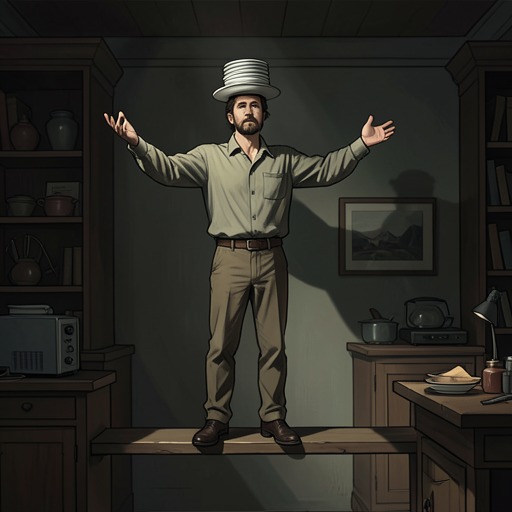
Vilhus Gast
The Master Butchers Singing ClubVilhus Gast is a Lithuanian Jewish itinerant performer and the partner with whom Cyprian Lazarre tours as part of a lyceum series. In Argus, Gast’s acts combine physical balance with reptiles, spiders, and staged danger. His most memorable appearance turns what first seems to be a badly shifting toupee into a live spider, then joins Cyprian in a theatrical dance with a huge python. Gast is not merely an offstage companion: his practiced control and flair for deception help make the traveling act a spectacle for a town audience.
Identity and Introduction
Cyprian explains that he is no longer looking for ordinary work: he has an engagement as part of a lyceum series and now travels with the Snake Man. The label initially leaves Delphine Watzka uncertain about what Cyprian’s new life means, and she asks about his partner. Cyprian clarifies the names: Mighty Tom is the spider, while the man performing beside him is Vilhus Gast. The distinction gives Gast his own identity within an act whose animals and performers are deliberately presented as a collection of marvels.
Gast is a performer who came to America from Lithuania and is Jewish. Cyprian says he is “a lot like me,” describing them both as entertainers. When Cyprian first took Gast home, Gast was surprised to encounter an Indigenous man; Cyprian, in turn, says that he had grown up without knowing a Jewish person. Their partnership emerges from that mutual unfamiliarity rather than from sameness of background. Gast knows about Indigenous people and recounts a belief that they were one of the lost tribes of Israel, condemned to wander like the Jewish people, always on society’s edge and subject to persecution. Cyprian’s response is to propose that they roam together, and the two build an act that they perform steadily.
The Act in Argus
Delphine and Markus arrive early at the school gymnasium for the show, taking seats in the first row of creaky folding chairs. Delphine chooses the front rather than sitting with her back to the stage, so she does not have to face the customers and former schoolmates who might stare or whisper about her and Cyprian. Her position lets her concentrate on the performance. The setting is modest, but the act that unfolds there is carefully composed for surprise, suspense, and audience participation.
Gast and Cyprian appear barefoot in tight black gymnasium suits, standing on large red rubber balls. They pedal around one another in a do-si-do, accelerate, then leap into the air and exchange places on the spinning balls to applause. Gast is close to Cyprian in size and shape, though his features are described as nondescript; the conspicuously bad toupee he wears becomes the visual joke at the center of the next balancing routine. These details make him both a physical counterpart to Cyprian and the concealed source of the act’s first startling transformation.
Gast holds still with his hands raised while Cyprian bounces a ball between his feet. Cyprian springs upward and locks hands with him; the men sway close to toppling before they recover their balance. Gast then dances the ball back and forth while pretending to struggle to support Cyprian. As they shift through one-armed and one-legged positions, the toupee slowly creeps away from Gast’s head. It proves to be a giant spider, which climbs his arm, reaches Cyprian’s elbow, and settles on Cyprian’s bare scalp as he lowers himself. The audience’s laughter and astonishment are part of the choreography: a disguise becomes a living creature, and the balancing trick continues with the spider apparently attached to Cyprian.
Gast produces a second, smaller spider from a box on a stand. The crowd falls quiet as he coaxes it with a feather along his arm and up Cyprian’s throat. The change from shrieks and laughter to hushed attention shows the act’s ability to control not just physical movement but the audience’s mood. The spiders make the performers’ bodies part of the spectacle, while Gast’s composed handling of them sustains the impression that the dangerous and the comic can occupy the same stage.
The Dance of Death
After the spider routine, the performance turns to Gast and Cyprian’s python. They reappear in jeweled turbans and transparent veils that billow around their legs and arms, while a tinny phonograph plays exotic-sounding music. A leather valise, eight or nine feet long and set on four sawhorses, is unlatched to reveal a live, mottled snake. The men announce the Dance of Death and coax the enormous animal from its case into their arms.
The python grows more alert as Gast and Cyprian wind and unwind around it. It tries to draw them into its coils, and their dance remains both graceful and improvised. Because the audience believes the snake may devour the performers, the spectacle holds the gymnasium in suspense. The men carry the python down the center aisle, allowing people to touch its dry, charged skin and see its incongruously small head and cold eyes at close range. Gast and Cyprian then return it to the case and snap the locks, converting the apparent threat into the setup for another piece of theatrical misdirection.
Cyprian calls for a butcher from the audience, and Pete Kozka is brought forward to test two gleaming, sharp-toothed handsaws. After Pete pronounces them keen and effective, the performers saw the python inside the valise. The snake writhes, and its tail lashes through the unlatched end. Gast and Cyprian burn a fragrant substance, chant portentous syllables, make signs over a pot of school glue, and put the python back together. The sequence makes the act’s risk seem to cross into the impossible, while its deliberately visible props and gestures keep the audience watching the mechanics of the illusion as well as its apparent miracle.
Performance and Significance
The show continues through smaller animal acts and balancing tricks. Gast and Cyprian put away the python, juggle lizards, and display a huge, motionless iguana that resembles a stone carving. Mighty Tom returns as Gast’s supposed toupee and is carried down the aisle in a large round candy jar so spectators can stare at him. The two performers balance cups, plates, and their curly-toed shoes on their heads and noses before bouncing off amid wild applause. Across the program, Gast’s identity as a partner is inseparable from a sequence of transformations: the toupee becomes a spider, the snake becomes the center of a death dance and apparent dismemberment, and the performance keeps shifting between danger and laughter.
Gast’s importance in the scene lies in what his partnership makes possible. Cyprian describes them as two people who might otherwise remain strangers to one another, brought together by a shared life of performance and by a recognition of wandering and exclusion. Onstage, that companionship becomes a practical collaboration: Gast supplies steadiness, animal handling, and the controlled reveal, while both men depend on each other to sustain acts that appear to put their bodies at risk. The audience sees a strange assortment of animals and feats; beneath the novelty, the act gives form to a chosen alliance between two performers who decide to travel together.