Waldvogel sausage-making principle
The Master Butchers Singing ClubThe Waldvogel sausage-making principle holds that no ingredient is too humble to deserve the finest available quality. Taught to Fidelis Waldvogel by his father just before Fidelis left Germany, it becomes both a practical standard for his trade and a measure of the care and discipline behind the food he makes.
The Principle and Its Inheritance
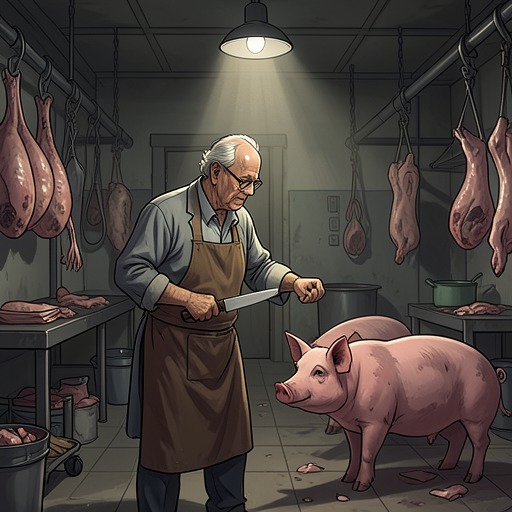
Fidelis’s father had practiced butchery throughout his life, and the family regarded it as a craft demanding study, precision, and timing. His hands seemed scarcely to move as he shaped an animal into orderly cuts. In this tradition, the principle of using the best ingredients belongs to a broader ethic of exacting work: skill is shown not only in the knife’s handling but also in the attention given to every part of the finished food.
On the eve of Fidelis’s departure, his father gave him the family’s sausage-making secret. Its instruction was simple, but its requirements were concrete: salt mattered; garlic had to be fresh rather than dried out; meat and sheep casings had to be exquisitely fresh. Nothing was dismissed as too ordinary to affect the result. The principle thus traveled with Fidelis as inherited knowledge, something he could put into practice far from the family trade in Germany.
Putting the Rule to Work
After arriving in America, Fidelis found work with Pete Kozka, the local butcher, and also took jobs in nearby towns and at farms where he was fetched to butcher. He brought his father’s skill for sausage-making to the Kozka business. For his first batch of Swedish sausages for Scandinavian customers, he followed the family rule closely enough to seek out the finest potato available in the area for the filling rather than use an arbitrary one.
The sausages succeeded. Thursdays became Fidelis’s sausage-making days, and customers gathered to buy links hot from the kettle, even before they had been smoked. That early sale also benefited Pete Kozka because the sausages weighed more at that stage. The principle therefore had practical effects beyond the taste and quality of the product: Fidelis’s care attracted customers and helped increase the butcher shop’s trade.
Quality, Scarcity, and Labor
Fidelis himself lived sparingly while he saved. He ate sausage ends, bruised fruit, stale cookies, and questionable trimmings; brewed his own beer; and washed his own shirts and aprons. The contrast between his austere personal life and the standards he maintained in his work makes the principle more than a slogan about refinement. He economized on his own meals, but did not treat economy as a reason to lower the quality of what he made for customers.
This distinction also explains why the rule is specific rather than abstract. Fine ingredients were not merely a luxury: freshness and grade mattered in the finished sausage, so the craft required judgment about each component. Fidelis’s insistence on a good potato for the filling shows the ethic extending even to an ingredient that might otherwise be treated as incidental.
Craft and the Meaning of Food
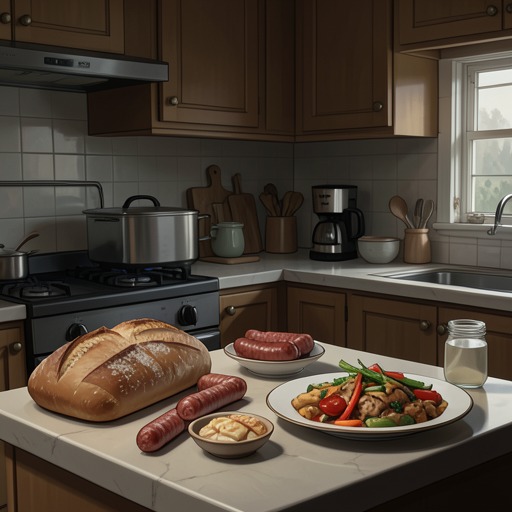
The principle stands in contrast to the machine-sliced bread Fidelis encounters in the public square of Ludwigsruhe shortly after marrying Eva Waldvogel. A white, precisely square loaf, sent from distant relatives as an example of a commonplace food transformed by machinery, persuades him that America is a place he should travel to. In his family’s view, however, food-making is not simply a matter of producing a uniform object: proper killing and butchery involve learned judgment, and ingredients must be chosen with care.
Across the novel, food also carries the circumstances of its sharing. Fidelis later eats baked beans with molasses, mustard, and smoked pork in a forestry camp, then wipes his tin plate with soft, square slices of white bread; elsewhere, he and another person share a carefully made sandwich of fresh country bread, sweet butter, smoked ham, and dill pickles. These meals do not restate the sausage rule, but they echo its attention to quality and preparation. The family principle gives Fidelis’s trade a durable standard: humble food can be made with seriousness, and care is visible in what is selected, prepared, and offered.