Walking to outdistance memory
The Master Butchers Singing ClubWalking to outdistance memory is Step-and-a-Half’s lifelong response to the trauma of the Wounded Knee massacre: movement gives her temporary relief from memories she cannot otherwise escape. The practice is not a cure or a clean departure from the past. It is a way of keeping going, sustained by open space and repeated journeys, and tested whenever age, fatigue, or reflection slows her down.
A life measured in miles
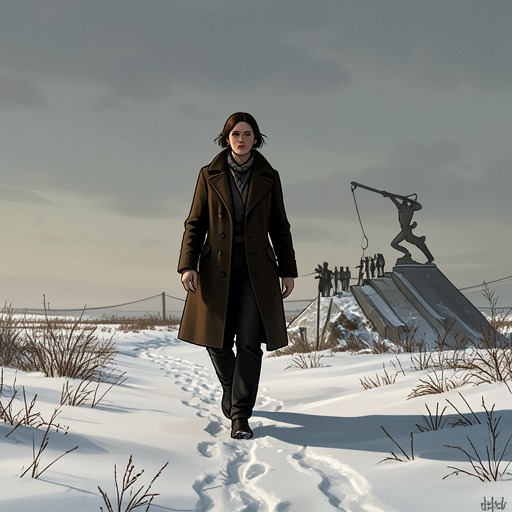
Before settling in Argus, Step-and-a-Half wandered the roads of North Dakota, sleeping in ditches, among trees beside rivers, and sometimes in barns or on porches. Her stride could carry her twenty or thirty miles in a day. The distances seemed easy, even soothing; she could arrive somewhere without remembering how she had got there. For a person with nowhere to go, arrival itself remained a puzzle. Argus gradually became an exception: she came back more often, stayed, and began to learn the town.
Settling did not mean that she stopped being a wanderer. She came to know Argus from the alleys and back porches rather than its tidy front steps, reading what people discarded as a record of the lives they concealed or neglected. In old age, she owns a junk store and sees the town through a junker’s eye. Movement and observation thus belong to the same way of inhabiting the world: walking carries her through its spaces, while the objects left behind let her interpret them.
The memories movement cannot erase
The reason Step-and-a-Half walks lies in the massacre at Wounded Knee. She remembers the violence against Lakota people and the death of her father, whose final words tell her to go home and say that it is over. The memory of a nursing baby whose mother has been killed, and of a child who tried to hide by covering his face, remains among the scenes that may return when she stops. She has also heard that a baby survived for three days and was found in a blizzard, frozen in the blood of its mother, wearing a small cap beaded with an American flag. These remembered and reported scenes form the burden against which her journeys are measured.
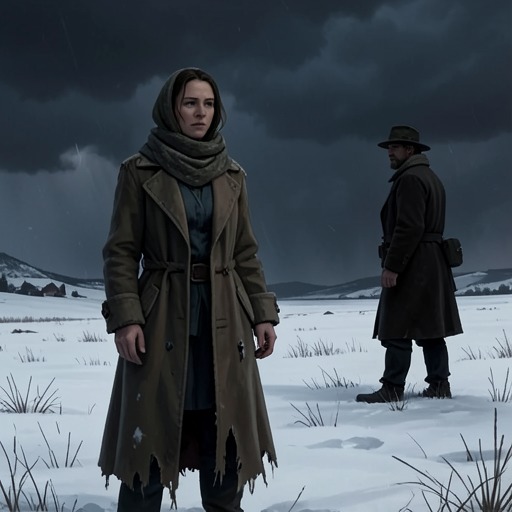
Walking gives her somewhere to put that burden without pretending to resolve it. She can accept the weather and the emptiness of the spaces outside human society; the wind’s rush can drown out the remembered sounds of the Lakota language and the language she spoke with her father. That relief is temporary, but the contrast matters: indifferent nature is easier for her to endure than recollections of human cruelty. Her motion is therefore less a search for a destination than a way to continue living with what she remembers and what she cannot fully remember.
Return, care, and the limits of escape
After entrusting the infant Delphine to Roy’s care, Step-and-a-Half expects to leave him with the child. She does leave, but the pattern does not hold as a single, final departure. She returns to Argus repeatedly, gives Roy money to help keep the girl secure, and sometimes tries, awkwardly, to care for Delphine as she grows. Her attachment is expressed through these intermittent acts rather than through a settled domestic life. The same movement that helps her escape memory also keeps her connected to the people she has left behind.
Roy cannot expect her to give up walking simply because he wants her to remain. The narrative makes that limit explicit: he cannot hold her in one place, and she cannot promise herself that she will stay. Yet her returns complicate the idea of flight. She is not indifferent to Roy or Delphine; she helps provide for the child and comes back to tend her when she can. Walking creates distance, but it does not sever the bond.
Old age and the return of the past
As an old woman in Argus, Step-and-a-Half has much less strength for the long roads. She can occasionally walk for miles, and those journeys still soothe her torment for a time, but increasingly she rests in the little room behind her shop. Age, ownership of the store, and persistent insomnia leave her with more opportunity for reflection than she had while constantly moving. The memories she had tried to outwalk can now assemble vividly as she lies beneath a quilt made from fabrics she collected.
Her recollections gather people and places from across the novel: Fidelis arriving in Argus with a suitcase she mistakenly thinks is empty; Eva’s boys and the sorrow of her friend’s death; the boy freed from the collapsed hill; and Roy, whose photographs she is glad he took with him to the grave. These returns show that memory is not simply defeated by distance. Walking once offered a temporary way to quiet it; in old age, when the miles become harder, the past comes back through scenes and relationships she had carried with her all along. Her life’s movement consequently holds both escape and return: she keeps walking to create distance from cruelty, yet Argus and the people there become part of what she returns to.
Narrative significance
The motif joins physical movement to the form of trauma: the past does not arrive as a finished account that can be left behind, but recurs in remembered scenes, fragments, and sudden reflections. Step-and-a-Half’s long walks provide relief without implying that the violence has been mastered. Her history also connects the massacre to the quieter continuities of care in Argus, where her departures coexist with money for Delphine and repeated attempts to help raise her.
The book’s closing view of Step-and-a-Half in old age makes the limits of walking visible. The space that once soothed her remains important, but her body can no longer carry her along it as before; reflection takes the place of many journeys, and remembered lives gather in her mind. Her story gives walking a double significance: it is a practical means of enduring trauma, and a recurring image of a life that can move away from violence without ever becoming wholly free of its memory.