Women’s care work and order
The Master Butchers Singing ClubWomen’s care work and order in the novel are not incidental domestic virtues: they are forms of skilled labor that keep the Waldvogel household and business functioning through illness, heat, grief, poverty, and war. Eva’s routines and practical knowledge teach Delphine how to manage a household and shop; Delphine then uses that knowledge to care for Eva, the boys, Fidelis, and customers. The work creates stability, but it is costly and often poorly recognized. Its effects are clearest in the concrete tasks—preparing medicine, preserving food, managing inventory, laundering bloodstained work clothes, and keeping watch over sleeping children—that turn care into the daily infrastructure of family life.
Eva’s systems: order and improvisation
Eva’s competence joins exacting standards to adaptation. In the butcher shop, she expects cleanliness and efficiency, but a prolonged heat wave and drought make both harder to sustain. The counters and floors become slippery with melted grease; the refrigerated cases run at full cold yet remain lukewarm, so the meat must be checked repeatedly for spoilage. A generator powers the crowded meat locker, while the household buys very little milk because it may sour on the drive home. Cream turns too, but Eva tries to culture it for cooking. These are not abstract signs of domestic hardship: they are daily decisions about what can be saved, prepared, sold, and kept safe.
Her garden offers a different kind of order. It grows from kitchen scraps—potato peelings, tea leaves, cucumber skins—buried or piled into the soil, where discarded seeds take root without a formal plan. Apple trees rise from cores; marigold seeds are scattered freely; birds are fed oatmeal. Delphine reads this apparent disorder alongside Eva’s carefully run household: Eva’s talent is not simply to impose rules, but to recognize what can flourish when given room. The garden’s unruliness becomes a complement to the routines that govern the shop and home, suggesting that care can organize life without making it wholly controlled.
Nursing as skilled, embodied work
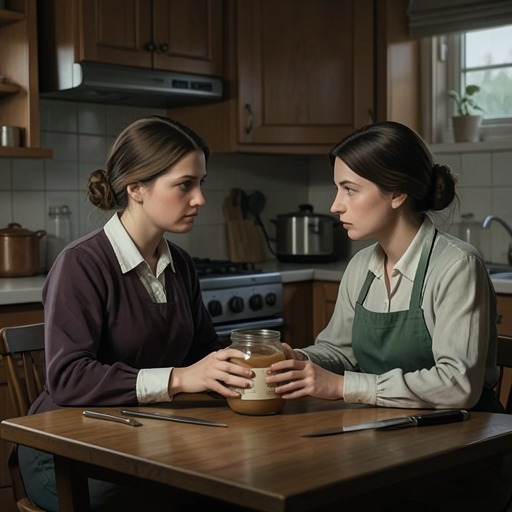
When Eva’s illness worsens, Delphine’s care becomes medical as well as domestic. Doctor Heech teaches her to prepare Magendie’s solution fresh, sterilize the hypodermic needle, and administer morphine. Delphine hates needles, but she learns the procedure and takes pride in being able to do it well. She does not rely only on a schedule: she watches Eva’s expression for the signs that pain relief is needed, sets water to boil, retrieves the prepared vial from the icebox, and massages Eva’s sore hands while waiting. The care is both technical and attentive, requiring practical knowledge and close observation of another person.
The work also occupies time and emotional energy. As Eva becomes weaker, Delphine sees her labor through the day: she may need to lie down, fall into a deep sleep, and then wake with renewed energy to push herself onward. Delphine responds by spending more time in the house and helping with the demands of the business. Their closeness is built not only from affection but from repeated attention to what Eva can no longer manage alone. Delphine’s service does not erase the fact that Eva is ill; it makes the remaining routines possible while the illness advances.
Household labor, grief, and succession
Delphine’s work reaches beyond the sickroom. She bleaches bloody aprons, scrubs the family’s clothes, airs and presses the good suits, and starches Fidelis’s shirts, preparing one for him each morning as Eva once did. The laundry is a full-time task in its own right. Delphine understands it as a farewell gift, because she expects to leave when Eva dies; remaining in her former position without Eva seems impossible to her. Her labor therefore carries both continuity and an approaching break: she reproduces Eva’s routine while knowing she may not remain to inherit its place.
The question of succession is also a question of who will perform the work. Tante sees caring for Fidelis and the boys as a chance to take over the household, and her comment to Delphine about whether Fidelis pays extra for caring for Eva exposes how easily that labor can be treated as a service owed or bought rather than as a relationship. Delphine’s work, by contrast, has grown from friendship and love, but that does not make it effortless or remove the need to decide whether she will continue it.
After Eva’s death, Delphine considers a more regular job as a telephone operator, attracted by fixed hours, routine, and the prospect of better pay. She ultimately negotiates her own terms for returning to the Waldvogel household and shop: she will arrive at eight each morning, work the busy hours, prepare lunch and dinner, and stay until six. By stating the hours and securing Fidelis’s agreement, she makes the conditions of her labor explicit. Care is not presented as an automatic extension of womanhood; Delphine chooses the work, but she also sets a boundary around it.
Care for children and the making of family
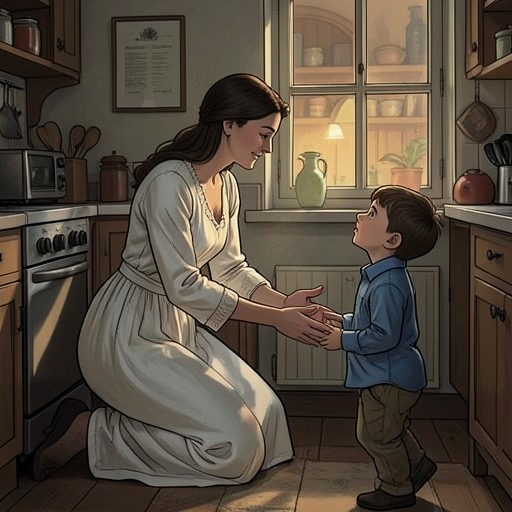
Delphine’s responsibilities expand when Markus comes to her after leaving Tante. She tells him he can stay until his father returns, and makes clear that he need not explain why he left unless he wants to. The offer gives him immediate shelter without demanding disclosure as its price. Her care takes familiar domestic forms—food, clothes, a place to sleep—but also includes a deliberate effort to let the child speak at his own pace. The relationship is shaped by trust: Markus has come to her, and she recognizes his choice as a bond she intends to protect.
That care becomes a routine of vigilance. When the family is grieving, the boys suffer accidents and illnesses, and Delphine nurses them through nights, sleeps at the foot of their beds, makes chicken soup, and checks for lice. Even when they appear healthy, she counts exactly ten breaths from each boy before leaving their room. The ritual reveals how care can steady a household while also becoming a source of anxiety: she has difficulty switching off the responsibility once she has taken it on.
The threatened departure of the boys for Germany makes that responsibility a matter of family authority. Tante persuades Fidelis to let her take them, apart from Franz, who is nearly finished with school. The proposed arrangement is justified as temporary and practical: the boys will be with their grandmother, and the shop may flourish without the demands of their care. But Delphine sees the emotional cost behind the plan. When Markus leans against her and cannot find words to say he does not want to go, she decides not to let him leave. Her response grows out of the history of care between them, not merely a claim to household convenience.
Business, scarcity, and public value
Eva’s instruction allows Delphine to carry care into the economic life of the butcher shop. She learns the practical methods and habits Eva accumulated through trial and error, then puts them to work in her own way. She enjoys selling the shop’s food and takes seriously the promise that its products are of the best quality. Her commercial judgment includes knowing what will sell, when to lower a price, and how to trade with farms; she introduces a weekly drawing for a dollar’s worth of groceries and stocks goods that invite customers into the store.
This management matters because many customers are poor. Delphine can draw money from wealthier buyers while trading carefully with those who cannot afford meat. She stocks dried beans and peas, adds goods such as oats, vinegar, oil, and mustard, and installs a dairy case for milk, cream, butter, and eggs. Her work links the shop’s survival to the neighborhood’s access to food. Care here is not confined to the family: it includes judging prices, negotiating supply, and adapting the business to different customers’ means.
The war changes the terms of that work. Orders increase, including requests from Jewish synagogues in Minneapolis for custom kosher work, while shortages make ordinary stocking more difficult. Gasoline is scarce even with a coveted C sticker for the delivery truck; coffee disappears, butter is requisitioned, and the distributor’s canned goods become lower grade or unavailable. Delphine sells margarine colored with yellow dye and sends Markus books when he writes from military service that powdered eggs are a staple and he is bored. She argues over rationing, bargains with suppliers, and creates advertisements to keep customers engaged. The pressure of public events enters the home and shop as a change in what can be bought, delivered, cooked, and sent to a child away from home.
The costs and meaning of care
Delphine’s work gives her a respected place in Argus. Through managing the store, keeping accounts, and following a daily schedule, she becomes one of the town’s stable and trusted women. People seek her advice, repeat her solutions, and value her judgment about inexpensive cuts of meat and household money. Yet this public recognition does not eliminate the private cost. She works long hours and tries to exhaust herself; after Markus leaves, she wakes at four in the morning with thoughts she cannot quiet. Practical competence can produce authority, but it does not protect her from grief or make care endlessly renewable.
The pattern reaches into marriage as well. Fidelis’s war-time frostbite leaves him with recurring cramps and numbness in his toes. Delphine washes, rubs, and salts his feet, trims his nails, and puts woolen socks on him. The scene reverses the familiar image of the butcher’s command over animal bodies: his own feet are vulnerable, and care requires her hands, time, and knowledge. It is an intimate task that embarrasses him slightly, but he accepts it and thanks her.
Across these episodes, women’s care work creates order without being reducible to obedience or self-sacrifice. Eva’s routines equip Delphine with knowledge; Delphine transforms that knowledge into paid work, nursing, child care, and decisions about who belongs in the household. She can give care, refuse an arrangement, negotiate hours, and defend a bond with Markus. The novel’s domestic stability is therefore made, not natural: it depends on labor, judgment, and relationships, and it remains vulnerable to illness, scarcity, grief, and the unequal expectation that a woman will keep everything going.