butchery as an art
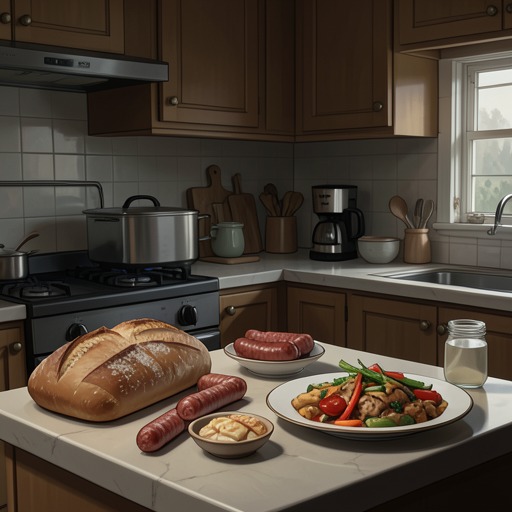
The Master Butchers Singing ClubButchery as an art is a learned discipline in which skill lies not only in the final product but in attention to every step: choosing materials, maintaining tools, judging the work, and knowing how one action leads to another. For Fidelis Waldvogel, it is an inheritance from his father and a way of organizing daily life. The novel sets this deliberate craft against the uniformity of machine-made food, while showing that mastery carries both economic value and a demanding burden of labor.
Inherited Knowledge and Professional Training
The novel presents butchery as a profession acquired through painstaking study from a young age. Mastery requires command of spices, the preparation of hundreds of varieties of sausage, and an intuitive understanding of how a knife should follow an animal’s form. Fidelis’s father embodies this expertise: his hands seem barely to move as the animal is reduced to orderly, familiar shapes. In Fidelis’s perception, this process does not simply divide meat; it changes its form into something more ordered and satisfactory.
The craft is passed on as both practical knowledge and a standard of quality. On the eve of Fidelis’s departure, his father gives him the family’s sausage-making rule: “There is no ingredient too humble. Use the finest of everything.” The advice is simple, but its application is exacting. Salt matters; garlic must be fresh rather than dried; the meat and sheep casings must be clean and exceptionally fresh. The principle makes quality a matter of attention to every ingredient, including those that might otherwise be treated as incidental.
Tools, Routine, and Precision
In America, Fidelis preserves the discipline of the trade through a daily knife ritual. After breakfast, he removes his German knives from their slotted wooden block, arranges them on flannel, and checks each for rust. He decides which need only the sharpening steel and which require the stones. The ritual is a form of judgment: the goal is not maximal sharpness at any cost, but an edge suited to the work.
Fidelis is conservative with his tools. He avoids oversharpening and wasting steel, yet knows that a dull blade can mash meat fibers and slip in the hand. When a knife needs more attention, he lays out six stones, beginning with a coarse black stone and moving through progressively finer ones. The final stone is as fine as paper; afterward, the blade can split an eyelash. The sequence gives the craft a visible measure of precision, while the daily repetition shows that mastery depends on maintenance as much as on inherited aptitude.
Work, Quality, and Livelihood
Fidelis finds work with Pete Kozka and also takes jobs in nearby towns, including custom butchering at farms when someone comes to fetch him. He brings his father’s sausage-making talent and recipes into the Kozkas’ business, helping increase its trade. For his first batch of Swedish sausages for Scandinavian customers, he seeks out the finest local potatoes rather than using whatever is readily available. The result draws customers on Thursdays, when they gather to buy the links hot from the kettle, even before smoking. The detail connects a family principle of care to the practical success of a small business.
That success does not initially mean comfort for Fidelis. He lives sparingly, eating sausage ends, bruised fruit, stale cookies, and questionable trimmings while making his own beer and washing his shirts and aprons. He saves toward a larger place, then combines his savings with financial help from his parents to bring Eva Waldvogel to America. Craft is therefore not only a matter of skill or pride: it is labor that supports a household and makes migration and family life possible.
The contrast with American sliced bread sharpens the novel’s account of craft. Shortly after marrying Eva, Fidelis sees a perfectly square, white slice in the public square of Ludwigsruhe. At first he mistakes it for a picture; he then learns it is bread made and sliced by machine, sent from distant relatives as an example of a commonplace food transformed by invention. Its precise shape prompts him to consider whether everyday American bakers might also make such bread. The episode places mechanized uniformity beside a family tradition that measures quality through the judgment and care invested in each ingredient and process.
Different Relationships to the Trade
The work does not mean the same thing to everyone in the butcher shop. Delphine Watzka is willing to sell groceries and cut headcheese, but she dislikes the killing and the lengthy work that follows. Sausage casings must be washed repeatedly; other preparations require patient, meticulous handling. She questions some of the steps, whereas Eva insists they matter. Delphine can imagine enjoying the mixing of spices into ground meat, but that part belongs to Fidelis, who guards his procedures and broods over each batch like an alchemist. The shop’s craft is thus shared labor, but not shared equally: expertise confers authority over its most protected stages, while other workers experience its repetition and demands.
A brief encounter over lard echoes the same attention to distinctions. Delphine urges a customer to try one kind, explaining that the cracklings should settle before the fat is poured off and that the product is cheap. Her insistence that there is lard and then there is lard makes judgment itself part of the shop’s everyday vocabulary. The principle of careful selection extends beyond Fidelis’s celebrated sausages into ordinary advice about cooking and saving.
Food, Memory, and Meaning
Food made with care also carries memory and connection. Later, Fidelis eats baked beans whose molasses, powdered mustard, and smoked pork recall a combination he has not tasted since childhood. He eats slowly, with reverence and shame, and wipes his plate with soft, square bread. The meal links taste to childhood and to Delphine in his thoughts; food here is not merely a product of technique but a means by which earlier attachments return.
A prewar sandwich offers another image of abundance and shared appreciation: fresh, heavy country bread, sweet butter, generously cut smoked and cured ham, and crisp dill pickles. Fidelis and his companion eat with slow gratitude. Set beside his early subsistence on scraps, the carefully assembled meal makes the value of good ingredients concrete. Across these scenes, butchery as an art signifies more than technical excellence. It is a way of attending to materials and feeding others, yet the novel does not romanticize it as effortless: its standards require disciplined repetition, and its labor can be unpleasant or contested even within the family business.