Execution Posts
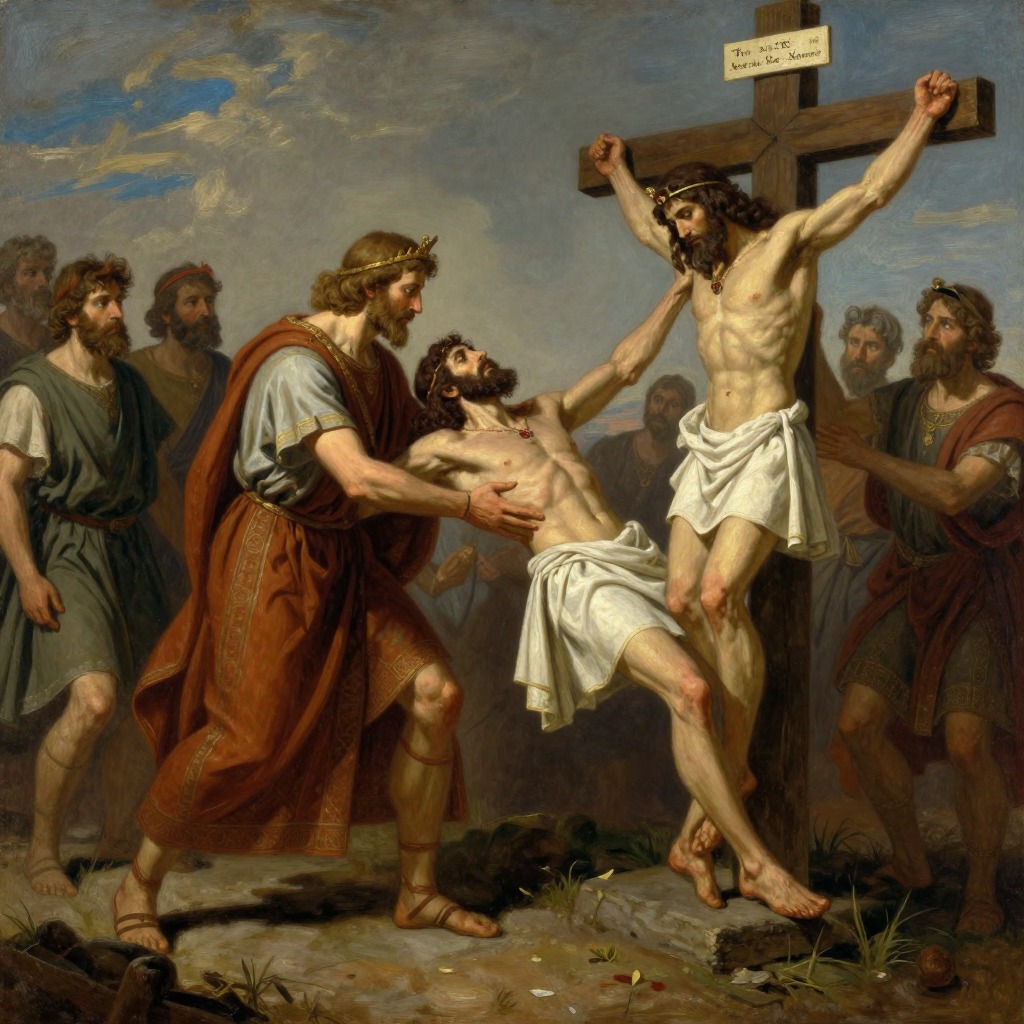
The Master and MargaritaThe execution posts on Bald Mountain are the stark, physical instruments of Roman imperial power and the site of the novel's most harrowing scene of state-sanctioned violence. Hewn from fresh wood and carried to the hilltop on carts alongside shovels, ropes, and axes, these posts with their crosspieces are the apparatus of a shameful execution by hanging, the method chosen by Pontius Pilate to carry out the death sentence he confirmed for Yeshua Ha-Nozri, Dysmas, and Gestas. They are not merely objects but the focal point of a meticulously organized display of terror, surrounded by a double cordon of Roman infantry and cavalry, designed to cow the population of Yershalaim during the Passover feast.
Construction and Arrival at Bald Mountain
The posts are first mentioned as part of the execution convoy that leaves Yershalaim around noon. They are loaded onto carts, along with the other necessary tools, and transported to Bald Mountain, a hill outside the city. The procession, which includes the condemned men, the centurion Mark Ratslayer, the chief of the temple guard, and a mysterious hooded man, makes its way under the scorching sun. The posts are unloaded from the carts at the summit, where they are then erected. The condemned men are bound to them with ropes, their arms stretched out and tied to the crossbars in three places, a detail that underscores the brutal, inescapable nature of the punishment.
The Crucifixion and Suffering
The posts become the locus of prolonged, public suffering. Yeshua, Dysmas, and Gestas hang on them for hours under the relentless sun, tormented by flies and horseflies. Yeshua, who loses consciousness early, is covered by a black swarming mass of insects. The centurion Ratslayer paces near the posts, indifferent to the heat, while the hooded man sits on a three-legged stool, poking the sand with a twig. The execution itself is a clinical, ritualized act: an executioner raises a spear, taps Yeshua's arms, and then, with a sponge soaked in water on the spear's tip, offers him a drink before delivering the final, merciful blow to the heart, whispering, "Praise the magnanimous hegemon!" The same procedure is repeated for Dysmas and Gestas, their bodies slumping as the ropes allow.
Matthew Levi's Vigil and the Aftermath
The posts are the object of Matthew Levi's agonized vigil. From a crevice on the north side of the hill, he watches, clutching a stolen bread knife, hoping to stab Yeshua to spare him further torment. His plan fails, and he can only curse God and demand a miracle. After the execution, when the storm breaks and the soldiers flee, Levi is the only one left on the hill. He cuts the ropes binding Yeshua's body, which collapses onto him, and then frees the other two bodies. The posts remain standing, empty, as water beats down on the bodies and rolls them over. The posts are thus not just instruments of death but also the silent witnesses to Levi's despair and the final, physical link between the executed and the living who mourn them.
Symbolic and Narrative Significance
The execution posts are a central symbol of the novel's critique of cowardice and state power. They are the direct consequence of Pilate's failure to act on his conviction of Yeshua's innocence, a failure that condemns him to two thousand years of anguished immortality. The posts represent the brutal, physical reality of the "authority" that Yeshua condemned as "violence over people." They are the antithesis of the "kingdom of truth and justice" he preached. In the novel's structure, the posts connect the ancient Yershalaim narrative to the contemporary Moscow story, where similar acts of cowardice and state-sanctioned persecution occur, albeit in a more absurd, theatrical form. The master's novel about Pontius Pilate, which he burns in a fit of fear, is a direct literary engagement with this same scene of execution, making the posts a recurring motif that links the historical and contemporary plots.