Griboedov's
The Master and MargaritaGriboedov's, officially known as the House of Griboedov, is the headquarters of the Massolit literary association in Moscow and the site of its legendary restaurant, serving as a central hub for the novel's satire of Soviet literary bureaucracy and the hedonistic, corrupt world of the official writers' elite.
Identity and Setting
The old, two-storeyed, cream-coloured house stands on the ring boulevard, in the depths of a seedy garden separated from the sidewalk by a fancy cast-iron fence. It is called 'The House of Griboedov' on the grounds that it was alleged to have once belonged to an aunt of the writer Alexander Sergeevich Griboedov, though the narrator notes that Griboedov never had any such house-owning aunt. The house is owned by Massolit, the literary association headed by Mikhail Alexandrovich Berlioz before his death. Members casually refer to it simply as 'Griboedov's'. The building contains administrative offices on the upper floor, including the 'Fishing and Vacation Section', 'One-day Creative Trips', 'Perelygino' (the writers' country colony), and the 'Housing Question' office, all satirizing the perks and preoccupations of the Soviet literary establishment. The ground floor is occupied by a restaurant, justly considered the best in Moscow, with two vast halls with arched ceilings painted with violet, Assyrian-maned horses, and tables with lamps shaded with shawls. The restaurant is not accessible to just anybody coming in off the street, and its fare is available at the most reasonable, by no means onerous, price.
The Restaurant and Its Clientele
The restaurant is a place of conspicuous consumption and gossip, where members like the ruddy-lipped, golden-haired poet Amvrosy and the skinny, run-down Foka discuss the quality of the perch au naturel and the sterlet in a silvery chafing dish. The narrator rhapsodizes about the menu: sterlet slices interlaced with crayfish tails and fresh caviar, eggs en cocotte with mushroom puree, fillets of thrush with truffles, quail a la genoise, and the seasonal snipe, great snipe, jack snipe, woodcock, quail, and curlew. The service is courteous, and a jazz band plays. The restaurant is a symbol of the privileged life of Massolit members, a stark contrast to the privations of ordinary Soviet citizens.
The Night of Berlioz's Death
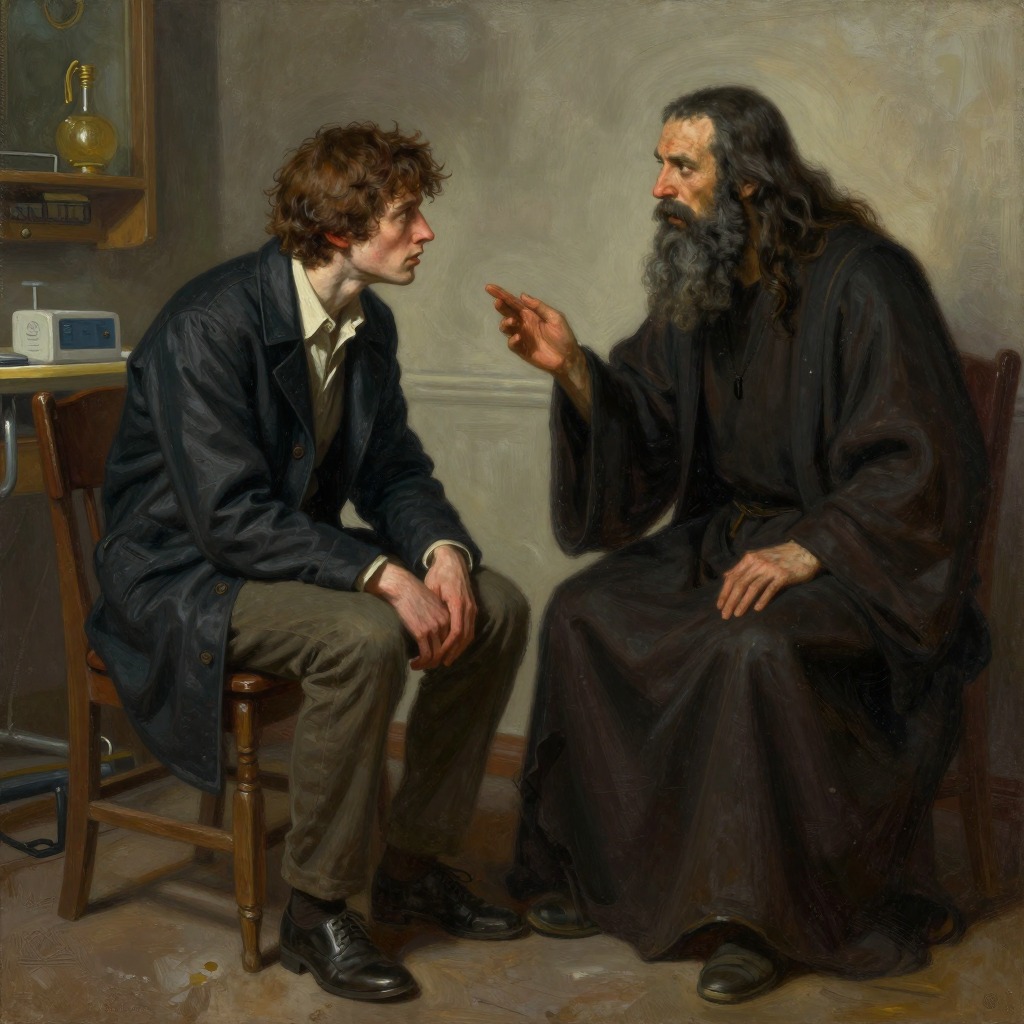
On the evening of Berlioz's death, twelve writers languish in the executive board office upstairs, waiting for him to chair a meeting. They suffer from the heat, are thirsty, and are nervous and angry. They discuss the coveted dachas at Perelygino, with the belletrist Beskudnikov, the poet Dvubratsky, the writer Nastasya Lukinishna Nepremenova (under the pen-name Bos'n George), the novelist leronym Poprikhin, the critic Ababkov, the scenarist Glukharev, and others. At midnight, they descend to the restaurant, where the jazz band strikes up and the hall breaks into dance. The news of Berlioz's death arrives, causing a wave of grief that soon subsides as members return to their tables to drink and eat. The restaurant's usual nocturnal life continues until an extraordinary occurrence: the poet Ivan Homeless, barefoot, in a torn Tolstoy blouse with a paper icon pinned to his chest, and carrying a lighted wedding candle, enters the veranda. He announces that a consultant has killed Berlioz and demands that the professor be caught. A scuffle ensues, and Ivan is eventually subdued, tied up with napkins, and taken away by a truck to a psychiatric clinic. The doorman, Pantelei, a policeman, a waiter, and the poet Riukhin carry him out. The scandal is described as nasty, vile, tempting, and swinish.
Narrative and Thematic Significance
Griboedov's functions as a microcosm of the corrupt and self-serving Soviet literary world that Bulgakov satirizes. It is the place where the master's novel about Pontius Pilate is rejected by editors who ask idiotic questions and where critics like Latunsky, Ariman, and Mstislav Lavrovich later publish venomous articles attacking him. The restaurant's atmosphere of gluttony and frivolity contrasts sharply with the spiritual and artistic freedom represented by the master and Margarita. The building's name, falsely attributed to a literary giant, underscores the theme of false authority and the hollow pretensions of the literary establishment. The chaos that erupts there after Berlioz's death and Ivan's intrusion foreshadows the broader disruption that Woland's presence will cause in Moscow.