Joseph Kaifa
The Master and MargaritaJoseph Kaifa, the High Priest of the Sanhedrin, stands as the implacable religious authority in the Yershalaim narrative, a figure whose political cunning and theological rigidity directly lead to the execution of Yeshua Ha-Nozri. As the president of the Sanhedrin, he is the primary interlocutor of Pontius Pilate during the trial, and his refusal to grant clemency to Yeshua in favor of the rebel Bar-Rabban exposes the brutal calculus of power that governs the city during the Passover feast. Kaifa is not merely a functionary but a formidable antagonist who understands the stakes of the confrontation with Rome and uses his position to protect the Jewish faith from what he perceives as a dangerous seducer of the people.
Identity and Authority
Kaifa is introduced as the man fulfilling the duties of president of the Sanhedrin, the high priest of the Jews. He is described as having a black beard and dark eyes that glint with defiance. His authority is both spiritual and political, rooted in the temple of Yershalaim and the ancient laws of the Jewish people. When Pilate invites him onto the balcony to shelter from the heat, Kaifa politely refuses, explaining that he cannot do so on the eve of the feast, a gesture that underscores his strict adherence to religious custom. This refusal also establishes the formal, adversarial tone of their subsequent conversation. Kaifa's power is further emphasized by his control over the temple guard and his ability to sway the crowd that has gathered in the square, a crowd that he knows will demand the release of Bar-Rabban.
The Confrontation with Pilate
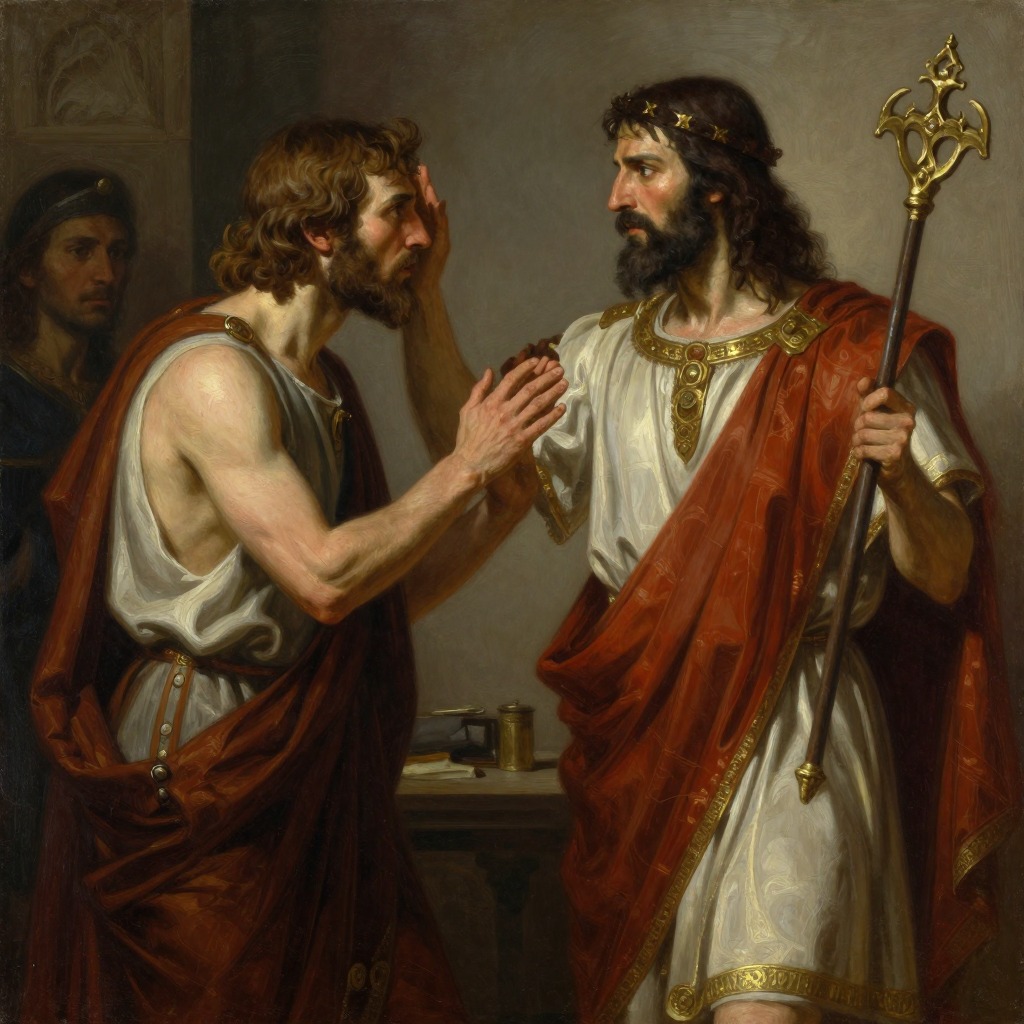
The central scene involving Kaifa is his tense, Greek-language dialogue with Pontius Pilate on the upper terrace of the palace garden. Pilate, having confirmed the death sentence on Yeshua, attempts to persuade the High Priest to choose Yeshua for the traditional Passover amnesty, arguing that Bar-Rabban is a far more dangerous criminal who incited rebellion and killed a guard. Kaifa, however, remains unmoved. He replies in a quiet but firm voice that the Sanhedrin has thoroughly familiarized itself with the case and intends to free Bar-Rabban. When Pilate presses him a third time, invoking his own authority as the representative of Rome, Kaifa repeats his decision with unwavering resolve. This refusal is not a simple act of stubbornness; it is a calculated political move. Kaifa sees Yeshua not as a harmless philosopher but as a seducer of the people whose preaching threatens to outrage the faith and bring Roman swords down upon the nation. He accuses Pilate of wanting to release Yeshua so that he can disturb the people, and he declares that as long as he lives, he will not allow the faith to be outraged.
The Exchange of Threats
The confrontation escalates into a direct exchange of threats. Pilate, feeling the impotence of his position, warns Kaifa that he will send a message directly to the emperor Tiberius on Capreae, accusing the High Priest of sheltering known criminals. He threatens to bring the entire Fulminata legion and the Arabian cavalry to Yershalaim, promising bitter weeping and wailing. Kaifa, however, is not intimidated. He responds with equal ferocity, accusing Pilate of hating the Jewish people with a cruel hatred and asserting that God and the almighty Caesar will protect them from the destroyer. This exchange reveals the deep-seated animosity between the two leaders, each representing a different form of absolute power: the imperial might of Rome and the theocratic authority of the Jewish temple. Kaifa's final, menacing gesture—raising his arm and pointing to the temple—underscores his belief that he is the true guardian of the people, even against the Roman procurator.
Role in the Execution
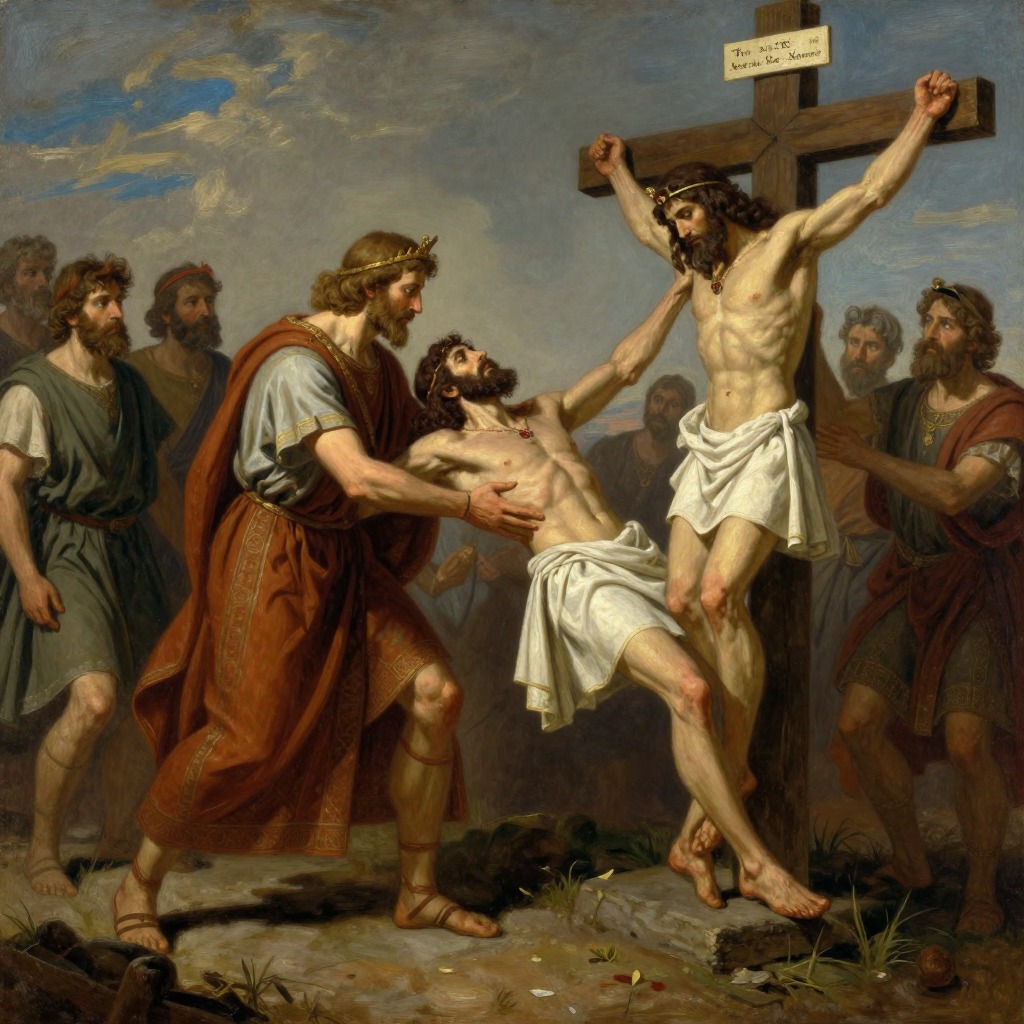
Kaifa's role does not end with the verbal confrontation. He is present at the subsequent conference on the garden terrace, where Pilate officially confirms the death sentence and asks the Sanhedrin to choose the criminal to be freed. Kaifa, as the head of the Sanhedrin, formally delivers the answer: Bar-Rabban. This act seals Yeshua's fate. Later, during the execution itself, the head of the temple guard, who is under Kaifa's authority, is present on Bald Mountain, standing alongside the Roman tribune and the man in the hood. This detail confirms that Kaifa's authority extends to the very site of the crucifixion, making him a direct participant in the judicial murder. His presence, even through a subordinate, ensures that the sentence of the Sanhedrin is carried out to the letter.
Thematic Significance
Kaifa embodies the theme of institutional power that is blind to truth and mercy. He is the antithesis of Yeshua's message of universal goodness and the kingdom of truth. Where Yeshua sees no evil people, Kaifa sees a dangerous heretic who must be eliminated to preserve the social and religious order. His character illustrates how religious authority, when fused with political calculation, can become a tool of oppression. The conflict between Pilate and Kaifa is not merely a personal dispute; it is a clash between two forms of worldly power—the cynical, pragmatic power of Rome and the rigid, dogmatic power of the temple—both of which are shown to be equally capable of destroying an innocent man. Kaifa's victory in securing the death of Yeshua is a hollow one, as it sets in motion the very cycle of suffering and guilt that will haunt Pilate for two millennia. His name, linked to the historical high priest who presided over the trial of Jesus, anchors the novel's fantastical events in a recognizable historical and theological framework, making the story of cowardice and injustice feel both ancient and urgently contemporary.