Stravinsky's Clinic
The Master and MargaritaStravinsky's Clinic is the psychiatric institution on the outskirts of Moscow where the poet Ivan Homeless is confined after his encounter with Woland at the Patriarch's Ponds, and where he meets the master. It functions as a space of diagnosis, confinement, and unexpected revelation, where the boundary between sanity and madness is tested and where the novel's two narrative threads—the Moscow satire and the Pilate story—converge through the conversations of its patients.
Location and Description
The clinic is a recently built, modern facility located by the bank of a river on the outskirts of Moscow. It is described as a "house of sorrow" and is equipped with advanced medical technology that the narrator compares favorably to the Metropol hotel. Ivan's room features a frosted glass cylinder that rotates to display words like "Drink," "Nurse," and "Call the Doctor" when a button is pressed. The room has a balcony with a grille, beyond which a pine wood and the river are visible. The clinic's corridors are quiet, with rubber matting, and at night, frosted white lights are replaced by faint blue night-lights. The examining room is a large space filled with gleaming nickel-plated instruments, Bunsen burners, and complex chairs, which Ivan mentally christens the "industrial kitchen." The clinic is presented as a place of scientific precision and humane care, yet it is also a place of confinement from which escape is physically possible but psychologically meaningless.
Admission and Diagnosis of Ivan Homeless
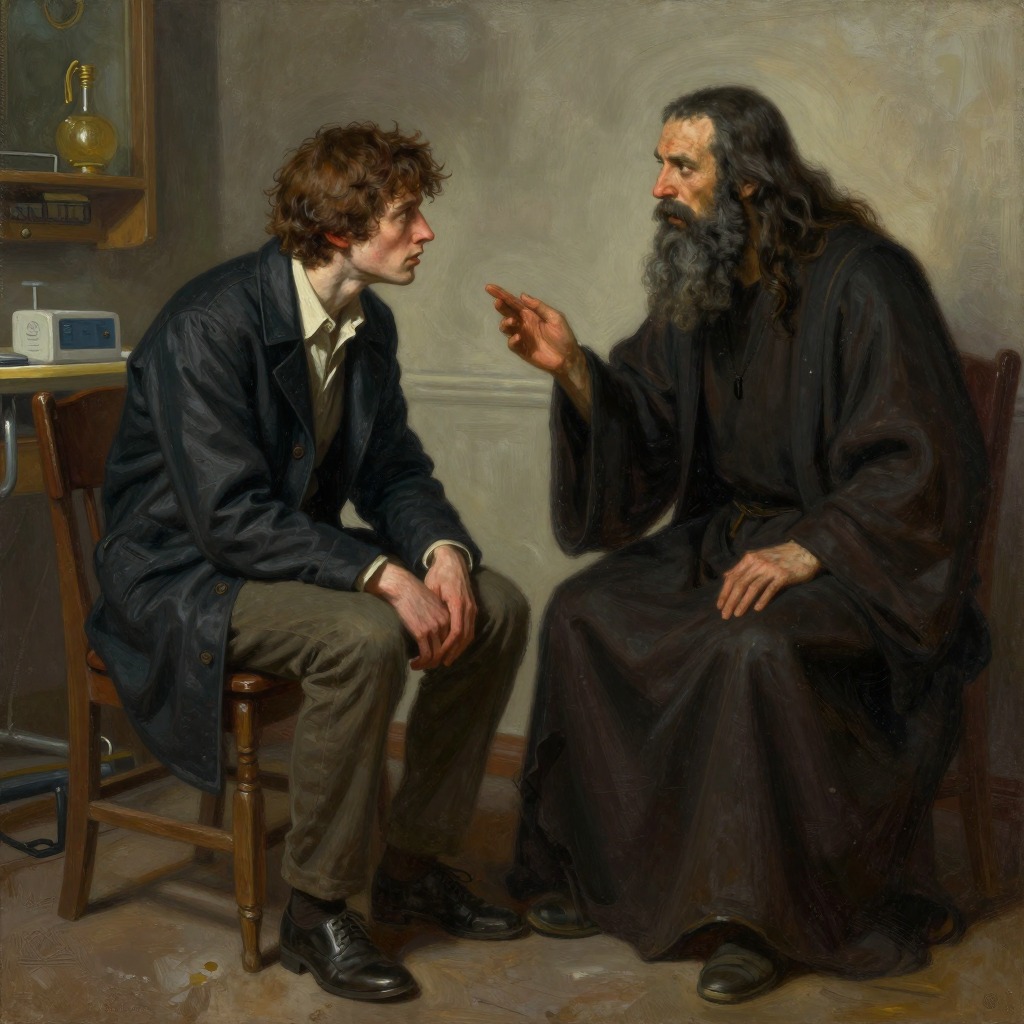
Ivan Homeless is brought to the clinic after a series of bizarre and violent actions following Berlioz's death at the Patriarch's Ponds. He arrives tied up with napkins, wearing only striped drawers, a torn Tolstoy blouse, and carrying a wedding candle and a paper icon. He is examined by the clinic's chief, Professor Stravinsky, who diagnoses him with "locomotor and speech excitation, delirious interpretations" and, after a brief conversation, concludes it is a case of schizophrenia, possibly complicated by alcoholism. Stravinsky's method is to engage Ivan in a logical dialogue, demonstrating that his plan to catch the mysterious consultant by running around the city in his underwear is futile. He persuades Ivan to stay voluntarily, promising him peace and help. Ivan is given an injection and placed in a private room, number 117, under observation. The clinic thus functions as a space where the extraordinary events of the previous night are re-framed as symptoms of mental illness, a diagnosis that the novel itself complicates.
The Master's Confinement and the Meeting of the Two Patients
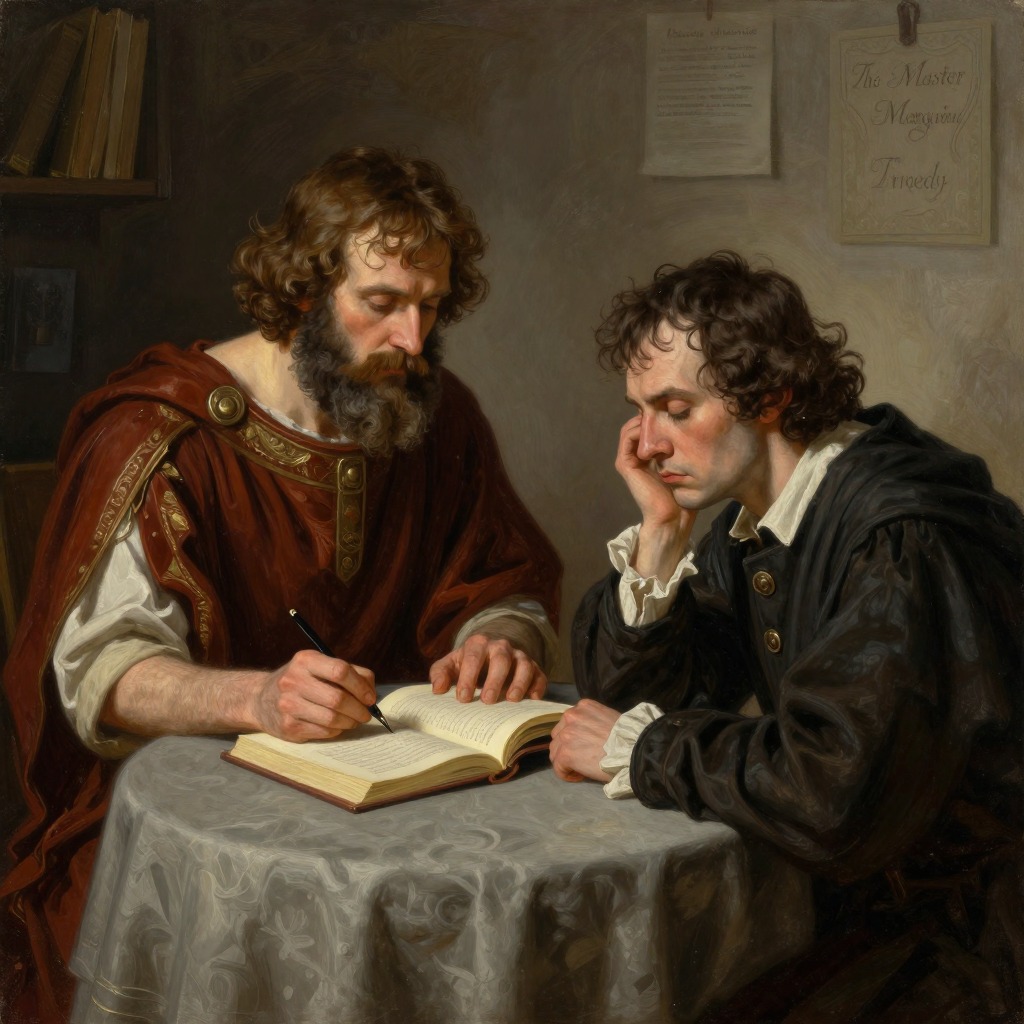
The clinic is also the home of the master, who has been a patient for four months. He has stolen a bunch of keys from the absent-minded nurse Praskovya Fyodorovna, allowing him to move along the common balcony and visit other patients. He enters Ivan's room on the night of the storm, and the two men begin a conversation that forms the emotional and thematic core of the novel. The master explains that he is in the clinic for the same reason as Ivan: "on account of Pontius Pilate." He tells Ivan the story of his novel, his love for Margarita, and his persecution by critics like Latunsky, Ariman, and Mstislav Lavrovich. The master's confinement is a direct result of his artistic and spiritual integrity, which the Soviet literary establishment could not tolerate. He describes his illness as incurable, though he admits he is much better than before. The clinic, for him, is a refuge from a world that has rejected him, a place where he can live without making "grandiose plans."
Other Patients and the Atmosphere of the Clinic
The clinic houses a variety of patients, each representing a different form of social or psychological breakdown. Nikanor Ivanovich Bosoy, the chairman of the tenants' association, is brought in after being framed for currency speculation. He has a dream in which he is forced to participate in a theatrical performance about turning over foreign currency, a dream that reflects the paranoia and absurdity of the Soviet system. Another patient, a fat man with a purple physiognomy, is placed in room 119 and keeps muttering about currency in the ventilation and swearing that unclean powers are living in his building. The master reports that a new arrival in room 120 keeps asking to be given back his head, a reference to the beheading of Berlioz and the subsequent trauma. The clinic is a place where the anxieties and terrors of Soviet life are made manifest, and where the boundary between the sane and the insane becomes increasingly blurred.
Narrative and Thematic Significance
Stravinsky's Clinic is a crucial setting in the novel, serving as a space where the Moscow and Yershalaim narratives converge. It is here that Ivan, the poet who began as a mouthpiece for state atheism, is transformed into a disciple of the master. It is here that the master's story of Pilate and Yeshua is retold and preserved. The clinic is also a symbol of the Soviet state's attempt to pathologize and contain any form of dissent or imagination. The diagnosis of schizophrenia is used to dismiss Ivan's encounter with Woland and the master's novel about Pontius Pilate. Yet the clinic also becomes a place of unexpected freedom and connection. The master and Ivan form a bond that transcends the institution's walls, and the master's story, though burned, is resurrected through Ivan's memory. The clinic, in this sense, is a paradoxical space: a house of sorrow that also offers a kind of peace, a place of confinement that allows for the most profound conversations about truth, art, and the nature of reality.