Communication breakdown
The MetamorphosisCommunication breakdown in The Metamorphosis is not simply a failure to exchange words. It is the widening gap between Gregor Samsa’s inward continuity and the meanings assigned to him by the people around him. He still understands his obligations, worries about his parents’ debt, plans to reach the train, and tries to reassure his family, but his changed voice and body prevent those intentions from becoming socially legible. Once others can no longer hear a person in his speech or recognize a family member in his appearance, every attempted explanation becomes evidence against him.
Voice, Work, and the First Misrecognition
Communication fails at the moment when Gregor’s transformation is first revealed, although Gregor initially refuses to understand it as a decisive break. He wakes to find himself transformed into a horrible vermin, with an armour-like back, a divided brown belly, and many thin legs that move helplessly. Yet his first practical responses remain those of a travelling salesman. He studies the alarm clock, calculates the missed five o’clock train and the possibility of catching the seven o’clock train, worries about his employer’s anger, and considers how suspicious a sick report would appear after fifteen years without illness. Even when he feels hungry and physically well apart from his altered condition, he interprets the strange voice as the beginning of a serious cold, an occupational hazard of travelling salesmen.
The wooden door briefly preserves the illusion that ordinary communication is still possible. When his mother calls that it is quarter to seven, Gregor answers that he is getting up. He wants to give a full explanation, but his voice contains a painful, uncontrollable squeaking and an echo that makes the words unclear to the listener. His mother accepts the response because she cannot hear what Gregor himself hears: he experiences his speech as meaningful, while the person outside receives only an uncertain and disturbing sound. His father and Grete then call from separate doors, and Gregor carefully enunciates each word, inserting long pauses in an effort to remove the strangeness from his voice. The effort produces no shared understanding. The family hears delay and evasion; Gregor believes he has answered them.
The Chief Clerk converts this uncertainty into an accusation. Speaking for Gregor’s parents and employer, he condemns the locked room, the brief answers, and Gregor’s failure to carry out his business duties. He even raises the possibility that money recently entrusted to Gregor might explain his absence and complains that his turnover has become unsatisfactory. Gregor responds with a flood of assurances: he claims to be slightly unwell, promises to open the door, insists that he will take the eight o’clock train, and asks the Chief Clerk to recommend him to the boss. His speech is an attempt to restore his professional identity by explaining circumstances and promising immediate compliance, but its urgency only intensifies the confusion. The Chief Clerk asks Gregor’s parents whether they understood a word and declares that what they heard was the voice of an animal. A medical emergency, a workplace failure, and a possible breach of trust have become indistinguishable because no one can receive Gregor’s account on its own terms.
Doors, Bodies, and the Limits of Explanation
The locked doors make communication spatial as well as vocal. Gregor has acquired the travelling habit of locking every door at night, even when at home, and congratulates himself on that caution when his family begins knocking. The habit once signified privacy and security; after the transformation, it turns his room into a site of suspicion and inspection. His family and the Chief Clerk stand outside, demanding access, while Gregor remains inside trying to make his body obey him. He wants to get dressed, eat breakfast, and think clearly before deciding what to do, but his many legs cannot be coordinated, his body is exceptionally broad, and an attempt to move out of bed ends with his lower body striking the bedpost and revealing its painful sensitivity.
Gregor’s physical condition makes explanation increasingly impossible. He struggles up against the chest of drawers, slides down its smooth surface, finally stands upright, and supports himself against a chair while listening. His objective remains communicative: he genuinely wants to open the door and let the others see him. He imagines that if they are shocked, the responsibility will no longer be his, while if they remain calm he will have no reason to be upset. This hope rests on the belief that sight will correct the misunderstanding created by sound. Instead, opening the door exposes a body that overwhelms every verbal intention. The Chief Clerk retreats, Gregor’s mother screams, and the family calls for a doctor and a locksmith. Their actions answer an appearance they cannot reconcile with the person whose words Gregor still believes he has spoken.
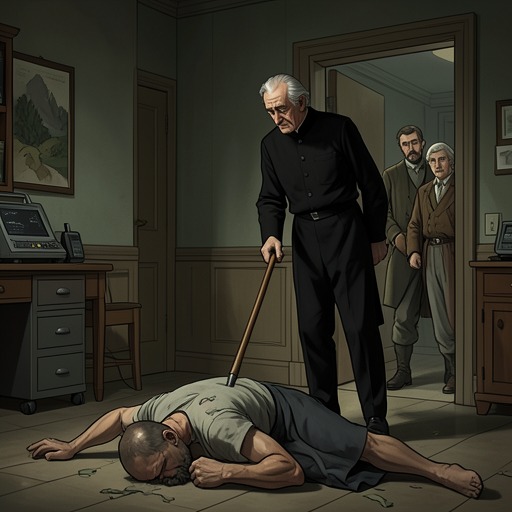
The expulsion from the doorway seals the failure of dialogue. Gregor tries to move back into his room and shows, through his position against the door, that he intends no violence and will withdraw without being forced. His father does not read this gesture as an appeal or a promise. He drives Gregor forward with a stick and shoves him through the doorway after Gregor’s flank scrapes against the white door, leaving him stuck, injured, and bleeding. The door is slammed shut. A bodily movement that Gregor understands as peaceful retreat is treated as a problem requiring force, and the family’s response makes his room not merely a private space but a confinement imposed through misinterpretation.
Care Without Shared Language
After the first attack, the family’s care is mediated by objects and observation rather than conversation. When Gregor wakes in the darkness, moving painfully with an injured leg and a stretched scar along his left side, he is drawn to a dish of sweetened milk with pieces of white bread. Grete has left it because milk had been his favourite drink, an act of care based on memory and an effort to preserve continuity with the brother she knew. But his appetite has changed: the milk now tastes unpleasant, and the pain in his side makes eating difficult. The failed offering shows that even affectionate knowledge can no longer guarantee understanding. Grete remembers Gregor’s former preference, but she cannot know his altered bodily experience, and Gregor cannot tell her directly what he needs.
For the first fourteen days, Gregor’s parents cannot enter his room. They wait outside while Grete cleans, asks what he has eaten, how he has behaved, and whether there has been any slight improvement. The family therefore constructs knowledge of Gregor through reports and signs. His mother wants to see her unfortunate son, but his father and sister initially restrain her; when she insists, she must be held back by force. Gregor listens closely and approves of the arrangement, believing that his mother might understand him better than Grete, who is courageous but still a child facing an adult burden. His hope is not that speech will be restored immediately, but that a different witness might recognize the person behind the altered body.
Gregor also tries to communicate consideration through concealment. Grete finds him staring motionless from the window and closes the door rather than entering, making clear that his appearance remains unbearable to her. Gregor hides under the couch and later spends four hours carrying a bedsheet on his back so that he will be completely covered. He leaves Grete free to remove the sheet if she does not think it necessary, and when she leaves it in place he imagines that he glimpses gratitude. The sheet becomes a silent negotiated language: Gregor sacrifices visibility to reduce her distress, while Grete’s decision not to remove it acknowledges, however incompletely, the boundary he is trying to create.
From Misheard Person to Unintelligible Animal
The family’s interpretations harden as the transformation continues. When Gregor’s mother sees him on the wall, she screams before recognizing him and collapses onto the couch. Grete addresses him directly for the first time since the transformation, shouting his name while accusing him through gesture rather than conversation. Gregor tries to help by following Grete to fetch smelling salts, as he would have advised his sister in the past, but his presence frightens her; a bottle breaks, a splinter cuts his face, and caustic medicine splashes over him. His wish to assist is received as another intrusion. Unable to explain, he crawls over the walls, furniture, and ceiling until confusion makes the room spin and he falls onto the dinner table.
His father then interprets Grete’s incomplete report as evidence of violence. Grete says that their mother has fainted and that Gregor has got out, but her father assumes that something bad has happened and that Gregor is responsible. Gregor rushes to his bedroom door, hoping his father will see that he intends to return peacefully. The gesture again fails. His father enters in anger and drives him back, while Grete throws herself around her father and begs him to spare Gregor’s life. The family’s communication has become triangular: Gregor cannot reach his mother or sister directly, Grete speaks through her fear and alliances, and the father responds to the family’s alarm with physical authority.
The apple lodged in Gregor’s flesh remains for more than a month as a visible reminder of this violence. It injures him so severely that he loses much of his mobility, perhaps permanently, and is reduced to the condition of an ancient invalid. The wound briefly interrupts the family’s total rejection: his father is reminded that Gregor, despite his revolting form, is still a family member who cannot simply be treated as an enemy. Yet the reminder is bodily rather than verbal. Gregor’s continued vulnerability communicates a claim to patience that no spoken appeal can establish, and the family’s duty to tolerate him is framed as an obligation to overcome revulsion rather than as recognition of an ongoing conversation.
The Final Denial of Gregor’s Identity
The family’s evening routine reveals both the persistence and the erosion of communication. The living-room door is left open, allowing Gregor to watch his family in the light of the dinner table and listen to their conversations. He no longer participates in lively exchanges; his father sleeps in his chair, his mother sews fancy underwear for a fashion shop, and Grete studies shorthand and French after taking a sales job. The household has reorganized itself around work and exhaustion. Gregor can still witness their lives, but witnessing is not participation. The open door grants him sight while preserving his exclusion from speech.
The decisive rupture comes when Grete tells her parents that they cannot continue living with the creature. She says that she does not want to call it her brother, that they have done everything humanly possible to look after it, and that they must get rid of it. Her argument depends on a severing of identity: if the creature were Gregor, she reasons, he would understand that human beings cannot live with an animal and would leave of his own free will. Gregor’s inability to answer becomes proof that he is not Gregor. The very condition that prevents him from defending his identity is used to establish that no identity remains to defend.
Gregor’s father repeats that an arrangement might be possible if Gregor could understand them, while Grete vigorously indicates that this is impossible. The phrase identifies communication as the last conceivable basis for coexistence: without a shared language, negotiation, family recognition, and moral obligation all collapse together. Grete then claims that the creature has driven out the tenants and threatens to take over the flat, transforming Gregor’s presence from a family crisis into an economic and domestic danger. When Gregor begins to turn back toward his room, intending only to withdraw, the family again reads the difficult movement as frightening. His good intention survives internally but cannot cross the gap between perception and meaning.
Death, Naming, and the Return of Ordinary Life
After Gregor dies, communication no longer needs to contend with his voice or intentions. The Charwoman announces his death bluntly and proves it by pushing his body with the broom. Mr. and Mrs. Samsa initially need to overcome the shock before grasping her meaning, but Mr. Samsa then gives thanks to God, and the women cross themselves. Grete looks at the corpse and observes that Gregor has become thin because he had eaten nothing for so long; the dried, flat body supplies a final physical explanation of his decline. In death, his condition becomes legible through visible evidence, but the family’s recognition is directed toward the corpse as an object rather than toward Gregor as a speaking subject.
The three lodgers also encounter the body without entering any meaningful relation to Gregor. They emerge asking about breakfast, are shown the corpse, and stand around it with their hands in the pockets of their worn coats. Their immediate concern shifts toward the practical disturbance of the household, just as the Chief Clerk’s first response to Gregor’s absence had been professional suspicion. The language surrounding Gregor changes from the family member who once financed the household to an unwanted thing that must be removed, and finally to a dead body whose disposal is already considered settled.
The family’s renewed communication begins only after Gregor can no longer answer. Mr. Samsa threatens to dismiss the Charwoman, then calls his wife and daughter to him, asking them to forget the old trouble and give him attention. They kiss and embrace him, finish their letters of excuse, and leave the flat together for the first time in months. On the tram to the open country, they discuss their work and prospects, consider moving to a smaller and cheaper flat, and notice Grete’s physical vitality. Their restored conversation and shared future depend on the removal of the person whose failed communication had made every household exchange tense and uncertain. The ending therefore makes communication breakdown both a symptom of Gregor’s exclusion and the mechanism by which the family learns to imagine life after him: once his voice has fallen silent permanently, the family can speak to one another again.