Dehumanization
The MetamorphosisDehumanization in Metamorphosis is not limited to Gregor Samsa’s insect-like body. It is the gradual conversion of a speaking, working, caring person into a category that others believe they may diagnose, contain, manage, insult, or discard. The transformation exposes how quickly human recognition depends on intelligible speech, economic usefulness, bodily familiarity, and conformity to family expectations.
Bodily Transformation and the Loss of Recognition
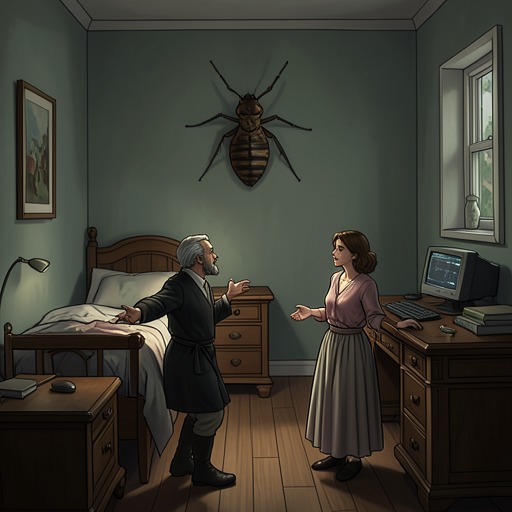
Gregor’s first experience of dehumanization begins with the body itself. He wakes to find himself a “horrible vermin,” lying on an armour-like back with a brown, segmented belly and many thin legs that wave helplessly. Yet his consciousness remains continuous: he recognizes his room, the textile samples belonging to his work as a travelling salesman, and the framed picture of the woman in furs. The contrast is decisive. The reader encounters a being who remembers, judges, worries, and plans, while the visible body invites an animal classification.
Gregor initially tries to interpret the change through ordinary human categories. He suspects that his altered voice is merely the beginning of a serious cold, an occupational hazard for travelling salesmen, and he remains concerned first with getting dressed, eating breakfast, and reaching work. His own account of his condition therefore resists the labels that will soon be imposed on him. He feels pain in his body, struggles to control his legs, and discovers that his lower body is especially sensitive, but he does not understand himself as having ceased to be Gregor Samsa.
The loss of recognition becomes public when Gregor finally opens the door. He turns the key with his powerful jaw, producing brown fluid that runs over the key, and forces the lock despite the pain. The effort is still an act of communication: he wants the people outside to see him, hear him, and understand that he has not abandoned his duties. Instead, the chief clerk recoils, Mrs. Samsa collapses, and Mr. Samsa clenches his fists as though prepared to drive him back. The doorway becomes a threshold between Gregor’s inward human continuity and the family’s outward judgment of his appearance.
Work, Diagnosis, and Economic Value
Before the transformation, Gregor’s humanity within the family is closely tied to his labor. He travels constantly, worries about train connections, endures bad and irregular food, and resents the exhaustion of business travel. He has remained in the job because he supports his parents and intends to pay off the debt they owe to his employer in another five or six years. His imagined “big change” is postponed until his debt has been cleared. Economic obligation has already narrowed his life before the body changes; the transformation makes that reduction visible.
The workplace responds to his absence not with concern for his bodily experience but with suspicion. After fifteen years without illness, Gregor fears that reporting sick will appear strained and dishonest. The chief clerk arrives at the family apartment and accuses him of barricading himself in his room, failing in his business duties, and showing “peculiar whims.” He invokes both Gregor’s parents and his employer, while also raising the possibility that money entrusted to Gregor explains his failure to appear. Gregor’s physical crisis is therefore immediately interpreted through discipline, turnover, reliability, and financial accountability.
Gregor tries to answer within the language of labor. He insists that he is only slightly unwell, promises to open the door, apologizes for making his parents suffer, and argues that there is no basis for the accusations. He is still attempting to preserve his identity as a dependable employee even as his voice has become almost unintelligible. The chief clerk, however, hears not an explanation but an animal sound. The workplace’s judgment is completed when intelligible speech fails: Gregor’s interior meaning remains intact, but his institutionally useful voice disappears.
The family’s financial history reveals why this judgment has such force. Gregor had worked with fiery energy after his father’s business collapsed, rising from junior salesman to travelling representative and placing his earnings on the table for the family. They came to depend on his income, and he was glad to provide it, although the warmth of affection did not grow in proportion to the money. His father has retained some savings from the failed business, but those funds can support the household for only one or two years and must be preserved for emergencies. Once Gregor can no longer work, the family must re-enter employment, and his former role as provider is replaced by the question of how to manage his useless body.
Language, Labels, and Household Containment
The family’s first response contains both care and exclusion. Mrs. Samsa sends for a doctor, Mr. Samsa calls for a locksmith, and Gregor feels briefly that he has been drawn back among people because they recognize that something is wrong and are prepared to help. Yet the proposed remedies already separate him from ordinary social life. The doctor represents medical classification, while the locksmith represents forced access to a locked room. Neither response is oriented toward understanding Gregor’s words on their own terms.
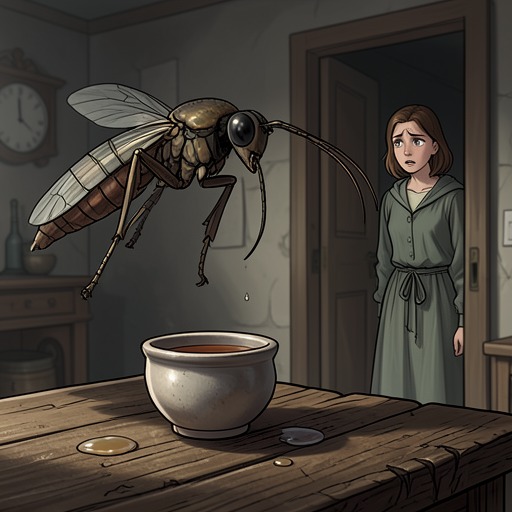
As communication deteriorates, naming becomes a tool of distance. The Charwoman calls Gregor an “old dung-beetle” and treats his room as the place where such a creature is kept. Her language turns the body into an object of rough familiarity rather than a person entitled to privacy or respect. When Gregor moves toward her in resentment, she does not respond as though confronted by a vulnerable family member; she lifts a chair and prepares to strike him. The label authorizes defensive violence and makes his anger appear to confirm the classification imposed on him.
The household also converts the room into a containment zone. Gregor’s father drives him back toward it, and the family’s doors regulate what can be seen, heard, and endured. Gregor’s own habit of locking doors, once a normal precaution learned through travelling, becomes part of the architecture of his isolation. Later, the room fills with objects that have no place elsewhere, while the family rents another room to three bearded lodgers who demand tidiness throughout the flat. Gregor is thus treated simultaneously as a hidden inhabitant and as household matter: present within the apartment, but excluded from its visible and legitimate domestic life.
The scene with his mother makes the boundary especially unstable. Gregor tries to protect the framed picture of the woman in furs when the furniture is being moved, showing attachment and a desire to preserve a remnant of his former room. His mother sees an enormous brown patch against the wallpaper before she recognizes him and faints. Grete calls out to him directly for the first time since his transformation, but the contact is produced by alarm rather than restored intimacy. When Mr. Samsa returns and hears that Gregor has escaped, he assumes that something violent has happened and drives him back. Gregor’s intention to retreat peacefully cannot overcome the family’s interpretation of him as a threat.
From Family Member to “Monster”
Dehumanization reaches its sharpest verbal form during the violin episode. Gregor is drawn toward Grete’s playing because music captivates him and seems to offer the nourishment for which he has been yearning. He wants Grete to bring the violin into his room and imagines telling her that he had always intended to send her to the conservatory. His response to music demonstrates a residual humanity that is not merely abstract: he remembers a future he had planned for his sister, values her talent, and seeks a relationship in which she would approach him voluntarily.
The lodgers do not perceive this inward response. When one points at Gregor, the violin falls silent, and the men regard him as more entertaining than Grete’s playing. Their discovery of him transforms the apartment’s hidden arrangement into a breach of domestic respectability. They demand explanations and then give immediate notice, threatening not to pay and suggesting legal action over the “repugnant conditions” in the flat. Gregor’s presence is treated as a defect in the family’s commercial accommodation, and the loss of the lodgers intensifies the household’s economic pressure.
Grete then makes the classification explicit. She says that the family cannot continue as it is, that she does not want to call the creature her brother, and that they must get rid of it. Her argument depends on a test of recognizable family behavior: if this were Gregor, she claims, he would have understood that human beings could not live with an animal like that and would have left voluntarily. Gregor’s continued attachment is reinterpreted as persecution, while his inability to communicate is treated as proof that he is no longer the brother he was.
This reasoning reverses Gregor’s earlier identity as the family’s protector. He had worked to pay their debt, supported the household, and planned an expensive education for Grete. Now Grete describes him as an animal that drives out tenants, threatens the family’s home, and might force them onto the streets. The same apartment in which his labor once secured everyone’s existence becomes the setting in which his body is declared incompatible with everyone else’s survival.
Care, Exhaustion, and the Restoration of Order
The family does not abandon Gregor immediately; that is part of the complexity of the dehumanization process. Food is brought to him, his room is entered, and Grete initially assumes much of the practical care. But he almost entirely stops eating, taking food into his mouth only to play with it before spitting it out. Bodily deterioration is then read through the family’s diminishing capacity to care rather than through Gregor’s continuing experience of pain, hunger, and altered appetite.
Care becomes labor, and labor becomes resentment. Grete is exhausted by outside work as well as by looking after Gregor. Mrs. Samsa’s attempts to replace her produce conflict within the household, while Mr. Samsa, Grete, and Mrs. Samsa dispute who should clean the room and how much responsibility remains owed to Gregor. The Charwoman fills the gap not through sympathetic recognition but through blunt routine. The movement from family care to paid or coercive maintenance shows how quickly affection can be displaced by management when the dependent person no longer reciprocates economically or socially.
The final reclassification occurs after Gregor’s death. The Charwoman announces that “that thing” has been dealt with, and Mr. Samsa immediately decides that she will be dismissed. The family then leaves the flat together for the first time in months and takes the tram into the open country. In the sunshine they discuss their work and prospects, discovering that all three possess jobs with promising futures. They begin planning a smaller, cheaper, more practical home, while Grete appears increasingly lively and beautiful to her parents. The family’s renewed mobility, economic confidence, and marital hopes coincide with the removal of Gregor’s body.
Dehumanization therefore culminates not simply in insult or confinement but in the conversion of death into administrative relief. Once Gregor no longer occupies a place that can be recognized as productive, communicative, or familial, his absence allows the household to imagine itself as functional again. The tram journey does not erase the suffering that preceded it, but its warmth and forward movement establish the social consequence of the process: the person who had sustained the family economically is ultimately treated as the obstacle from which the family must be freed.