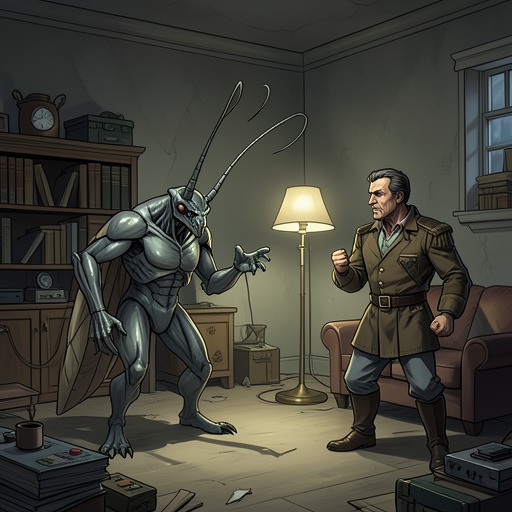
Domestic confinement and closed doors
The MetamorphosisDomestic confinement and closed doors are not merely background conditions in Gregor Samsa’s transformation; they are the practical architecture through which his identity is tested and progressively withdrawn. The Samsa family apartment contains him, hides him, exposes him, and finally seals him away. Each door marks a changing boundary between Gregor and the people who depend on him, fear him, care for him, supervise him, and ultimately treat his removal as necessary for the household’s survival.
The Locked Bedroom and the Working World
Gregor’s confinement begins before anyone openly declares him a prisoner. On the morning he fails to catch his train, he remains behind the locked door of Gregor Samsa’s room while the alarm clock, the five o’clock train, the office assistant’s report, and the Chief Clerk’s expected arrival organize the household around the demands of work. Gregor’s first practical thought is not escape but punctuality: he calculates whether he can reach the seven o’clock train, worries about the samples that remain unpacked, and fears that his fifteen years without illness will make any report of sickness appear suspicious. The room therefore functions as an extension of the workplace, with time, inspection, and professional accountability pressing through the walls.
The locked door also protects a deeply internalized habit. Gregor congratulates himself on his travelling-salesman practice of locking every door at night, even while at home. What once signified prudence and personal security now prevents the family from entering and prevents Gregor from presenting himself as a sick but recognizable employee. The same lock that gives him privacy turns his body into an unexplained absence. His mother, father, and Grete can speak to him only through wood, and the Chief Clerk interprets the barrier as suspicious refusal rather than as evidence of incapacity.
The Chief Clerk’s arrival converts the private bedroom into an administrative scene. From outside, he demands an immediate explanation and links Gregor’s closed door to failure in his business duties, unsatisfactory turnover, and the employer’s suspicion concerning money entrusted to him. The demand is not simply to answer but to become publicly legible again. Gregor, still trying to preserve his position as worker and provider, promises to open the door, dress, pack his samples, and leave. His confinement is thus measured against his ability to resume circulation through trains, offices, and commercial travel.
Opening the Door and Becoming Visible
Gregor’s attempt to open the door is an ordeal of bodily ingenuity. He pushes himself toward it with a chair, holds himself upright against the surface using the adhesive tips of his legs, and turns the key with his mouth because he has no proper teeth. His powerful jaw allows him to move the lock, but a brown fluid runs from his mouth over the key and onto the floor. The act of opening is therefore also an unmistakable revelation of physical difference: the door yields, but the form that emerges can no longer be reconciled with the voice and occupational identity heard from behind it.
The door is already wide open before Gregor can be properly seen. He must turn himself carefully around one of its panels so that he does not fall onto his back, and the delay intensifies the moment of recognition. The Chief Clerk retreats with his hand over his mouth. Mrs. Samsa collapses onto the floor, while Mr. Samsa clenches his fists, appears ready to drive Gregor back, and then covers his eyes as he weeps. The living room becomes a tribunal of sight: Gregor sees the others, and they see a body that makes his previous explanations impossible.
The threshold also frames the ordinary world that Gregor can no longer enter. Behind the family, the hospital across the street is visible through the rain, the breakfast dishes remain on the table, the entrance hall and stairs lie open beyond the apartment, and a photograph of Gregor as a uniformed army lieutenant displays the respected human figure he once occupied. These details place his transformed body beside images of institutional order, domestic routine, mobility, and masculine authority. He insists that he will still get dressed, pack his samples, and go to work, but his words cannot cross the new divide between his self-understanding and the family’s perception.
The Door as a Family Boundary
After the first disclosure, the family’s relation to Gregor is organized by controlled access. The occupants of the apartment know that he is inside, yet they approach him indirectly, cautiously, and for limited purposes. During the first night, a door on one side of the room opens only slightly and closes hurriedly; another does the same later. Gregor waits beside the door, hoping either to draw the timid visitor inside or to discover who it is, but no one enters. The contrast is stark: while the doors had been locked, everyone had wanted access to him; once he opens one, no one is willing to cross the threshold.
The tall room that has been Gregor’s for five years becomes uneasy precisely because it is now both familiar and coercive. He hides beneath the couch, where the pressure against his back gives him immediate relief, even though part of his body remains exposed. He spends the night there, waking from light sleep because of hunger and repeatedly returning to the same resolve: he must remain calm, patient, and considerate so that his family can endure the unpleasantness imposed on them by his condition. Confinement is therefore enforced not only by locks but also by Gregor’s own protective self-restraint.
Grete’s visits establish a provisional corridor between the bedroom and the family. She enters anxiously, retreats when she sees him, then returns on tiptoe as if approaching a seriously ill person or a stranger. Gregor hides beneath the couch so that she will not have to see him clearly, and later carries a bedsheet across the room to cover himself completely. She leaves the sheet in place, and Gregor interprets what may be a look of gratitude as acceptance of this arrangement. The gesture allows access to continue, but only by making Gregor less visible within his own room.
For the first fourteen days, Mr. and Mrs. Samsa cannot bring themselves to enter. They wait outside while Grete cleans and ask her what Gregor has eaten, how he has behaved, and whether any improvement can be seen. Mrs. Samsa wants to visit her son and calls him her unfortunate son, but Mr. Samsa and Grete initially prevent her from doing so. Even care takes the form of a regulated boundary: Grete becomes the authorized intermediary, Mrs. Samsa becomes the excluded but emotionally attached mother, and Gregor becomes a condition to be reported on rather than a participant in conversation.
Furniture, Visibility, and the Shrinking Interior
The bedroom’s contents become part of the struggle over what Gregor is allowed to be. Once he learns to crawl along the walls and ceiling, he finds movement there easier and more pleasurable than lying on the floor. Grete notices the adhesive traces left by his feet and decides to remove the chest of drawers and desk so that he will have more room. The proposed removal appears compassionate because it responds to his altered mobility, yet it also threatens to erase the material signs of his human life.
Grete cannot move the heavy furniture alone, so she brings in Mrs. Samsa while Mr. Samsa is away. Mrs. Samsa questions whether an empty room would truly help Gregor. The furniture has been part of his life for a long time, and removing it might make him feel abandoned; the bare walls would sadden her, and she wonders whether Gregor would feel the same. The disagreement identifies the room as more than an obstacle course. It is an archive of continuity, and clearing it would make the transformation spatially complete by replacing a person’s room with an enclosure designed only for an animal body.
Gregor’s response reveals how urgently he depends on the room’s remaining human traces. When the furniture is being removed, he leaves the wall to protect the framed picture of the woman in furs, pressing himself against the glass so that he can preserve it from being taken away. His body adheres to the picture, and he must pull himself free by force. The bedroom therefore contains a contradiction: its furnishings restrict his crawling, but their disappearance threatens the last visible connection between his present confinement and his former identity.
From Refuge to Final Exclusion
After Mr. Samsa’s apple attack, Gregor’s injured body loses most of its mobility. The apple remains lodged in his flesh for more than a month, a visible sign of violence that nevertheless reminds his father that Gregor is still a family member and cannot simply be treated as an enemy. The bedroom becomes less a place from which Gregor can emerge than a site where an injured dependent is kept. His deterioration makes the boundary physically more decisive, while the family’s duty to be patient preserves him inside the household only in a diminished and increasingly conditional form.
The living-room door is sometimes left open in the evenings, allowing Gregor to watch his family from the darkness of his room. This partial access reverses the earlier scene at the threshold. He no longer presents himself to the household; instead, he observes it without being seen. Through the opening he watches Mr. Samsa sleep in his uniform, Mrs. Samsa sew, and Grete study shorthand and French after taking a sales job. The open door offers Gregor a fragile form of participation, but it also confirms that family life continues on the other side without requiring his speech, labor, or physical presence.
When the Samsa family takes in the Three Lodgers, the apartment’s spatial hierarchy changes again. The lodgers use the shared living room and bring in their own furnishings and equipment, while unnecessary household objects, kitchen dustbins, and clutter are pushed into Gregor’s room. The bedroom becomes a repository for what the family no longer wants visible. Gregor must crawl through the junk because there is no other room in which to move, and he eventually finds a tired, sorrowful satisfaction in rearranging it. His confinement now serves the apartment’s economy: the space that once belonged to him is treated as storage, and his continued presence is compatible with the household only when he is hidden among discarded things.
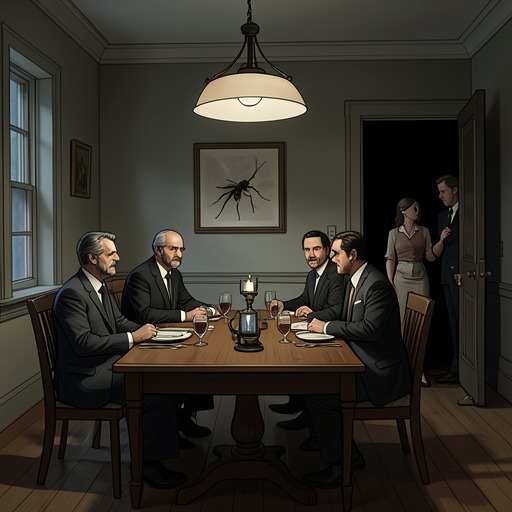
The living-room door is left slightly open during the lodgers’ evening meal, exposing Gregor to a social arrangement from which he has been displaced. The Three Lodgers sit at the table where Gregor formerly ate with his parents, while Mrs. Samsa and Grete serve them meat and potatoes and the family eats in the kitchen. Gregor hears their chewing and longs for food, yet he recognizes that he cannot share what they eat. The doorway makes the exclusion visible: the former provider is confined to the dark room, the paying lodgers occupy the communal table, and the family’s hospitality is directed toward those who now support the apartment financially.
The final closure follows the lodgers’ rejection and Grete’s declaration that the family must get rid of the monster she no longer wants to call her brother. Gregor makes his way back toward his room, exhausted and no longer hurried by anyone. Grete waits by the doorway, then shuts it, bolts it, and locks it behind him, saying, “At last!” The phrase marks the completion of a process that began with Gregor’s own cautious locking of doors. What once protected him from interruption has become the family’s instrument of final exclusion.
Inside the darkness, Gregor can no longer move. The pain in his body weakens, and he thinks back on his family with emotion and love; if he could choose, he feels that he would go away even more strongly than Grete had demanded. He remains there until the clock tower strikes three, as dawn begins outside, and dies without reopening the door. His death ends the spatial crisis not by restoring communication but by removing the body around which every boundary had been organized.
Narrative Significance
Domestic confinement and closed doors make the household’s moral structure visible as a sequence of permissions and refusals. The door controls speech when Gregor’s altered voice cannot be understood, sight when his appearance becomes unbearable, movement when his room is treated as a sealed zone, and social membership when the living room continues without him. It also exposes the instability of care: family members feed, clean, observe, and worry about Gregor, yet those acts occur through distance, concealment, reporting, and restraint.
The recurring door produces a formal pattern of delayed recognition and reversed access. At first Gregor is hidden behind it while insisting that he remains a worker; then he opens it to prove his innocence and reveals a body that others cannot accept; later he watches through a partly open door as the family reorganizes itself; finally Grete locks him inside after the household has decided that his presence is incompatible with its future. The architecture does not merely symbolize alienation. It distributes power, determines visibility, and turns a shared apartment into a system in which belonging can be granted temporarily and withdrawn by closing a door.