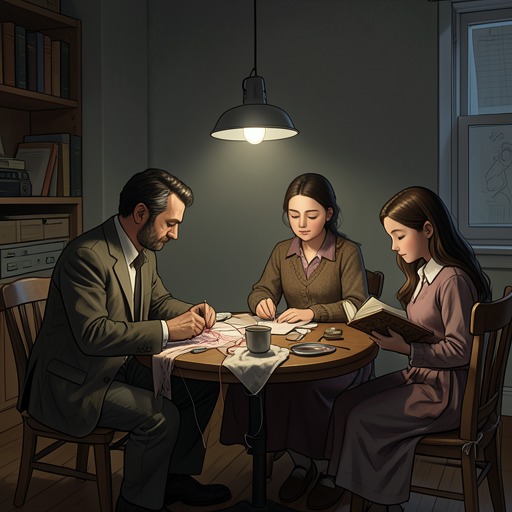
Filial duty and family obligation
The MetamorphosisFilial duty and family obligation are the moral and economic structure of the Samsa family’s life. Before Gregor Samsa’s transformation, Gregor Samsa treats supporting his parents as an unquestionable responsibility, while the family’s dependence on his income gives that responsibility a material foundation. After his transformation, the obligation reverses direction: the household must work and care for him, but its patience steadily erodes as care becomes labor, expense, and confinement. The family’s eventual recovery after Gregor Samsa’s death exposes the disturbing limit of its familial ethics: belonging is strongest while a person can sustain the household, and weakest when that person becomes an enduring burden.
Duty Before the Transformation
Gregor Samsa’s working life is governed by responsibility to his parents. He resents the exhausting routine of travel, early rising, train connections, irregular food, and constant contact with strangers, and he imagines resigning from his position. He does not do so because his parents remain in his thoughts. His immediate plan is to continue working until he has assembled enough money to pay off his parents’ debt to his employer, which he estimates will take another five or six years; only then does he imagine making a decisive change in his own life.
This projected freedom is therefore conditional rather than immediate. Gregor Samsa’s ambition to leave his job is subordinated to a debt inherited by the family and administered through his employment. The employer’s authority reaches into the household: when Gregor Samsa fails to appear for work, the Chief Clerk comes to the Samsa family apartment, questions his conduct, and warns that his parents may again face pressure connected with the money entrusted to Gregor Samsa. Gregor Samsa responds less as an independent worker defending himself than as a son trying to prevent his absence from injuring his parents.
His obligation has already reshaped his identity. After the collapse of his father’s business five years earlier, Gregor Samsa worked with exceptional intensity, rising from junior salesman to travelling representative and converting his success into cash placed before his astonished family. He later earned enough to bear the costs of the whole household, and he did so. The family accepted the money with gratitude, while Gregor Samsa was glad to provide it, although the warmth between them diminished. Economic provision thus substitutes for ordinary intimacy: his value is expressed through what he can place on the table.
The Family’s Hidden Resources and Gregor’s Plans
The first crisis reveals that Gregor Samsa has misunderstood the family’s financial position. Mr. Samsa kept some money from the failed business in a small cash box, and a portion of Gregor Samsa’s monthly earnings had also been saved rather than spent. The reserve is modest, sufficient to maintain the family for perhaps one or two years but not enough to live on indefinitely from interest. It is emergency money, not a replacement for wages, so the household’s dependence on labor remains intact.
Gregor Samsa feels pleasure at his father’s thrift because the discovery briefly eases the burden he has carried. The saved money might have reduced his father’s debt to the employer and brought his release from the job closer, but once Gregor Samsa is unable to work, preserving the reserve becomes more sensible. His imagined future changes without his choosing it: the money that might have purchased personal freedom must instead protect the family against immediate insecurity.
Filial duty also includes a cultural and emotional investment in Grete Samsa. Gregor Samsa recognizes her as a gifted and expressive violinist and secretly plans to send her to the conservatory the following year, despite the expense. The conservatory has been treated by the family as a beautiful but unrealistic dream, yet Gregor Samsa has privately decided to announce his plan on Christmas Day. His responsibility therefore extends beyond debt repayment and household maintenance; he wants to convert his earnings into his sister’s education and future.
Care, Shame, and Reversed Dependence
After Gregor Samsa becomes unable to work, he does not abandon the family in thought. During his first night of confinement, he concludes that he must remain calm, patient, and considerate so that his family can bear the unpleasantness imposed on them by his condition. Even while isolated behind a door, he continues to define his conduct through their comfort. His first instinct is not to demand care but to minimize the cost of receiving it.
The family, however, initially understands his absence primarily through work and financial danger. Grete Samsa cries when Gregor Samsa refuses to let the Chief Clerk enter, and Gregor Samsa assumes that her distress comes from fear that he will lose his job and leave their parents exposed to renewed demands. The Chief Clerk reinforces this interpretation by treating Gregor Samsa’s confinement as a failure of business duty and by speaking on behalf of both the employer and the parents. Gregor Samsa’s physical crisis is therefore translated into a moral accusation: he is not merely ill or transformed, but apparently irresponsible.
The reversal of dependence forces every member of the household toward labor. Mr. Samsa is healthy but old, lacking confidence after five years without work, and physically slowed by weight gained during that period. Mrs. Samsa suffers from asthma, making movement and sustained work difficult. Grete Samsa, still seventeen, had previously enjoyed late mornings, nice clothes, modest pleasures, and violin playing rather than a full working life. Once Gregor Samsa cannot earn, the family must consider how each person can contribute, and Gregor Samsa reacts with shame and regret whenever he hears them discuss the need to earn money.
Grete Samsa becomes Gregor Samsa’s principal caretaker, while the parents remain outside the room for the first fourteen days. They wait by the door for Grete Samsa’s reports about what Gregor Samsa has eaten, how he has behaved, and whether any improvement can be seen. Their concern is real, but it is mediated through observation and management rather than direct contact. Mrs. Samsa longs to see her son and calls him her unfortunate son, while Mr. Samsa and Grete Samsa initially restrain her. Family obligation consequently produces both an impulse toward contact and a boundary of fear around the transformed body.
From Mutual Support to Exhaustion
Grete Samsa’s care begins with attention to Gregor Samsa’s altered needs. When he rejects milk, she brings a selection of food on an old newspaper, including half-rotten vegetables, bones covered with hardened white sauce, raisins, and almonds, in order to test what he can eat. Gregor Samsa tries to spare her distress by hiding under the couch and by covering himself with a bedsheet so that she will not have to see him. His self-erasure is presented as another form of filial consideration: he manages his body to reduce the burden placed on his sister.
Over time, the exchange becomes less reciprocal and more mechanical. Grete Samsa must work, and she begins pushing food into Gregor Samsa’s room with her foot before leaving and sweeping it away later, often untouched. The room accumulates dirt, smears, dust, and filth. When Mrs. Samsa thoroughly cleans it, using several bucketfuls of water that make Gregor Samsa ill, Grete Samsa reacts with tears and anger because she regards the cleaning of Gregor Samsa’s room as her responsibility alone. Care has become a contested household assignment rather than an unforced expression of affection.
The family’s material sacrifices make the exhaustion visible. The maid is dismissed, an imposing charwoman takes over the heaviest work, Mrs. Samsa adds work for strangers to her sewing, and family jewellery is sold. The household remains in a flat that is too large for its circumstances because moving is difficult, partly because of Gregor Samsa and partly because the family feels trapped by a misfortune unlike anything known among their relations. Everyone performs the work expected of poor people: Mr. Samsa brings bank employees their breakfast, Mrs. Samsa washes clothing for strangers, and Grete Samsa serves customers at her desk while studying shorthand and French for a better position.
Gregor Samsa’s injury intensifies the ethical pressure. After Mr. Samsa’s apple attack, an apple remains lodged in Gregor Samsa’s flesh for more than a month. His mobility declines so severely that he becomes like an ancient invalid, taking long minutes to cross his room and losing the ability to crawl across the ceiling. The injury forces Mr. Samsa to recognize that Gregor Samsa, despite his revolting form, remains a family member who cannot simply be treated as an enemy. Yet this recognition is reduced to a demand for patience and the suppression of revulsion, showing that kinship survives rhetorically even as ordinary companionship disappears.
The Limits of Family Membership
Even after his injury, Gregor Samsa remains oriented toward the family’s life. When the living-room door is left open in the evenings, he watches the household at the dinner table and listens to its conversation. The arrangement permits him to remain near them while keeping him physically and socially apart. He sees Mr. Samsa sleep in his chair, Mrs. Samsa sew fancy underwear for a fashion shop, and Grete Samsa study after taking a sales job. The family is still organized around collective effort, but Gregor Samsa now occupies the position of a silent observer rather than a provider or participant.
His own feelings become divided. At times he imagines taking over the family’s affairs as he once did; at others he is enraged by the lack of attention and plans to enter the pantry to take what he is entitled to, even when he is not hungry. The language of entitlement persists, but the practical basis for it has vanished. He once earned the right to provide and to be recognized; now he can neither work nor communicate, and his claim to food, space, and consideration appears to the household as an additional demand.
Grete Samsa eventually articulates the family’s rejection of that demand. After the lodgers’ violin incident, she says that the household cannot continue as it is and refuses to call the creature in Gregor Samsa’s room her brother. She declares that they must get rid of it, arguing that the family has done everything humanly possible to care for it and remain patient. Her statement converts a family crisis into a decision about identity: Gregor Samsa’s biological relation is displaced by the category of an intolerable object.
The rejection is especially bitter because Gregor Samsa’s earlier obligations had included Grete Samsa’s future. He had worked toward the possibility of sending her to the conservatory, while she now treats his continued existence as incompatible with the family’s survival. The exchange between them is not simply a collapse of affection; it is the failure of a household economy in which sacrifice was expected to produce lasting mutual belonging. Once Gregor Samsa can no longer contribute, the return of care becomes temporary, conditional, and finally withdrawn.
Aftermath and Ethical Significance
Following Gregor Samsa’s death, the surviving family members leave the Samsa family apartment together for the first time in months and take the tram into the open country. In the sunlight they discuss their prospects and discover that all three now have jobs with good promise for the future. They begin planning a smaller, cheaper, more practical flat in a better location. The outing marks a rapid restoration of family movement and hope, but it also confirms that the household’s renewed stability depends on Gregor Samsa’s absence.
The family’s attention turns decisively toward Grete Samsa’s future. Mr. Samsa and Mrs. Samsa notice that she has grown into a well-built and beautiful young woman, and they silently agree that it will soon be time to find a suitable husband for her. Grete Samsa stretches her body when they reach their destination, an image of emerging adulthood and possibility. The future once imagined through Gregor Samsa’s plan for the conservatory is replaced by the parents’ new hopes for her social and domestic advancement.
Filial duty and family obligation therefore operate in two contradictory registers. They inspire Gregor Samsa’s sustained labor, his repayment of debt, his care for his parents’ security, and his plan for Grete Samsa’s education. They also bind the household to economic calculation, making care measurable through work, food, space, and endurance. The family can call Gregor Samsa a son while he is injured, confine him while claiming patience, and finally treat his death as the condition for renewed prosperity. The concept’s deepest significance lies in that unresolved contradiction: obligation can preserve a family through sacrifice, but when sacrifice ceases to generate economic value, the same structure can expose how conditional its solidarity has always been.