Gregor Samsa
The MetamorphosisGregor Samsa is the protagonist of Metamorphosis and the story’s decisive experiment in separating human identity from the body, the voice, and the economic role assigned by others. He awakens transformed into a horrible vermin, yet his first responses remain those of an anxious worker and devoted son: he worries about missing his train, angering his employer, and abandoning the family whose debts he has been paying. The tragedy lies not only in his altered body but in the speed with which the world begins to judge him through that body, while his inward obligations and affections persist.
Identity and Ordinary Life
Gregor’s ordinary identity is established through work and responsibility. He is a travelling salesman whose room contains textile samples, and he has spent fifteen years in service without once being ill. His employment is not presented as freedom or self-realization: it is a demanding obligation undertaken to recover his parents’ financial position. After his father’s business collapsed five years earlier, Gregor worked with what the narrative describes as fiery vigour, rose from junior salesman to travelling representative, and placed his earnings on the table at home. He eventually earned enough to bear the costs of the whole family, and both Gregor and the family became accustomed to that arrangement, even though the gratitude he received no longer carried much warm affection.
His private hopes reveal a tenderness that the household’s financial structure conceals. Gregor remains especially close to Grete Samsa, who is fond of music and a gifted violinist. During his short periods in town, they discuss the conservatory as a beautiful but seemingly impossible dream. Gregor secretly plans to send her there the following year, despite the expense, intending to announce this plan grandly on Christmas day. His imagined future is therefore built around another person’s development rather than his own release from work; even his longed-for change is first conceived as a gift to his sister and family.
Transformation and the First Crisis
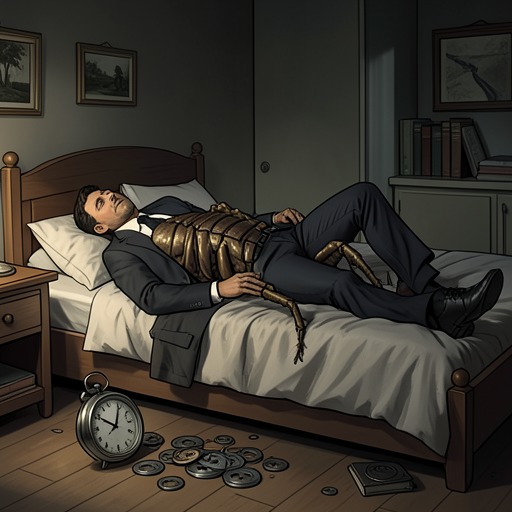
One morning, Gregor Samsa wakes from troubled dreams and finds himself transformed in his bed into a horrible vermin. His new body has an armour-like back, a slightly domed brown belly divided into stiff sections, and many thin legs that wave helplessly. The room remains a recognizable human room between familiar walls, with textile samples on the table and a framed picture of a woman in furs above it. This continuity of setting intensifies the rupture: the domestic world has not changed, but Gregor can no longer inhabit it in the same physical way.
Gregor initially interprets the transformation through the language of ordinary illness. He assumes that the strange voice emerging from him may be the first sign of a serious cold, an occupational hazard for travelling salesmen. He tries to get out of bed, dress, and eat breakfast before deciding what to do, believing that lying in bed will prevent sensible thought. His attempts become a practical struggle with an uncontrollable body: the little legs move in different directions, the lower part of his body is difficult to shift, and a careless shove sends him painfully against the bedpost. His mind remains organized around routine even as routine has become physically impossible.
The alarm clock converts bodily crisis into employment crisis. At nearly quarter to seven, Gregor realizes that he has missed the five o’clock train; the next train leaves at seven, the samples are not packed, and the office assistant will already have reported his absence. He considers reporting sick but knows that this would appear suspicious because he has never been ill during fifteen years of service. He imagines the employer arriving with a doctor from the medical insurance company, accusing his parents of having a lazy son, and treating illness as evidence of work-shyness. Gregor feels physically well apart from excessive sleepiness and unusual hunger, but the workplace has already made his condition morally suspect.
The family’s attempts to reach him reveal both concern and the beginning of confinement. His mother calls through the door, his father knocks, and Grete asks whether he needs anything. Gregor answers that he is getting up, carefully trying to remove the strangeness from his altered voice. He refuses to open the door and congratulates himself on the travelling habit of locking every door at night, even when at home. The locked room thus becomes both a temporary protection and the first structure of his exclusion.
Exposure, Violence, and Confinement
The arrival of the Chief Clerk makes Gregor’s failure to appear at work a public and institutional accusation. The Chief Clerk speaks on behalf of Gregor’s parents and employer, condemns the barricaded room, and demands an immediate explanation for his absence. He portrays Gregor’s conduct as an unheard-of failure of business duty and hints that money recently entrusted to him might explain it. Gregor still thinks in terms of preserving his position and reassuring his family; he struggles toward the lock because he wants them to see that he is not refusing responsibility.
Gregor opens the door only through extraordinary physical effort. He pushes a chair across the room, braces himself against the door with the adhesive tips of his legs, and turns the key with his jaw. He lacks proper teeth, but his jaw is strong enough to move the lock; brown fluid runs from his mouth over the key and onto the floor. When the door opens, the Chief Clerk retreats in horror, Gregor’s mother collapses, and Mr. Samsa clenches his fists before covering his face and weeping. Gregor is visible only in part, still leaning against the inner door, as though even his revelation cannot produce a complete encounter between the person he believes himself to be and the creature others see.
The exposure ends not in explanation but in expulsion. Gregor tries to return to his room, yet his father drives him forward with a stick. His body becomes stuck in the doorway; one flank scrapes against the white door, his legs quiver uselessly on one side, and a heavy shove finally sends him bleeding into the room. The door is slammed and bolted. In this scene, the family’s fear, the employer’s suspicion, and the architecture of the apartment converge: Gregor’s failure to remain economically legible becomes a physical justification for forcing him behind a closed door.
When he awakens that evening, the left side of his body is one painfully stretched scar, one leg drags lifelessly, and he limps on his two rows of legs. Grete leaves sweetened milk with pieces of white bread, remembering that milk had been his favorite drink, but Gregor finds that it no longer tastes good. Hunger remains intense, while appetite has changed. His body’s altered demands separate him from the food and habits through which his family still tries to recognize him.
From the darkness of his room, Gregor hears the silent family in the lighted living room and takes pride in having provided them with a peaceful, comfortable home. He fears that this peace and wealth may now come to a horrible end. The doors that once kept others out have become barriers keeping him in: people approach them, hesitate, and withdraw. Gregor’s confinement is therefore emotional as well as spatial, because his care for the family survives precisely as the family’s ordinary access to him disappears.
Family Roles and Physical Decline
Gregor’s transformation exposes financial facts that had been hidden from him. His father still possesses savings from the failed business, kept in a cash box and withdrawn through a complicated lock. Gregor had believed that nothing remained, and he had never asked for clarification because his only concern after the collapse had been to work hard enough to make the family forget its despair. The discovery complicates his self-image as the indispensable provider: his sacrifice was real, but the family was not as economically helpless as he had assumed.
Grete initially becomes Gregor’s principal caretaker. For the first fourteen days, his parents cannot bring themselves to enter the room; instead, they wait outside while Grete cleans and then ask what he has eaten, how he has behaved, and whether any improvement can be seen. The family, which had regarded Grete as somewhat useless, now depends on her labor. Gregor approves of her work and still imagines that his mother might understand his condition better, though he recognizes that Grete, despite her courage, is still only a child facing an adult burden.
Gregor attempts to protect Grete from his appearance. When she finds him staring motionless from the window, she retreats and shuts the door, and he hides beneath the couch. He later carries a bedsheet across the room on his back and arranges it so that she will not see him, leaving her free to remove it if she wishes. She leaves it in place, and Gregor thinks he glimpses gratitude. Even in isolation, he acts through accommodation: he modifies his room and conceals himself so that the person caring for him will suffer less.
His altered body also opens unfamiliar possibilities. Because the room is small and food has ceased to give him pleasure, Gregor learns to crawl up walls and across the ceiling. Hanging there gives him more room to breathe and a light swinging sensation; he can even fall without injuring himself. This mobility offers a brief counterpoint to the injuries that later make him nearly immobile. The transformation is thus not a simple loss of all capacity, but a reorganization of bodily experience that the household understands only through fear and disgust.
The turning point comes when Grete and Mrs. Samsa attempt to remove furniture from Gregor’s room. Gregor clings to the framed picture of the woman in furs, protecting one remaining object from his human room. When his mother sees the large brown shape against the wallpaper, she screams and faints; Grete addresses Gregor directly for the first time since the transformation and then shuts him out while tending to their mother. In the confusion, a broken bottle cuts Gregor’s face and caustic medicine splashes over him. His attempt to help as he once would have done becomes another source of danger, confirming that his intention can no longer control how his actions are read.
Mr. Samsa returns and assumes that Gregor has committed some violent act. Gregor presses himself against his bedroom door to show that he means to return without resistance, but his father is unwilling to recognize this intention. The ensuing attack leaves an apple lodged in Gregor’s flesh. No one removes it, and it remains there for more than a month as a visible reminder of his injury. The wound permanently reduces his mobility, turning him into an ancient invalid who takes long minutes to cross the room and can no longer crawl across the ceiling.
From Family Member to Threat
The apple produces a temporary moral hesitation in Mr. Samsa. Because the injury is serious and remains visible, it reminds him that Gregor, despite his revolting form, is still a family member who cannot simply be treated as an enemy. The family must swallow its revulsion and be patient. Yet this recognition does not restore Gregor’s former place. His room becomes the site from which he watches a family reorganized around work, fatigue, and restricted sympathy.
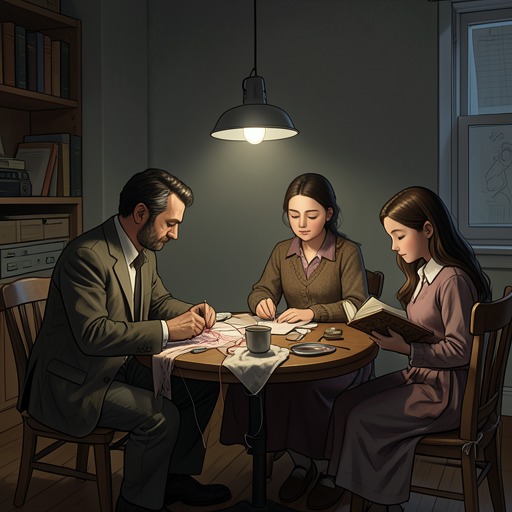
Each evening, when the living-room door is left open, Gregor watches his father sleep in a chair, his mother sew fancy underwear for a fashion shop, and Grete work at a sales job while studying shorthand and French to obtain a better position. The lively conversations of earlier times have disappeared. Gregor once longed for those conversations when he was tired in a small hotel room; now he can hear the family but cannot participate in its domestic life. His former income has been redistributed into new labor, and the household’s survival no longer depends on his return.
The family’s changing economic position alters its interpretation of Gregor. Once his labor made him valuable, his silence could be excused as illness or temporary incapacity. Once other members begin working, his continued presence appears to consume space without producing income. The apartment’s doors, meals, furniture, and conversations become measures of this altered exchange. Gregor is still capable of affection and observation, but the family increasingly measures him by the costs of feeding, housing, and concealing him.
That transformation reaches its explicit form after the family takes in three lodgers. During an evening when Grete plays the violin, Gregor listens from his room and is moved by the music. He imagines that Grete’s playing ought to be heard by people capable of appreciating it, and he wants to tell her that he had intended to send her to the conservatory. The music briefly restores the relation between inward humanity and outward form: the creature in the room responds to art more deeply than the respectable men at the table.
Grete instead declares that the family must get rid of Gregor. She says that she no longer wants to call the monster her brother and argues that if it were really Gregor, he would have understood that human beings could not live with such an animal and would have gone away voluntarily. Her language reverses the evidence of Gregor’s conduct. He has repeatedly tried to avoid frightening the family, return to his room, and preserve their welfare, but those efforts are treated as proof that he is no longer the person who makes them. The family’s final judgment depends less on what Gregor intends than on the category into which his body has been placed.
Gregor attempts to withdraw without frightening anyone, turning painfully toward his room and striking his head against the floor to help himself move. The family sees the movement as alarming, while he understands it as an act of consideration. Grete’s demand therefore completes the communication breakdown: shared language, memory, and intention have all become weaker than visible form and practical fear.
Death and Narrative Significance
After being locked back in his room, Gregor discovers that he can no longer move. The loss is not presented as a sudden dramatic struggle but as the final quiet consequence of injury, hunger, and abandonment. His body aches, yet the pain is weakening; he can barely feel the decayed apple or the inflamed area around it. At three in the morning, as daylight slowly begins outside the window, his head sinks down and his last breath leaves him.
Gregor’s last inward movement is toward his family. He thinks of them with emotion and love and feels that, if possible, he must go away even more strongly than Grete had demanded. His death thus contains both surrender and self-erasure: he accepts the family’s conclusion that his departure is necessary, but the reader has just witnessed that this departure comes from continued concern rather than from the absence of human feeling.
The Charwoman discovers the corpse and announces that it is dead. Mr. and Mrs. Samsa and Grete enter the room, and Mr. Samsa gives thanks to God. Grete observes how thin Gregor has become and notes that he had eaten almost nothing for a long time. His body is dried up and flat, no longer able to lift itself on its legs or force the family to look away. Death makes visible the physical deterioration that the household had endured but could not fully confront while he remained alive.
Gregor’s death immediately changes the family’s social and economic horizon. The lodgers are dismissed, the family writes letters excusing itself from work, and the three Samsas leave the flat together for the first time in months. On a tram filled with warm sunshine, they discuss their prospects and discover that all three have good jobs with promising futures. They decide that they need a smaller, cheaper, better-located, more practical flat. The family’s renewed mobility is structurally dependent on Gregor’s disappearance.
The final image turns toward Grete’s future. Her parents recognize, almost simultaneously, that their daughter has blossomed into a well-built and beautiful young lady, and they begin thinking that it will soon be time to find a good man for her. Grete stretches her young body when they reach their destination, a gesture of expansion after Gregor’s long contraction into a room and then into a corpse. The family’s apparent recovery is therefore also an unsettling replacement: Gregor’s life as worker, son, and planned benefactor has ended, while Grete is prepared to enter the social future that he once hoped to secure for her.
Gregor’s arc is not a heroic journey toward return or integration. It is an inverted transformation narrative in which the protagonist’s inward continuity is tested against the social meanings imposed on his body. He begins as a provider whose value is tied to labor, becomes a dependent whose care strains the household, and ends as an obstacle whose removal restores family movement. The story preserves his love, memory, and concern even as its other characters withdraw recognition, making Gregor’s death less a revelation that he was secretly human than an indictment of the conditions under which his humanity was allowed to count.