Gregor Samsa's death
The MetamorphosisGregor Samsa's death is the terminal event of his transformation from the Samsa family's principal provider into an injured, confined body that the household can no longer accept as a brother or son. It follows the collapse of his remaining claim to shared family life: after his sister declares that the creature must be removed and insists that it cannot be Gregor, he retreats into Gregor Samsa's room, is locked inside, and dies before dawn. The event simultaneously ends Gregor's suffering and exposes the family's dependence on his disappearance as the condition of their recovery.
Causes and Background
Gregor's death is prepared by the material and emotional history of the Samsa family. Before the transformation, he worked as a travelling salesman and carried the household financially after his father's business collapsed five years earlier. He believed that nothing remained from that failed business, yet his father had preserved money in a little cash box. Gregor's strenuous work had enabled him to support the whole family, but this arrangement had also made his value primarily economic. His private plan to send Grete Samsa to the conservatory, despite the expense, shows that his attachment to her still exceeded the practical terms governing the household; he intended to reveal the plan on Christmas Day.
The transformation destroys the role through which Gregor had secured his place in the family, but it does not immediately destroy his own sense of responsibility. On the morning he wakes as a horrible vermin, his first concerns remain his train, his collection of textile samples, his employer's suspicion, and the possibility that the office assistant will report his absence. After fifteen years of service he has never been ill, and he imagines that the Chief Clerk might arrive with a doctor from the medical insurance company and accuse his parents of having a lazy son. Even while his body has become unrecognizable, Gregor initially interprets the altered voice as the beginning of a serious cold and tries to organize himself around breakfast, dressing, and work.
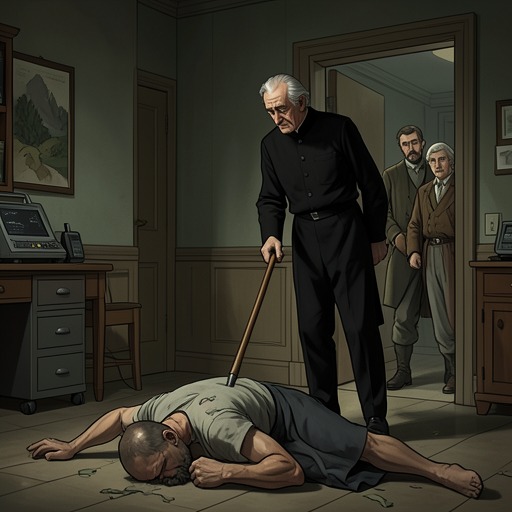
His attempts to return to ordinary life repeatedly reveal the widening gap between intention and bodily capacity. He cannot turn onto his right side, cannot coordinate the many thin legs that have replaced his arms and hands, and injures himself while trying to leave the bed. When he finally opens the door for the Chief Clerk, his family and the visitor do not encounter a sick worker who can explain himself. They see a body that has to be driven back into Gregor Samsa's room. His father forces him through the narrow doorway with a stick, scraping and injuring one side of him before shoving him bleeding into the room and slamming the door.
Physical Decline and Confinement
The injury inflicted during his expulsion becomes a lasting condition rather than a temporary setback. An apple remains lodged in Gregor's flesh for more than a month, and no one dares to remove it. The wound leaves him with greatly reduced mobility, so that he takes long minutes to crawl across his room and can no longer climb across the ceiling. The family’s patience is therefore tied to his visible incapacity: the injury reminds even his father that, despite his revolting form, Gregor remains a family member who cannot simply be treated as an enemy.
At first, Grete provides the most sustained care. For the first fourteen days, Gregor's parents cannot bring themselves to enter the room, while Grete tidies it, observes what he has eaten, and reports whether any improvement can be seen. Gregor approves of his mother's wish to visit because he imagines that she might understand the burdensome task better than Grete, whom he still regards as young despite her courage. Yet this care is already organized by the closed door: the parents wait outside, Grete mediates what they know, and Gregor's condition is discussed without his participation.
Gregor's own body becomes increasingly difficult for others to recognize as the body of a person. Food, once a source of comfort, loses its ordinary meaning. On his first evening, he is drawn to a dish of sweetened milk with pieces of white bread, the drink Grete knows was formerly his favorite, but the milk disgusts him and he turns away. Hunger continues, yet appetite no longer connects him to his former identity. His physical deterioration, the decay surrounding the lodged apple, and the failure of food to sustain ordinary family exchange progressively reduce him to what others perceive as a problem of maintenance.
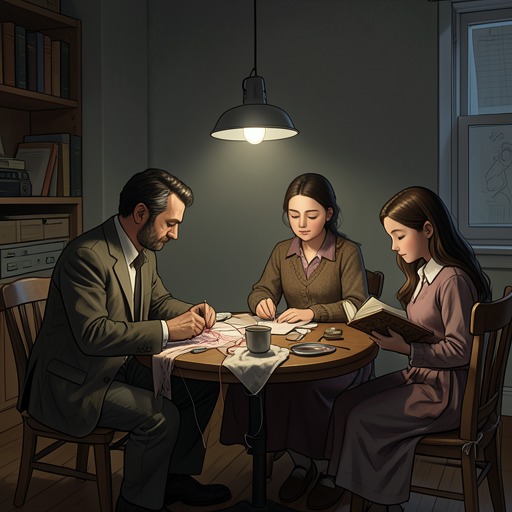
The room also changes from a temporary refuge into a permanent enclosure. Gregor crawls over its walls, furniture, and ceiling to entertain himself, and he sometimes hangs from the ceiling because breathing feels easier there. Later, after his injury, he can no longer move in this way. The open living-room door in the evenings offers a limited compensation: from the darkness of his room he watches the family at dinner and listens to their quiet conversations. His father sleeps in a chair, his mother sews fancy underwear for a fashion shop, and Grete works at a sales job while studying shorthand and French for a better position. The family is reorganizing itself economically, but Gregor can participate only as an unseen observer.
Rejection and Final Retreat
The decisive break occurs when the family’s earlier language of patience gives way to explicit rejection. After the three lodgers have been drawn into the household’s crisis, Grete tells her parents that they cannot continue living this way. She refuses to call the creature her brother and argues that the family must get rid of it. In her reasoning, Gregor's continued presence has driven out the tenants, threatens to take over the whole flat, and may force the family to sleep on the streets. The family member who once planned Grete's education is now represented as an animal responsible for the household's ruin.
Grete's argument also changes the meaning of Gregor's silence. She claims that if the creature were really Gregor, it would have understood that human beings cannot live with an animal like it and would have gone away voluntarily. This logic makes recognizable humanity depend on self-erasure: Gregor can prove that he is still Gregor only by removing himself. The family's inability or unwillingness to hear him completes the communication breakdown that began with his altered voice and continued through locked doors, mediated reports, and fearful interpretation of his movements.
Gregor does not intend to frighten anyone when he turns toward his room. His injured body makes the movement extraordinarily difficult; he pants, repeatedly strikes his head against the floor, and must stop to rest. The family eventually realizes that he is trying to withdraw, and for the first time no one rushes him. He is astonished by the distance between his position and the doorway, unable to understand how he had crossed it earlier when he was stronger. He concentrates on reaching the room without turning back, while his family remains silent behind him and his mother falls asleep in her chair.
As soon as he is inside, Grete hurries forward and shuts, bolts, and locks the door. The sound makes Gregor's legs collapse beneath him, and her cry of relief marks the final conversion of his room from a domestic space into a sealed boundary. The family no longer needs to drive him back with force; exclusion has become automatic, performed through the lock. In this sense, his death begins before the last breath: the household has already defined him as something that must be contained and removed.
Death and Discovery
Alone in the darkness, Gregor discovers that he can no longer move. The loss is not presented as a new terror. His entire body aches, but the pain is weakening, and he can scarcely feel the decayed apple or the inflamed area around it. His physical stillness therefore becomes strangely compatible with relief. He thinks of his family with emotion and love and feels, if anything, an even stronger need to go away than Grete had expressed. His final movement is inward and contemplative rather than resistant: he remains in a peaceful rumination until the clock tower strikes three in the morning.
As the light begins to spread outside the window, Gregor's head sinks down without his willing it, and his last breath leaves weakly through his nostrils. The narration gives no medical explanation and no dramatic final speech. Death arrives through the exhaustion of movement, appetite, and agency that has marked his decline. The body that once struggled to catch a train, open a lock, and cross a doorway now becomes completely still, while the surrounding household will determine what that stillness means.
The Charwoman discovers the death early in the morning. At first she assumes that Gregor is deliberately lying still and tries to rouse him with a broom, first tickling him from the doorway and then poking him. Only when she can shove him across the floor without resistance does she recognize that he is dead. Her discovery treats the corpse first as an object to test and move, then as news to announce loudly to the household. The manner of discovery contrasts with Gregor's private, nearly silent death: the family learns of his end through an external inspection rather than through intimacy with his final moments.
Mr. Samsa and Mrs. Samsa hurry into Gregor Samsa's room, with Grete following after having slept in the living room since the three lodgers arrived. Mr. Samsa responds by giving thanks to God, crossing himself, and leading the three women to do the same. Mrs. Samsa begins to restrain the broom but does not complete the gesture. Grete looks closely at the corpse and observes how thin Gregor has become, explaining that he had eaten so little that the food came out unchanged. His dried, flat body finally makes visible the physical extent of his decline, even as its stillness prevents the family from looking away.
Aftermath and Significance
Gregor's death immediately changes the household's emotional and practical structure. The family no longer needs to negotiate with the three lodgers over breakfast or conceal the body from them. The lodgers emerge demanding their forgotten meal, but The Charwoman silently directs them toward Gregor's corpse. The men stand around it in their worn coats, and their presence turns the death into a final household crisis that must be managed alongside their tenancy.
The family then begins to restore boundaries. The Charwoman opens the window wide, bringing warmer fresh air into the room at the end of March, while the corpse remains inside as the old domestic order is being cleared away. The three lodgers are dismissed, and the family's immediate future no longer depends on maintaining the apartment's former arrangement. Gregor's death thus resolves the conflict that his presence had come to symbolize: the household can stop treating him as both relative and threat because the body has ceased to demand anything.
Mr. Samsa, Mrs. Samsa, and Grete write letters of excuse to their employers, contractor, and principal, then leave the flat together for the first time in months. Their movement into the warm sunshine of the tram and out into the open country gives the aftermath a striking physical contrast with Gregor's dark, locked room. They discuss their prospects and discover that all three have jobs with good promise. Their conversation turns toward a smaller, cheaper, better-located, and more practical apartment, suggesting that the family’s recovery will involve not only grief or relief but a material reorganization of domestic space.
The final emphasis falls on Grete's future. Her parents see that she has grown into a well-built and beautiful young lady, and they silently agree that it will soon be time to find a good man for her. When they reach their destination, Grete is the first to rise and stretch her young body. Her movement reverses Gregor's trajectory: while his body became constricted, injured, and finally immobile, Grete's body is presented as developing toward an adult future. The family’s renewed plans therefore make Gregor's death both a tragedy and a release within the household system. It ends the life of the former provider, but it also permits the family to imagine work, housing, marriage, and ordinary social continuity without him.