Gregor Samsa's room
The MetamorphosisGregor Samsa's room is the central interior space of Gregor Samsa's transformation: a familiar human bedroom that becomes a sealed enclosure, a makeshift sickroom, a zone of family conflict, and the setting of Gregor Samsa's death. Its changing contents, thresholds, sounds, and patterns of access trace the family's movement from dependence on Gregor as a wage earner to the management and rejection of his altered body.
Definition and Initial Setting
Gregor Samsa's room is introduced as a proper human room, though somewhat too small, lying peacefully between four familiar walls. Its ordinary domestic details preserve Gregor's identity at the moment when his body has become unrecognizable: textile samples are spread across the table because he works as a travelling salesman, and a picture of a woman in a fur hat and fur boa hangs above it in a gilded frame. The room therefore contains both the routine of his occupation and a private object selected and framed by Gregor himself. The contrast between its human order and the transformed body on the bed establishes the room as a space where incompatible classifications coexist.
The room is also governed by Gregor's working life before anyone enters it. On the morning of his transformation, he remains preoccupied with the alarm clock, the five o'clock train, the unprepared collection of samples, and the reaction of his employer. He has worked for fifteen years without illness and initially interprets his altered voice as the beginning of a serious cold, an occupational hazard for travelling salesmen. Even while lying in an unfamiliar body, he treats the room as the staging ground for getting dressed, eating breakfast, and returning to work. The ordinary furniture cannot accommodate his new anatomy, however: he cannot use arms or hands to rise, his many legs move beyond his control, and his attempt to shift his lower body ends with a painful collision against the bedpost.
Door, Threshold, and Confinement
The room's door separates Gregor from every institution and relationship that defines his former life. His mother, father, and sister approach it from different sides, calling to him and asking whether he needs anything, while Gregor carefully assures them that he is getting up. He refuses to open it and congratulates himself on the travelling habit of locking every door at night, even at home. A practical precaution thus becomes the first mechanism of confinement: the locked door protects privacy, but it also keeps Gregor's body, voice, and condition from entering shared domestic space.
The door becomes a test that Gregor must pass before he can prove that he remains responsible and employable. He pushes a chair toward it, braces himself against the wood with the adhesive tips of his legs, and turns the key with his powerful jaw. A brown fluid runs from his mouth over the key and onto the floor, while the effort causes him pain. When the lock finally turns, he regards the result as proof that he did not need a locksmith. Yet the opened door does not restore communication. The Chief Clerk sees Gregor first and retreats in horror; Mrs. Samsa collapses; Mr. Samsa clenches his fists and weeps. The room's threshold exposes Gregor without making him understood.
After the failed encounter, Mr. Samsa drives Gregor back toward the room with a stick and hissing noises. Gregor cannot move backward in a straight line and must turn his broad body within the narrow doorway. His father does not open the second door to give him more space, because the immediate objective is simply to force him back inside. Gregor becomes stuck, scrapes one flank against the white door, leaves brown flecks on it, and is finally shoved bleeding into the room. The door is slammed and locked, turning the bedroom from a private interior into an enforced cell.
Bodily Adaptation and the Room's Reorganization
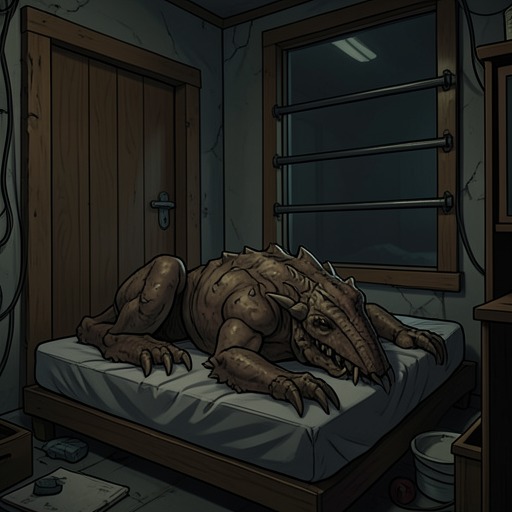
After this expulsion, the room becomes the only territory Gregor can inhabit. He wakes at dusk from a deep, coma-like sleep with his left side stretched into a painful scar and one injured leg dragging lifelessly. He follows the smell of food to the door, where Grete has left sweetened milk with pieces of white bread, assuming that his former favorite drink will still suit him. It does not. His changed body can eat only when it works together as a snuffling whole, and pain makes the attempt difficult. The room therefore records a separation between memory and bodily need: the food belongs to Gregor's human past, but his transformed appetite rejects it.
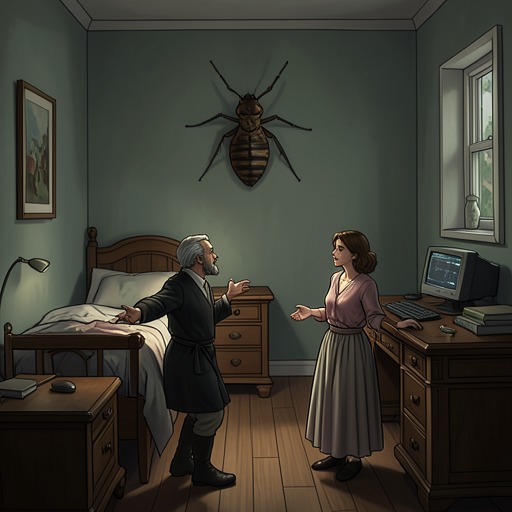
As the room becomes dark and restrictive, Gregor discovers new forms of movement. The few square meters of floor give him little room to crawl, and he avoids being seen at the window during the day. He begins climbing the walls and ceiling, where he can breathe more freely and feel his body swing lightly. These movements provide moments of relief and almost happiness, and his increasing control means that even a fall from the ceiling need not injure him. The room briefly becomes an adapted environment rather than merely a prison, although the traces left by his feet make that adaptation visible to Grete.
Grete responds by proposing to remove the furniture, especially the chest of drawers and the writing desk, so that Gregor can move more easily. The work requires her mother to help; the maid refuses involvement and has asked to keep the kitchen locked, while Gregor's parents initially remain outside his room rather than entering. The room thus becomes the focus of a new care arrangement in which Grete assumes practical responsibility and the parents rely on her reports about Gregor's food, behavior, and possible improvement.
Gregor experiences the removal differently. The chest contains his fretsaw and other tools, while the desk bears the worn place where he did homework as a business trainee, at high school, and even at infant school. As the women scrape furniture across the floor, he feels assailed from all sides and realizes that they are taking away everything dear to him. The room is not empty space to be optimized for an animal body; it is the material record of a human biography. When Gregor leaves the couch and presses himself against the framed picture of the woman in furs, covering it with his body so that it cannot be taken away, he protects one remaining object from the erasure of his former self.
Family Access and Changing Alliances
For the first fourteen days, Mr. and Mrs. Samsa cannot bring themselves to enter the room. They wait outside while Grete tidies it and ask her to report exactly how it looks, what Gregor has eaten, how he has behaved, and whether any improvement can be seen. Mrs. Samsa longs to visit her unfortunate son, but Mr. Samsa and Grete initially restrain her. The doorway makes care indirect and conditional: Gregor is discussed, observed, and managed before he is encountered.
When Mrs. Samsa finally enters, Gregor hides beneath the couch and lowers a sheet so that she will not see him. His effort to spare her distress reveals that the room remains a place of reciprocal concern even as direct contact becomes difficult. The arrangement also makes Grete the household's intermediary. She controls when the door opens, guides her mother inside, and takes the heaviest part of the work of moving the chest of drawers. Yet her courage is accompanied by fear, and the room's visual shock quickly overwhelms the fragile structure of care.
Gregor's attempt to preserve the picture brings him into view. Mrs. Samsa sees the enormous brown patch against the wallpaper and faints before recognizing him; Grete shouts his name, runs for smelling salts, and then closes the door between Gregor and their mother. Gregor tries to help as he once might have done, but he can only stand behind Grete while a broken bottle cuts his face and caustic medicine splashes over him. The room has become a place in which his intention to assist produces alarm, injury, and further exclusion.
Mr. Samsa's return intensifies this transformation of the room into a defensive boundary. Misreading Grete's report, he assumes that something violent has happened and enters angry and relieved at once. Gregor presses himself against his bedroom door to demonstrate that he intends to return voluntarily, but his father does not recognize the gesture. The family conflict is consequently organized around the doorway: Gregor understands himself as a member trying to withdraw, while his father sees a threat that must be driven back.
Injury, Surveillance, and Final Exclusion
The apple lodged in Gregor's flesh remains for more than a month, and no one dares remove it. The injury becomes a visible reminder inside the room that Gregor is still a family member who should not be treated entirely as an enemy. At the same time, it permanently reduces his mobility. He becomes like an ancient invalid, taking long minutes to cross the room and losing the ability to crawl across the ceiling. The room changes from an environment of experimental freedom into a landscape measured by pain and diminished range.
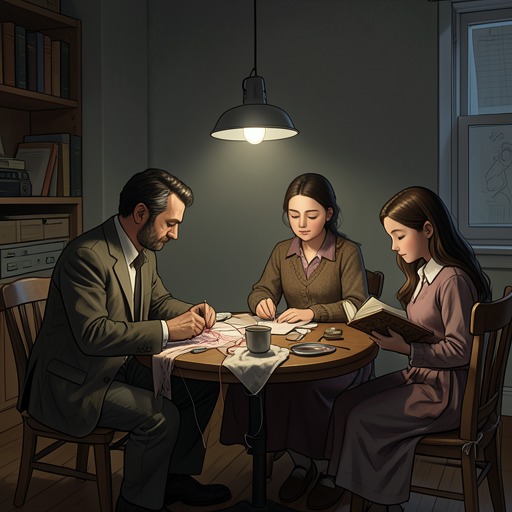
Even so, the open door to the living room gives Gregor a limited connection to the family each evening. From the darkness of his room he watches them at the dinner table and listens to their subdued conversation. Mr. Samsa sleeps in his chair; Mrs. Samsa sews fancy underwear for a fashion shop; Grete takes a sales job and studies shorthand and French to improve her prospects. The room functions as a viewing chamber from which Gregor can observe the family adapting economically, but the open doorway does not restore participation. He is present by permission and hidden from sight, listening to a household whose labor and future no longer depend on him in the same way.
The decisive reversal occurs when Grete declares that the family cannot continue and says that she does not want to call the creature her brother. She argues that it must be removed and that the family must stop believing it is Gregor. Her reasoning turns the room into evidence against Gregor's membership: because an animal cannot live with human beings, she claims, the creature has forfeited the identity of brother and has become a danger to the flat. The room is no longer a protected interior for a dependent family member but the occupied territory of an unwanted animal.
Gregor nevertheless tries to leave the shared space without frightening anyone. Turning around is agonizing; he repeatedly raises and strikes his head against the floor, pants with effort, and crawls slowly toward his room. Once he reaches the doorway, Grete shuts, bolts, and locks the door behind him, saying that the confinement is finally complete. Inside the darkness Gregor can no longer move, though he feels relatively comfortable as the pain weakens and the apple and inflamed area become difficult to sense. He thinks of his family with emotion and love and feels that, if possible, he must go away even more strongly than Grete. At three in the morning, as light begins to spread outside the window, his head sinks and his last breath leaves him.
Death and Aftermath
The room is the setting of Gregor Samsa's death and the first place where that death is treated as a practical fact. The Charwoman discovers that his body can be pushed across the floor without resistance and announces that he is dead. Mr. Samsa, Mrs. Samsa, and Grete enter; Mr. Samsa gives thanks, and the women follow his crossing gesture. Grete observes that Gregor has become extremely thin because he ate nothing for so long, and the body is described as dried up and flat. The room converts the ambiguous transformed figure into a corpse that can be classified, inspected, and removed.
The family's response confirms the room's final change in status. The Charwoman opens the window wide, allowing fresh air into the space, while the three lodgers are directed toward Gregor's corpse and complain first about their forgotten breakfast. Soon afterward, Mr. Samsa announces that the Charwoman will be dismissed, and the family leaves the flat together for the first time in months. They write letters excusing themselves from work, take the tram into the open country, and discuss their jobs, improved prospects, and the need for a smaller, cheaper, more practical home.
The room therefore ends as the negative space of the family's recovery. While Gregor occupied it, the household's labor, food, movement, and speech were organized around a locked door. After his death, the family can imagine a different dwelling and a future centered on Grete's growth. Its significance lies in this spatial and moral reversal: the room begins as the private human interior of a working son, becomes the site of his confinement and progressive dehumanization, and ends as the enclosed space from which the surviving family believes it has finally been released.