Gregor Samsa's transformation
The MetamorphosisGregor Samsa's transformation is the decisive event of Metamorphosis: one morning he wakes in the Samsa family apartment and finds himself changed into a horrible vermin. The change is physical and immediate, but its deepest force lies in the mismatch between Gregor's continuing human consciousness and the bodies, institutions, and relationships that can no longer recognize him as human.
The Morning of the Transformation
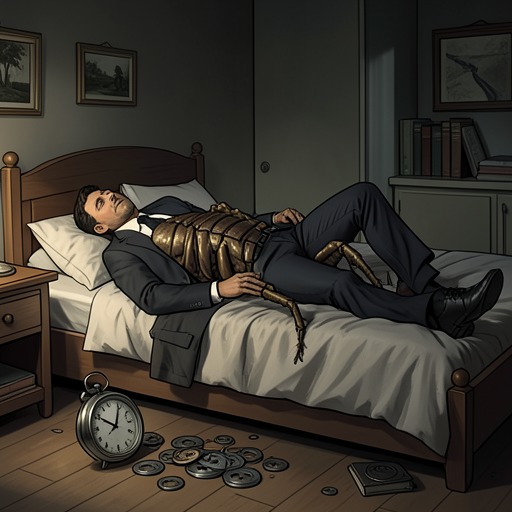
Gregor awakens on his armour-like back, looking across a brown, slightly domed belly divided into stiff sections and many thin legs waving helplessly. The bedding barely covers him. His room remains a proper human room, though small, with familiar walls, textile samples spread across a table, and the picture of a woman in furs in a gilded frame. The ordinary objects do not soften the transformation; they make it more unsettling by preserving the domestic world around a body that no longer belongs within it.
Gregor initially treats the event as a problem to be explained away. He wonders whether it is a dream and later assumes that the altered voice is the first sign of a serious cold, an occupational hazard for a traveling salesman. He tries repeatedly to turn onto his right side, the position in which he normally sleeps, but his new body rolls him back. After nearly a hundred attempts, he stops only when a mild, unfamiliar pain begins. His first response is therefore neither philosophical acceptance nor panic, but practical denial directed toward the immediate demands of getting out of bed.
Work, Debt, and the Refusal to Stop
Even after the transformation, Gregor's thoughts remain organized by employment. He looks at the alarm clock and discovers that it is nearly a quarter to seven, while his train should have left at five. Missing the train will anger his employer, and the office assistant will already have reported his absence. Gregor considers reporting sick but knows that this would appear suspicious: in fifteen years of service he has never been ill. He imagines the employer sending a doctor from the medical insurance company and accusing his parents of having a lazy son.
His anxiety is tied to the family's debt. Gregor has been working to pay off his parents' debt to his employer and expects it to take another five or six years. Only afterward, he thinks, will he make a major change in his life. The transformation thus interrupts a deferred plan for freedom at the very moment when Gregor remains most tightly bound to labor. His body has become incapable of ordinary movement, yet his sense of duty still sends him toward the train, the samples, the employer, and the family's financial survival.
The contrast is especially sharp because Gregor does not initially feel conventionally ill. Apart from excessive sleepiness after a disturbed night, he feels well and unusually hungry. The institutional language surrounding illness is less interested in his bodily experience than in whether his absence can be justified. Work anxiety becomes the first framework through which the family and employer interpret the unexplained event.
Speech, Doors, and Failed Recognition
Gregor's altered voice reveals the transformation before his body does. When his mother knocks, his answer sounds to him like a recognizable response, but it contains a painful squeaking that makes the words unclear to others. He tries to enunciate carefully and place long pauses between words, hoping to remove the strangeness from his speech. His mother, father, and Grete Samsa hear a person behind the door, but they cannot receive his language as ordinary human communication.
The locked door becomes the first boundary between Gregor's inward identity and the household's external judgment. He congratulates himself on his traveling habit of locking every door at night, a practice that once offered privacy and security but now prevents immediate recognition. His family asks whether he is well and whether he needs anything; Grete begs him to open the door. Gregor instead wants to dress, eat breakfast, and think clearly before facing anyone. The same enclosure that protects him from discovery also leaves the family to construct explanations without access to his experience.
The Chief Clerk arrives on behalf of the employer and treats Gregor's absence as a breach of business duty. He speaks of the unusual nature of Gregor's failure to appear and mentions that the employer has even suspected a problem involving money recently entrusted to him. Gregor wants to open the door and explain himself, partly because he hopes the sight of him will end his responsibility for the others' shock. Yet when he finally makes himself upright and reaches the door, the family and the Chief Clerk hear only an animal voice. His attempt at explanation becomes evidence against him.
Exposure and Bodily Consequences
Once the door is opened, the household's uncertainty becomes visible horror. The Chief Clerk calls Gregor's speech the voice of an animal, while Gregor's mother calls for a doctor and his father calls for a locksmith. Gregor, by contrast, feels briefly reassured that the family has recognized that something is wrong and is prepared to seek help. He expects the doctor and locksmith to accomplish great things, though he does not clearly distinguish their roles. This moment preserves a narrow hope that the transformation is a solvable emergency rather than a permanent reclassification.
That hope collapses as Gregor tries to leave the room. He struggles to coordinate his legs, climbs onto the chest of drawers, braces himself against a chair, and finally forces his broad body through the doorway. His flank scrapes against the white door, leaving brown flecks; he becomes stuck, with the legs on one side hanging in the air and those on the other pressed painfully against the floor. His father gives him a heavy shove, sending him bleeding into the room, and slams the door behind him.
The injury establishes the transformation as an ongoing physical condition rather than a single grotesque revelation. When Gregor wakes that evening, his left side feels like one stretched scar, one leg drags lifelessly, and his mobility is already impaired. He has survived the first confrontation, but the household's attempt to restore order has converted his struggle for access into lasting bodily damage.
Hunger, Confinement, and the Family's Reorganization
Grete leaves Gregor sweetened milk with pieces of white bread, remembering that milk had formerly been his favorite drink. He is extremely hungry, but the milk tastes unpleasant, and the pain in his side makes eating difficult. His appetite has not disappeared, yet the foods and habits associated with his human life no longer sustain him. Food becomes a practical measure of the distance between remembered identity and present embodiment.
Gregor spends the evening in darkness near the door, listening to the silence of the living room. He takes pride in having provided his parents and sister with a peaceful, comfortable home, and he fears that this prosperity may now end. His transformation therefore remains linked to the family's economic structure even when he is no longer able to work. He can still imagine himself as provider, but he is increasingly confined to the role of a hidden body whose needs threaten the household's stability.
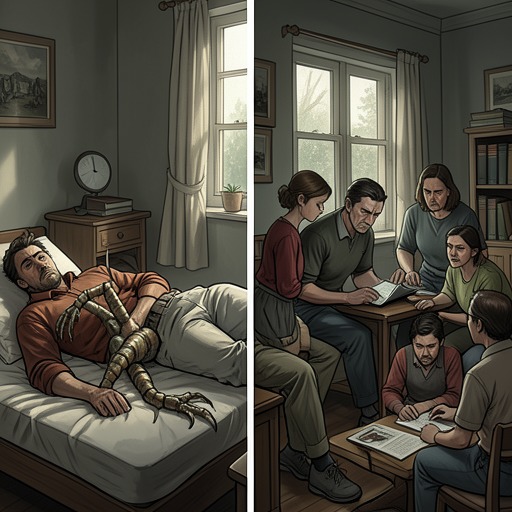
The family gradually adapts by returning to work. Gregor observes his father, mother, and sister from the open living-room door: his father sleeps in a chair, his mother sews fancy underwear for a fashion shop, and Grete takes a sales job while studying shorthand and French for a better position. This reorganization reveals that the transformation has not merely isolated Gregor; it has redistributed the labor on which the household depends. His former role as provider is replaced by the family's collective effort, while his room becomes a storage space and eventually part of the apartment's economic use.
From Family Member to Excluded Body
For more than a month, the apple lodged in Gregor's flesh remains unremoved as a visible reminder of his injury. His physical decline and reduced mobility force his father to acknowledge, at least temporarily, that Gregor remains a family member who cannot simply be treated as an enemy. The obligation to suppress revulsion and exercise patience survives, but it becomes conditional and increasingly fragile.
The transformation also changes the language applied to Gregor. The Charwoman calls him an old dung-beetle and treats his presence as an object of rough curiosity rather than a family crisis. When he moves toward her in resentment, she raises a chair as a weapon and calmly challenges him to come closer. His body is thus alternately managed as a patient, feared as an animal, and handled as a nuisance, with no stable vocabulary capable of holding together his consciousness and his appearance.
Grete eventually insists that the family must abandon the idea that the creature is Gregor. She argues that if he were still Gregor, he would understand that human beings cannot live with such an animal and would have left voluntarily. Her conclusion transforms the family's uncertainty into a final judgment: the body in the room is no longer treated as a brother who has undergone a terrible condition, but as an animal whose continued presence threatens the household. The transformation's social endpoint is not simply isolation but expulsion from the category of family.
Death and Aftermath
Gregor's transformation ends in death after he has almost entirely stopped eating. His body is found dried up and flat, and Grete observes that the food had come out unchanged. The family responds to the corpse with shock, relief, and ritual gestures; Mr. Samsa gives thanks to God, and the women cross themselves. The body that once demanded care is now treated as proof that the crisis is over.
The transformation's consequences become clearest after Gregor's death. The family leaves the apartment together for the first time in months and discusses its prospects, discovering that all three remaining members have jobs with good promise. They begin imagining a smaller, cheaper, and more practical home. As the pressure of Gregor's presence disappears, Mr. and Mrs. Samsa recognize Grete as a beautiful young woman and begin considering a suitable husband for her. The family's renewed future is therefore built directly on the end of Gregor's bodily and social existence.
As an event, Gregor Samsa's transformation is both a physical metamorphosis and a crisis of interpretation. Gregor continues to remember work, debt, family pride, hunger, and concern for others, but speech, appearance, appetite, mobility, and domestic boundaries progressively contradict those memories. The family's changing responses show how personhood is maintained through recognition and reciprocal participation; once Gregor can no longer work, communicate, or appear human to those around him, the household resolves the contradiction by treating his death as restoration.