Gregor Samsa’s confinement
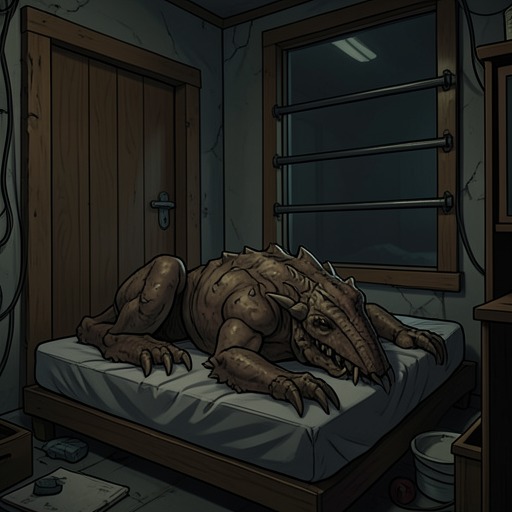
The MetamorphosisGregor Samsa’s confinement is the central spatial and social condition of his transformed existence. After waking in an inexplicable altered body, he remains in Gregor Samsa’s room behind a locked door, separated from employment, ordinary speech, shared meals, and direct family contact. The room offers shelter, but it also makes his exclusion visible: he is still within the Samsa family apartment, yet increasingly treated as a body to be hidden, monitored, redirected, and eventually removed from the family’s future.
The Locked Room and the Failure of Work
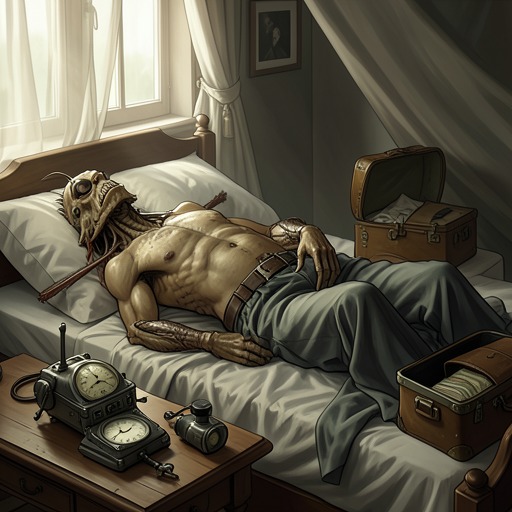
Gregor’s confinement first takes shape through the conflict between his body and the timetable that had governed his life as a travelling salesman. The alarm clock shows that he has missed the five o’clock train and is already approaching seven, while the next train leaves at seven. He worries that the office assistant will report his absence, that the boss will suspect him of shirking, and that a doctor from the medical insurance company might be sent to investigate. Although he feels unusually hungry and excessively sleepy, he initially interprets the strange change in his voice as the beginning of a serious cold, an occupational hazard of travelling salesmen. His work identity therefore survives inside the room as an internal discipline: even before anyone physically prevents him from leaving, he measures himself against trains, office reports, medical scrutiny, and the expectations of fifteen years of service.
The locked door becomes the first practical boundary of his isolation. Gregor has acquired the habit, through travelling, of locking every door at night, even when he is at home, and now congratulates himself on that caution. The habit protects him from immediate exposure, but it also prevents the family from reaching him and turns a familiar domestic precaution into a barrier. His mother, father, and sister call to him from different doors, asking what is wrong and whether he needs anything, while Gregor repeatedly promises that he is ready and will get up. Yet he has no intention of opening the door. He wants to rise undisturbed, dress, eat breakfast, and only then decide what to do, still assuming that orderly routine might restore the situation.
Exposure and Forced Return
The confinement becomes coercive when the Chief Clerk arrives at the Samsa family apartment to investigate Gregor’s absence. Gregor struggles toward the door with a chair, braces himself against it with the adhesive tips of his legs, and turns the key with his jaw because he has no usable teeth. A brown fluid runs from his mouth over the key, but his strong jaw allows him to complete the task. The sound of the lock turning briefly encourages him, as though the effort might prove that he remains capable of answering the demands placed upon him.
When the door opens, however, it does not restore communication. The Chief Clerk retreats in horror. Mrs. Samsa collapses, and Mr. Samsa clenches his fists, covers his eyes, and weeps before assuming a hostile posture. Gregor exposes only part of his body from behind the second door, but even this limited appearance makes him an object of shock rather than a person whose explanation will be heard. The scene establishes that visibility is dangerous: the door permits him to be seen, but not understood.
Mr. Samsa then drives him back into his room with a stick and with hissing noises. Gregor cannot move backward properly and must turn his broad body in the narrow doorway while fearing a blow to his back or head. His father does not open the other door to give him more space; the priority is simply to get him inside as quickly as possible. Gregor becomes stuck, scrapes one flank against the white door, and leaves brown marks while the legs on one side quiver in the air. A heavy shove finally frees him and sends him, bleeding, deep into the room. The door is slammed shut with the stick, converting the room from a place he chose to remain into the enclosure to which he has been forcibly returned.
Care, Surveillance, and Spatial Adaptation
After the expulsion, the family’s relation to the room becomes a pattern of hesitant approach and retreat. During the first evening, each side door opens slightly and closes again, as if someone wishes to enter but cannot overcome fear. Gregor waits beside the door, hoping either to draw the visitor inside or to discover who it is, but no one comes. The contrast with the previous morning is decisive: when the doors were locked, everyone wanted access to him; once he has opened one and become visible, the keys remain outside and the room is avoided.
Gregor responds by trying to make his confinement less burdensome for the family. He hides under the couch, even though his body is too broad to fit completely beneath it, because the cramped darkness makes him feel more at ease. He resolves to remain calm, patient, and considerate so that his family can bear the unpleasantness he believes he imposes on them. This self-restraint shows that confinement is not maintained by walls alone. Gregor continues to regulate his own conduct according to the needs and judgments of those outside, treating his isolation as a duty imposed by his condition.
For the first fourteen days, Mr. Samsa and Mrs. Samsa cannot bring themselves to enter Gregor Samsa’s room. They wait outside while Grete Samsa cleans it and then ask for detailed reports about its appearance, Gregor’s food, his behavior, and any possible improvement. Grete Samsa becomes the family’s intermediary and caretaker, while her parents remain dependent on her account of the unseen occupant. Mrs. Samsa wants to visit her son, calling him her unfortunate son, but Mr. Samsa and Grete initially prevent her; the wish to care for Gregor is therefore constrained by fear of seeing him.
Gregor also rearranges his behavior to accommodate Grete Samsa’s discomfort. When she enters earlier than usual and finds him staring motionlessly from the window, she immediately leaves and closes the door, apparently unable to endure his appearance. Gregor then hides under the couch and later spends four hours carrying a bedsheet on his back so that he can be completely covered. Grete leaves the sheet in place, and Gregor interprets a possible look of gratitude as approval. The covering becomes a compromise within the confinement: he remains in the room, but even his limited visibility is managed so that the caretaker can enter without having to confront his body directly.
Deterioration and the Open Door
The room gradually becomes both prison and observatory. Because the few square meters of floor leave him little room to crawl, Gregor begins moving along the walls and ceiling. He particularly enjoys hanging from the ceiling, where he can breathe more freely and feel his body swing lightly. This movement briefly expands his relation to the room, allowing him to inhabit its vertical surfaces rather than merely lie on the floor. Yet the family’s fear and the need to rearrange the furniture make even this adaptation unstable.
When Gregor attempts to preserve the framed picture of the woman in furs on the wall, his mother sees the enormous brown patch of his body and faints. Grete Samsa cries out at him, and a broken bottle injures his face while caustic medicine splashes over him. Gregor’s attempt to help his mother only produces another crisis, and he retreats amid anxiety and self-reproach. The family’s interpretation of his movement as menace repeatedly converts his efforts at care or withdrawal into evidence that he must be controlled.
Mr. Samsa’s subsequent apple attack permanently deepens the confinement. No one removes the apple lodged in Gregor’s flesh, so it remains for more than a month as a visible reminder of the injury. The wound leaves him with greatly reduced mobility; crossing his room takes long minutes, and crawling across the ceiling becomes impossible. The room therefore contracts even as its door is sometimes left open. In the evenings Gregor watches the family from the darkness while they sit at the dinner table, and the open door gives him a limited form of participation: he can see them and hear their conversation, but only with everyone’s permission and from a position where he cannot be seen.
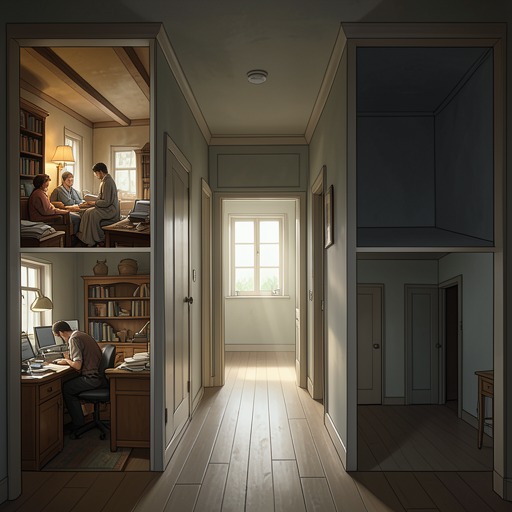
This access to the living room does not restore his former place in family life. The lively conversations he once remembered from lonely hotel rooms have disappeared. Mr. Samsa sleeps in his chair, Mrs. Samsa sews fancy underwear for a fashion shop, and Grete Samsa works at a sales job while studying shorthand and French to improve her future position. Mr. Samsa refuses to remove his uniform even at home, remaining dressed as though he were always awaiting the voice of a superior. The family has reorganized its labor around Gregor’s absence, while Gregor remains a silent spectator of that reorganization.
From Family Member to Excluded Body
The family’s financial situation explains why Gregor’s confinement initially carries an element of reluctant care. Mr. Samsa reveals that some money remains from the business that collapsed five years earlier. Gregor had believed that nothing survived from that failure and had responded by working with exceptional intensity, rising from junior salesman to travelling representative and placing his earnings at home to support the family. He had been able to bear the costs of the household, and he had secretly planned to send Grete Samsa to the conservatory despite the expense. His room is thus also the place where the family’s former economic arrangement becomes legible: the person who once sustained the household is now unable to work, while the family must discover its own capacity to survive.
That discovery changes the meaning of care. The family members begin taking on employment and domestic work, and Gregor’s usefulness as provider no longer organizes the household. After the lodgers’ violin incident, Grete Samsa declares that the family cannot continue as it is and says that they must get rid of the creature. She argues that they have done everything humanly possible to care for it and be patient, but that they must stop believing it is Gregor. In her account, the room no longer houses an injured family member whose condition requires accommodation; it houses an animal whose continued presence threatens the apartment and the family’s ability to live normally.
Grete’s rejection transforms the family boundary from guarded inclusion into explicit exclusion. She insists that, if the creature were Gregor, it would have understood that human beings could not live with an animal like that and would have gone away voluntarily. Gregor, meanwhile, is trying only to turn around and return to his room. His painful movement is mistaken for a new threat, and the family gathers around Mr. Samsa as though protection against Gregor were necessary. The room remains his assigned place, but his return to it is now treated as the condition for everyone else’s safety rather than as a form of shelter for him.
Final Immobilization and Death
After Grete Samsa’s demand, Gregor retreats into his room and the door is hurriedly shut, bolted, and locked. He soon discovers that he can no longer move at all. The loss of mobility is not represented as a sudden struggle against confinement; instead, Gregor experiences it as the endpoint of a process that has made movement increasingly unnatural, painful, and socially unacceptable. His body aches, but the pain weakens, and he can scarcely feel the decayed apple or the inflammation surrounding it.
In this final immobility, Gregor thinks of his family with emotion and love and concludes that he must go away even more strongly than Grete Samsa had demanded. The thought converts exclusion into an inwardly accepted disappearance. As the clock tower strikes three in the morning and daylight begins to enter through the window, his head sinks and his last breath leaves him. Confinement ends not with release into shared space but with the cessation of the body that had occupied the disputed room.
The family’s response confirms how completely his enclosure has become a problem of household order. The Charwoman discovers the corpse, announces that it is dead, and pushes it with her broom. Mr. Samsa gives thanks to God, and the women cross themselves. Grete Samsa observes that Gregor has become thin because he has eaten so little; his body is dried up and flat, no longer capable of forcing anyone to look away. The room’s occupant has been reduced from a hidden and threatening presence to a corpse that can be moved without resistance.
Afterward, the family leaves the apartment together for the first time in months and travels by tram into the open country. They discuss their jobs, their prospects, and the possibility of moving to a smaller, cheaper, and more practical flat. Grete Samsa appears livelier, and Mr. Samsa and Mrs. Samsa recognize that she has grown into a young woman for whom they can imagine finding a suitable husband. The family’s renewed mobility and future planning stand against Gregor Samsa’s confinement: once his room is empty, the household can again move outward, form plans, and imagine a future organized around its surviving members.