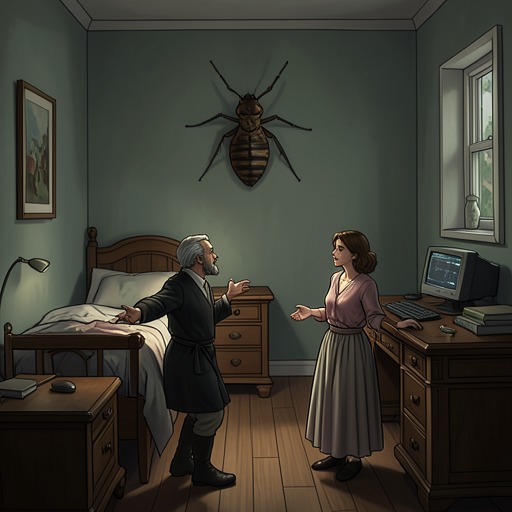
Gregor Samsa’s metamorphosis
The MetamorphosisGregor Samsa’s metamorphosis begins when he wakes from troubled dreams and discovers that he has been transformed in his bed into “a horrible vermin.” The transformation is decisive not because it supplies a medical explanation, which the narrative never provides, but because it converts an overworked provider into a body that cannot move, speak intelligibly, or perform the labor on which the family depends. His continuing thoughts, obligations, and attempts to cooperate remain recognizably human even as his body is increasingly named and treated as animal, burden, threat, and finally corpse.
Identity and Bodily Experience
Gregor first encounters the transformed body as an unfamiliar physical problem. He lies on an armour-like back beneath bedding that can barely cover his brown, domed belly, divided into stiff sections, while many thin legs wave helplessly below him. His room remains a proper human room, with familiar walls, textile samples from his work as a travelling salesman, and the framed picture of a woman in furs, but the ordinary furnishings now surround an occupant who no longer fits the human order they imply.
His first response is not wonder but practical denial. He wonders whether what has happened is a dream and considers sleeping longer, yet his altered body cannot turn onto its right side, the position to which he is accustomed. He tries again and again until a mild, unfamiliar pain stops him. An itch on his belly reveals white spots he cannot understand; when one of his legs touches the area, he withdraws it in a cold shudder. The body is therefore experienced from within as a sequence of failed expectations, pain, and partial discoveries rather than as a stable new identity.
The transformation also alters Gregor’s voice before it visibly exposes him to the household. When he answers his mother through the closed door, his speech contains a painful squeaking and an echo that makes the words uncertain to listeners, although they seem clear to him. He continues to believe that the change may be the beginning of a serious cold, an occupational hazard for travelling salesmen. This interpretation preserves his former identity for as long as possible: he is still a worker who has become temporarily unwell, not yet a family member whose bodily form has invalidated his place.
Work, Obligation, and Communication
Even after the transformation, Gregor’s first sustained concern is work. He calculates train times, worries that the office assistant has already reported his absence, anticipates his employer’s anger, and fears that a doctor from the medical insurance company will accuse his parents of having a lazy son. Fifteen years without illness make a sick report appear suspicious, while his family’s debt to his employer binds his body to an economic duty he can no longer fulfill. He still feels physically well in the limited sense that he is hungry and not conventionally feverish, but the workplace recognizes neither this distinction nor his subjective account.
His thoughts reveal the pressure behind the apparent transformation. He recalls the exhausting routine of travelling day after day, arranging train connections, eating badly and irregularly, and meeting people without ever forming lasting friendships. He imagines paying off his parents’ debt in another five or six years and then making a major change in his life. The metamorphosis arrives before that promised future freedom, turning the life he hoped eventually to leave into the very standard by which his family and employer judge him.
Communication breaks down while Gregor’s sense of responsibility persists. His mother, father, and sister call to him through separate doors, and he repeatedly assures them that he is ready and will get up. He refuses to open the door at first, congratulating himself on the travelling habit of locking every door at night, yet the locked room also becomes the first boundary between his inner experience and the household’s interpretation of him. When the Chief Clerk arrives, Gregor genuinely wants to open the door, explain himself, and perhaps still reach the station. Instead, his attempt to speak produces only an animal voice to those outside.
The Chief Clerk interprets Gregor’s absence through commercial suspicion. He reproaches him for barricading himself in his room, answering only yes or no, causing concern to his parents, and failing in duties that he calls unheard of. Gregor’s effort to defend himself becomes evidence against him because the people listening cannot receive the meaning he believes he is expressing. His mother asks for a doctor, while the Chief Clerk identifies the sound as the voice of an animal and Gregor’s father summons a locksmith. Medical help, institutional judgment, and forced entry converge without any diagnosis of Gregor’s condition.
Movement, Confinement, and Care
The transformed body makes the most ordinary actions laborious. Gregor can blow off the covers, but his exceptional breadth and the uncontrolled movement of his legs prevent him from using the human methods of pushing himself upright. When he tries to move the lower part of his body from the bed, he strikes the bedpost and discovers that this region is especially sensitive. He eventually climbs against the chest of drawers, braces himself on a chair, and tries to make his voice understandable, but each achievement is purchased through pain and loss of control.
His first opening of the door turns exposure into expulsion. Once the family and the Chief Clerk see him, the possibility of returning to work disappears. His father drives him backward with a stick; Gregor scrapes one flank against the white door, becomes stuck in the doorway, and is finally shoved bleeding into his room. The door is slammed shut behind him. The household therefore treats his room not as a temporary sickroom but as a site of containment, while the threshold becomes the physical line between family membership and exclusion.
After the attack, Gregor sleeps in a coma-like state and wakes at dusk with a stretched scar across his left side and a badly injured leg dragging behind him. His injuries permanently reduce his mobility. He can no longer crawl across the ceiling and needs long minutes to cross his room, yet the open living-room door each evening gives him a limited form of participation. Hidden in darkness, he watches his family at the dinner table and listens to their quiet conversations. This arrangement resembles care because he remains inside the apartment, but it is also surveillance and separation: he may observe family life only from a room in which the family does not wish to see him.
Food marks the transformation with particular clarity. Grete leaves him sweetened milk with pieces of white bread because milk had formerly been his favorite drink. Gregor is extremely hungry, but the milk now tastes wrong, and pain in his left side makes eating difficult. Later he nearly stops eating altogether, sometimes playing with food in his mouth before spitting it out. His altered appetite is not merely a symptom of bodily change; it also makes familiar gestures of care fail, since the family can offer what once comforted him without being able to know what his transformed body can accept.
Family Reclassification and Social Exclusion
Gregor continues to measure his existence through his family’s welfare. Looking through the door at the quiet apartment, he feels pride that he has provided his parents and sister with a peaceful, comfortable home. The possibility that this peace and wealth might end frightens him more than the loss of his former body. Even while confined, he understands himself as responsible for preserving the household that now treats him as an emergency within its walls.
The family’s responses move between recognition and rejection. After Gregor escapes his room and frightens his mother, his father returns home, assumes that something terrible has happened, and confronts him with anger. Gregor presses himself against the bedroom door to show that he intends to return voluntarily, but his father does not recognize this gesture as an appeal. The episode ends with the father’s violence and Gregor’s injured retreat, while Grete begs that Gregor’s life be spared. For a time, the apple lodged in Gregor’s flesh remains as a visible reminder that the apparently revolting body is still a family member and cannot be treated simply as an enemy.
That provisional recognition does not restore Gregor’s former place. His father, mother, and sister reorganize their lives around work and reduced domestic resources. His father sleeps in a chair, his mother sews underwear for a fashion shop, and Grete takes a sales job while studying shorthand and French for a better position. Gregor’s metamorphosis thus changes the family from a unit sustained by one travelling salesman into a household whose members must labor for themselves. Their new competence simultaneously confirms Gregor’s former importance and makes his continued presence appear less necessary.
The room itself becomes a storage space, especially after the apartment takes in The Three Lodgers. Gregor’s body is increasingly surrounded by objects that have no other place, while the lodgers’ insistence on tidiness extends their authority over the whole apartment. The Charwoman, unlike the family, is not repelled by him; she opens the door to look in and calls him an old dung-beetle. When Gregor approaches her resentfully, she raises a chair as a weapon rather than retreating. Her language and gesture reduce him to an object of rough curiosity and enforce the fact that even within the household he no longer controls the terms of his appearance.
Grete eventually states the transformation’s social verdict. She insists that the family must get rid of the idea that the creature is Gregor, arguing that if he were still Gregor he would understand that human beings could not live with such an animal and would leave voluntarily. Her claim converts bodily difference into proof of lost identity. It also reveals the family’s exhaustion: the presence that once depended on Gregor’s labor now seems to persecute them, drive out their tenants, and threaten their ability to remain in the apartment.
Decline, Death, and Significance
Gregor’s metamorphosis ends in physical depletion and social disappearance. He has lost mobility, appetite, and access to ordinary conversation, while the family has lost the patience that once allowed them to call him a member of the household. The condition is never treated through a successful diagnosis or cure. Instead, the family alternates between improvised care, confinement, fear, and demands that the transformed body be removed.
When Gregor dies, The Charwoman announces that he is dead and proves it by pushing his body with a broom. His body is dried up and flat, confirming how completely he had stopped eating. The family’s immediate response is relief and thanksgiving; they cross themselves, and his death is understood as the end of an intolerable condition. The body that had once carried the family’s economic obligations is now treated as a finished object whose removal permits the household to recover its peace.
The aftermath gives the transformation its final reversal. After months of not leaving the apartment together, the remaining Samsa family goes by tram into the open country. They discuss their jobs and future prospects, decide that a smaller, cheaper, more practical flat would improve their circumstances, and recognize that Grete has become a well-built and beautiful young woman. Their movement into sunlight and their plans for a new home contrast sharply with Gregor’s confinement and death. The family’s restored future is therefore materially enabled by the disappearance of the person who had previously enabled their comfort.
Gregor Samsa’s metamorphosis is consequently both a bodily state and a test of social identity. It exposes the fragility of the categories that govern his life: worker, son, provider, patient, animal, and enemy. His private consciousness remains attentive to duty, family, food, pain, and communication, but recognition is controlled by those who can still move through doors, speak in an accepted human voice, and participate in work. The transformation makes visible a process in which a person can remain inwardly attached to family life while being progressively excluded from its language, labor, space, and future.