Gregor Samsa’s physical deterioration
The MetamorphosisGregor Samsa’s physical deterioration is the material history of his transformation: a body that first resists his commands, then becomes injured and immobile, and finally dwindles into a dried, flattened corpse. The decline is never presented as a simple medical condition with a diagnosis or cure. Instead, it is experienced through failed movements, altered appetite, pain, damaged skin, restricted space, and the changing responses of the people who once depended on him. His bodily collapse also exposes how quickly care can coexist with concealment, exclusion, and the treatment of a family member as an obstacle to ordinary life.
Initial Bodily Disruption
The transformation is immediately defined by a radical mismatch between consciousness and physical form. Gregor Samsa wakes to find himself on an armour-like back, looking down at a slightly domed brown belly divided into stiff sections and at many thin legs waving helplessly beneath him. His bedding can hardly cover the new body. Although his room remains a familiar human room, his body no longer belongs comfortably within it, and the ordinary objects around him—his bed, alarm clock, work samples, and the picture of a woman in furs—become the fixed surroundings of an unfamiliar physical existence.
His first response is not to seek help but to minimize the change. He considers sleeping longer and treating the experience as nonsense, then attributes his altered voice to the first sign of a serious cold, an occupational hazard for a travelling salesman. He feels physically well apart from excessive sleepiness and unusual hunger, which makes the transformation more disturbing: the body is visibly monstrous and mechanically unmanageable, yet Gregor initially interprets it through the vocabulary of ordinary illness and work. His body has changed before his habits and obligations have caught up with it.
Movement becomes the first undeniable evidence of his deterioration. Gregor cannot turn onto his right side, the sleeping position to which he is accustomed, and repeated attempts leave him rolling back onto the same helpless arrangement of legs. He tries to push himself upright with arms and hands that no longer exist, while the small legs move independently and uncontrollably. Even getting the lower part of his body out of bed is difficult; when he shoves forward with all his strength, he strikes the lower bedpost and discovers that this newly unfamiliar region is intensely sensitive. The body is not merely grotesque in appearance. It has become an environment Gregor cannot yet navigate.
Pain, Injury, and Loss of Mobility
Gregor’s physical condition worsens during his attempt to open the bedroom door and prove that he is still capable of responding to the demands of work and family. He moves a chair to the door, braces himself against it with the adhesive tips of his legs, and turns the key with his mouth. His strong jaw compensates for the absence of proper teeth, but the effort produces brown fluid from his mouth and causes him pain. The act of opening the door therefore displays both adaptation and damage: Gregor can discover new bodily abilities, but only by forcing the transformed body beyond its limits.
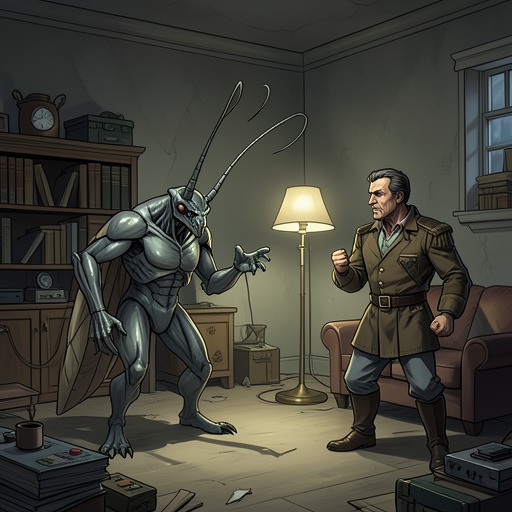
When he finally appears, he cannot enter the room normally. He must turn around one of the double doors while trying not to fall onto his back, and only half of his body is visible. The chief clerk recoils, Gregor’s mother collapses, and his father responds as though the body were a threat that must be driven away. Gregor’s physical appearance becomes the center of an encounter in which nobody can receive his explanations as he intends them. His body speaks through its visibility before his altered voice can be understood.
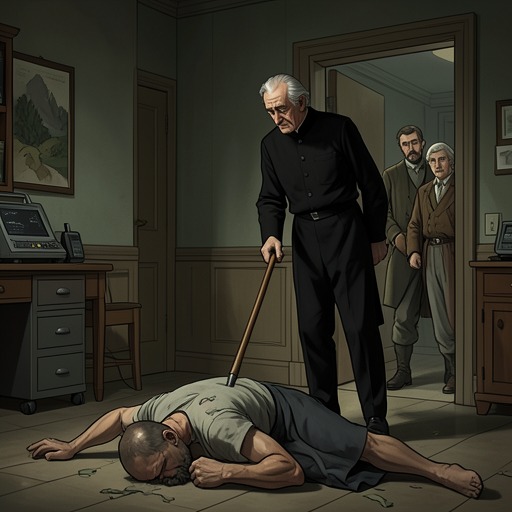
His return to the room becomes a physical assault. His father hisses at him and drives him forward with a stick, refusing to open the second door or give him enough space to turn and pass through. Gregor’s body is too broad for the doorway; one flank scrapes against the white door, leaving brown flecks and a painful injury. He becomes stuck, with the legs on one side quivering in the air and those on the other pressed against the floor, until his father gives him a heavy shove that frees him and sends him, bleeding, into the room. The door is then slammed shut. The family’s first organized response to the altered body is therefore not treatment but expulsion into confinement.
The injury has lasting consequences. When Gregor wakes that evening, his entire left side feels like one stretched scar, he limps badly, and one leg hangs lifelessly after being badly damaged in the morning’s events. Later, the apple lodged in his flesh remains there for more than a month because nobody dares remove it. The visible wound becomes a permanent reminder that Gregor’s body has been attacked by the very family whose financial survival once depended on him. His father is forced to recognize, at least temporarily, that the injured creature is still a family member and cannot be treated wholly as an enemy. Yet the wound is neither properly healed nor removed; it becomes part of the body’s long decline.
Confinement and Bodily Adaptation
The injuries reduce Gregor’s mobility, probably permanently. He is compared to an ancient invalid and needs long minutes to crawl across his room; the ceiling, once a source of pleasure, is no longer accessible. His physical world contracts to a few square metres and to the threshold of a door that is opened only under controlled circumstances. The reduction is not only spatial. It alters the rhythm of his existence, replacing travel, trains, and commercial work with crawling, waiting, and listening from darkness.
Before the injury, Gregor discovers that the transformed body has capacities unavailable to his human one. He learns the value of his antennae when feeling his way toward the door, and he enjoys crawling up walls and hanging from the ceiling because he can breathe more freely there and feel his body swing lightly. A fall that would once have been dangerous causes him no damage. This period of adaptation complicates the deterioration: Gregor is not simply losing every capacity, but acquiring a different bodily relation to space even as the family refuses to build a life around it. The body can adapt, yet the domestic environment remains organized around human expectations and increasingly restrictive boundaries.
His family’s management of the room gradually turns confinement into neglect. Objects with no place elsewhere are placed around him after one room is rented to The Three Lodgers. Furniture, equipment, kitchen dustbins, and other unwanted things accumulate in Gregor’s room, reducing the space available for movement. At first he pushes through the clutter because he has nowhere else to crawl; later he finds a grim satisfaction in moving it, although the effort leaves him sad and exhausted, sometimes immobile for hours. Physical activity survives only in a diminished form, and even that activity is produced by the family’s failure to preserve a livable space.
The door to the living room, left open each evening, gives Gregor a limited substitute for participation. He watches the family at dinner and listens to their subdued conversation while remaining hidden in his room. His father sleeps in his chair, his mother sews, and Grete Samsa studies shorthand and French after taking a sales job. Gregor’s body is therefore present at the edge of family life but excluded from its shared space. The open door offers sight and sound without touch, speech, or social equality; physical confinement becomes a form of social disappearance.
Appetite and Physical Depletion
Gregor’s appetite changes alongside his mobility. On the first evening, he is hungrier than usual and approaches a dish of sweetened milk with pieces of white bread, the drink that had normally been his favourite. He immediately discovers that the transformed body no longer receives familiar food in familiar ways. Pain in his tender left side makes eating difficult, and he can eat only when his whole body works together as a snuffling whole. The milk tastes unpleasant, so he turns away from it despite his former preference. The loss of appetite marks the separation between remembered identity and present physiology.
Over time, Gregor almost entirely stops eating. He may take food into his mouth merely to play with it, leave it there for hours, and then spit it out. The change is connected not only to his altered body but also to the condition of his room and the family’s treatment of him. Food is provided, yet nourishment no longer restores him. The repeated presentation and rejection of food makes deterioration visible without requiring a medical explanation: the body can no longer sustain the social arrangement in which Gregor once earned money, ate with the family, and remained a useful son.
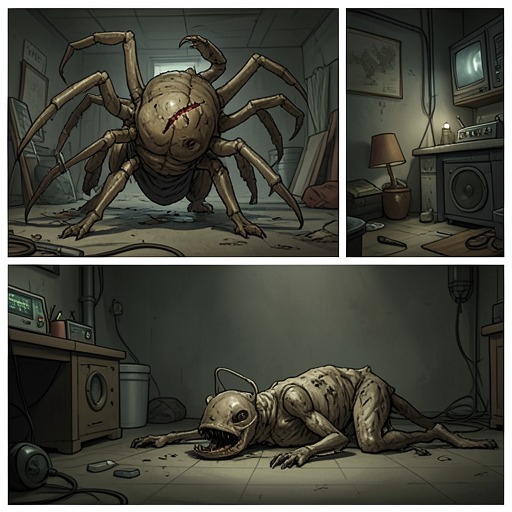
By the end, the consequences of this withdrawal are unmistakable. Grete Samsa observes that Gregor had eaten nothing for so long and that the food came out again just as it had entered. His body is completely dried up and flat. The physical process that began with a swollen, segmented belly and frantic legs ends in extreme depletion, with the corpse no longer able to lift itself on its legs or perform even the movements that once made others avert their eyes.
Final Immobility and Death
Gregor’s final physical state is characterized by the disappearance of pain together with the disappearance of movement. After he is shut back into his room following Grete’s declaration that the family must get rid of him, he discovers that he can no longer move at all. He does not experience this as a sudden surprise; rather, it seems to him that the ability to move on the spindly legs had been unnatural. His body aches, but the pain gradually weakens. He can barely feel the decayed apple or the inflamed area around it, now covered in white dust.
This stillness has a deceptive peace. Gregor thinks of his family with emotion and love and feels that, if possible, he must go away even more strongly than Grete has demanded. The body’s final surrender is thus accompanied by a last inward orientation toward the family, but the physical condition leaves no means of expressing that feeling to them. At three in the morning, as the light begins to appear outside the window, his head sinks down without his willing it and his last breath passes weakly from his nostrils.
The discovery of the corpse completes the family’s reclassification of Gregor’s body. The Charwoman first assumes that he is lying still deliberately, then pokes him with a broom and realizes that she can push him across the floor without resistance. She announces that he is dead, and Mr. Samsa responds by giving thanks to God. The family crosses itself, while Grete looks at the corpse and identifies its thinness and the failure of its nourishment. Death is treated as confirmation of a physical fact that had already been socially anticipated: the body that once supported the household has become, in the family’s eyes, a condition from which the household must be released.
Significance of the Decline
Gregor’s physical deterioration makes visible the conflict between bodily experience and social judgment. He remains capable of attachment, intention, adaptation, and concern for his family, but his failing body becomes the evidence by which others decide that he can no longer count as Gregor. Grete’s insistence that the family must stop regarding the creature as her brother converts physical difference into a reason for expulsion, even though the injured body still bears the history of familial obligation and dependence.
The decline also exposes the limits of care within the Samsa family apartment. Gregor is given food, watched through a door, and occasionally protected from the full shock of his condition, but his injuries are not repaired, his room is progressively filled with discarded objects, and his inability to communicate makes every act of care conditional. What begins as bewildered attention becomes a system of containment. His body is kept inside the household while being removed from its language, work, meals, and decisions.
The ending gives this bodily history its bleakest irony. Gregor’s death does not follow a single announced diagnosis; it emerges from accumulated injury, immobility, confinement, and refusal of nourishment. When the family sees the dried and flattened corpse, physical deterioration has reached its final form: a body no longer demanding space, food, explanation, or protection. The restoration of household order depends on the disappearance of the body that had once made the household possible.