Gregor Samsa’s social alienation
The MetamorphosisGregor Samsa’s social alienation is the central condition produced by his transformation from a travelling salesman and family provider into a being whom others can no longer recognize as human. It is not merely physical isolation. It is a layered loss of speech, authority, mobility, shared space, economic value, and familial identity, culminating in the family’s acceptance of his death as the restoration of ordinary life.
Identity Before and After Transformation
Gregor’s alienation begins within a life organized by work and debt. Before his transformation, he had risen from junior salesman to travelling representative through intense effort after the collapse of his father’s business. He had converted his earnings into cash for the family and had borne the costs of the whole household, while planning to repay his parents’ debt to his employer within another five or six years. His value in the family was therefore tied to service: he was the person who worked, paid, and postponed his own future.
That arrangement had not produced complete emotional intimacy. Gregor and his family accepted his money with gratitude, and he was glad to provide it, but the earlier warmth had diminished. His remaining close relationship was with Grete Samsa, whose musical ability inspired his secret plan to send her to the conservatory. The plan, which he hoped to announce on Christmas day, reveals a private emotional life that his working role concealed. His alienation thus predates his insect form: he belongs to the family materially, but his hopes and sacrifices are only partly shared.
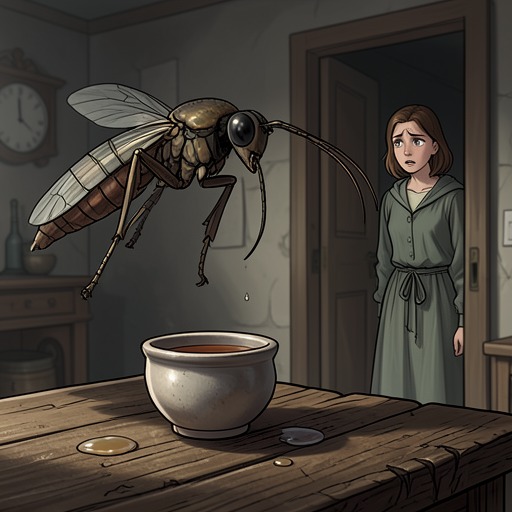
When Gregor wakes, transformed into a horrible vermin, the room around him remains a proper human room, with familiar walls, textile samples, and a framed picture of a woman in furs. The contrast makes his exclusion visible before anyone else enters. His surroundings still testify to his human history, but his body has become an object that no longer fits the category of the person who occupied them.
Communication Breakdown and Social Recognition
The first decisive rupture is linguistic. Gregor hears his own voice as an unfamiliar sound, with painful squeaking and an echo that makes his words unclear to others. He continues to believe that his speech is intelligible and tries to answer his mother, father, and Grete Samsa carefully, but the family hears only a disturbing alteration. The discrepancy between what Gregor intends and what others receive turns communication into evidence against him.
The Chief Clerk’s response converts this uncertainty into public judgment. After Gregor speaks from behind the locked door, the Chief Clerk asks whether his parents have understood any of it and suggests that Gregor may be trying to make fools of them. Gregor’s mother imagines that he may be seriously ill and calls for a doctor, but the Chief Clerk identifies the sound more brutally as the voice of an animal. The same bodily sign is therefore interpreted through competing frameworks: illness might preserve Gregor’s human identity, whereas the animal label removes it.
Gregor himself still acts as a social subject. He wants to open the door, explain himself, and speak with the Chief Clerk so that the others can see him and judge the situation directly. He imagines that calm acceptance would relieve him and that, if they were shocked, the responsibility would no longer be his. Yet when he finally turns the key with his powerful jaw, injuring himself and leaving brown fluid on the key, the act of self-disclosure produces horror rather than recognition.
The open door briefly creates the possibility of reintegration, but the scene instead establishes a new social boundary. The Chief Clerk retreats with his hand over his mouth; Gregor’s mother collapses; and Mr. Samsa clenches his fists, covers his eyes, and weeps. Gregor remains only partly visible behind the second door, physically inside the apartment but socially outside the room. The family can see him, yet seeing does not restore mutual understanding.
Confinement, Surveillance, and Expulsion
Gregor’s locked room becomes the material form of his alienation. Before the transformation, he had locked doors at night out of habit acquired through travelling. Afterward, the same domestic boundary changes meaning: it protects the family from his presence and confines him away from ordinary interaction. His attempt to return to work is replaced by a struggle to move across thresholds controlled by other people.
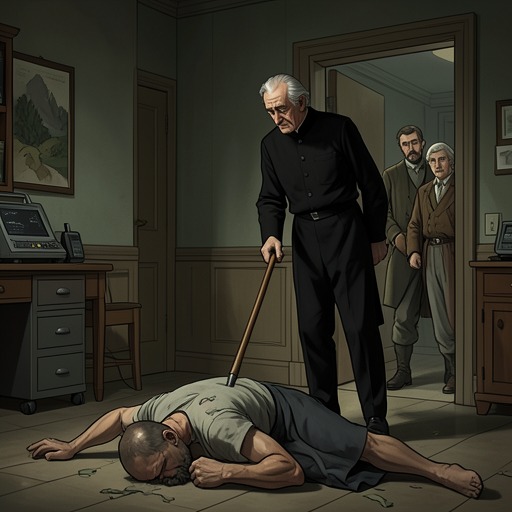
Mr. Samsa’s response makes the family apartment a disciplinary space. He drives Gregor back with a stick and hisses at him like a wild man, insisting on speed rather than understanding. Gregor cannot move backward properly, cannot turn without difficulty, and cannot fit his broad body through the doorway. Instead of opening the other door or allowing him time to prepare himself, his father forces him forward. Gregor becomes stuck, scrapes and injures one side of his body against the white door, and is finally shoved deep into his room. The door is slammed and locked, transforming family protection into violent exclusion.
The injury has lasting social consequences. An apple remains lodged in Gregor’s flesh for more than a month, a visible reminder of the attack, and his mobility declines until he resembles an ancient invalid. His body is no longer simply different; it is increasingly unable to participate in the movements required by shared domestic life. The household’s doors and rooms are arranged around his absence even while his body remains inside them.
For the first fourteen days, Mr. and Mrs. Samsa cannot bring themselves to enter Gregor Samsa’s room. Grete Samsa assumes the practical work of tidying the room and reporting to her parents what Gregor has eaten, how he has behaved, and whether there has been any improvement. The family therefore maintains contact through observation and reports rather than conversation. Even Mrs. Samsa’s desire to see her son is treated as dangerous and must initially be physically restrained.
Gregor tries to reduce the burden of his appearance. When Grete Samsa begins to find him unbearable, he hides under the couch and later spends four hours carrying a bedsheet across the room so that he can be completely covered. The sheet is an act of consideration, but it also records his internalization of exclusion: Gregor now helps manage his own disappearance from the family’s sight.
Economic Displacement and the Reorganization of the Family
Gregor’s social position changes as soon as his labor disappears. He had believed that nothing remained from his father’s failed business, and his work had been organized around rescuing the family from that catastrophe. After his incarceration, he learns that his father had retained savings in a cash box. The discovery weakens the economic justification for Gregor’s former centrality: his family had not been as completely dependent on him as he believed.
The family nevertheless experiences the transformation as a practical crisis. Gregor’s father, mother, and Grete Samsa must eventually work, and the household becomes quieter and more fatigued. His father sleeps in his chair, his mother sews fancy underwear for a fashion shop, and Grete takes a sales job while studying shorthand and French for a better position. The family’s survival no longer depends on Gregor’s direct earnings, and their new labor gradually gives them an identity independent of him.
This economic reorganization also alters emotional alliances. Grete Samsa initially performs the care work that preserves Gregor’s connection to the household, while Mr. and Mrs. Samsa remain outside his room. Later, however, the burden of care becomes part of Grete’s argument against him. When the family’s lodgers are driven away after the violin incident, she declares that they cannot continue living this way and refuses to call the creature her brother. The person who had once been closest to Gregor becomes the clearest agent of his social removal.
From Family Member to Obstacle
The language applied to Gregor marks the final collapse of his identity. Grete Samsa calls him a monster and insists that the family must get rid of him. She argues that they have done everything humanly possible to care for it and be patient, replacing the familial pronoun with an impersonal designation. She also claims that they must abandon the idea that the creature is Gregor, because a human being would have understood that people could not live with an animal and would have left voluntarily.
This reasoning makes Gregor’s continued presence appear as an attack on the household. Grete says that the animal has persecuted the family, driven out the tenants, and threatened to force them onto the streets. The family’s fear and economic pressure become indistinguishable from moral condemnation. Gregor is no longer treated as a sick relative whose condition has to be endured; he is treated as an obstacle that must be removed so that the others can resume their lives.
Yet the narrative preserves evidence that contradicts the family’s classification. After the apple attack, Gregor’s serious condition reminds even Mr. Samsa that, despite his revolting form, Gregor remains a family member who cannot simply be treated as an enemy. The family’s duty to swallow its revulsion and be patient survives temporarily, but only as a strained obligation. Gregor is included as kin at the same moment that he is managed as a dangerous body.
Gregor’s own behavior further complicates the accusation that he wishes to dominate the apartment. When he turns toward his room, he is trying to withdraw rather than frighten anyone, but the movement alarms the family. He is unable to communicate his intention, and his effort to leave the common space is interpreted as another threat. Social alienation therefore becomes self-reinforcing: Gregor’s attempts at consideration cannot be recognized because the family has already ceased to read him as a human agent.
Death and the Restoration of Social Order
Gregor’s final isolation is inward as well as spatial. After Grete Samsa declares that he must go, he is hurriedly shut, bolted, and locked inside his room. He can no longer move, although he feels relatively comfortable as the pain weakens. The decayed apple and the inflamed area around it have become nearly insensible, and his body has reached a condition in which physical suffering is fading together with physical agency.
His last thoughts retain attachment to the family. He thinks back on them with emotion and love and feels that, if possible, he must go away even more strongly than Grete Samsa does. His death is therefore not presented as a triumph over the family or as revenge for their rejection. It is the final consequence of a social world in which his continued existence has come to seem incompatible with the family’s ability to live.
The family’s response to his corpse confirms the extent of his dehumanization. The Charwoman discovers that he is dead and announces it bluntly. Grete Samsa observes that he had grown thin because he had eaten so little, while Mr. Samsa gives thanks to God. The body is dried up and flat, no longer lifted on its legs and no longer capable of forcing the others to look away. Death makes Gregor manageable: the family can now treat him as a finished problem rather than a contested person.
The immediate aftermath completes the social reversal. Mr. Samsa, Mrs. Samsa, and Grete Samsa leave the apartment together for the first time in months, take a tram into the open country, and discuss their promising jobs and the possibility of moving to a smaller, cheaper, more practical flat. The family’s renewed mobility contrasts with Gregor’s confinement and death. As Grete’s parents notice her becoming a lively, well-built young woman, they begin imagining a suitable husband for her. The household’s future opens precisely when Gregor’s place within it has been erased.
Gregor Samsa’s social alienation therefore moves from dependence to estrangement, from estrangement to confinement, and from confinement to exclusion. His transformation does not create all the family’s tensions; it reveals how thoroughly belonging had been organized around labor, speech, usefulness, and the capacity to remain within accepted human categories. Once those functions disappear, the family can preserve its economic and social future only by redefining Gregor as an animal, an enemy, and finally a corpse.