Gregor opens his bedroom door
The MetamorphosisGregor opens his bedroom door in an effort to make his condition visible and recover control over the crisis surrounding his missed train and unexpected visit from the Chief Clerk. The action is decisive because it converts uncertainty into undeniable spectacle: Gregor believes that showing himself may allow him to explain, reassure his family, and perhaps still reach work, while the people outside the room see a frightening creature whose presence demands medical, domestic, and disciplinary responses.
Causes and Immediate Stakes
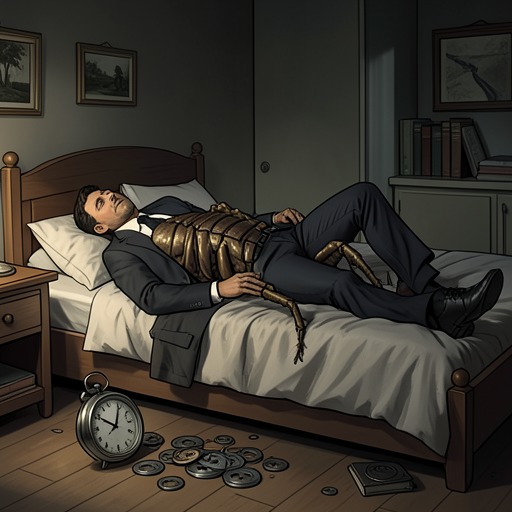
Gregor’s attempt to open the door follows the first morning of his transformation, when he wakes in his familiar room with an armour-like back, a brown, divided belly, and many thin legs that wave helplessly. Although his body has become radically unfamiliar, his first explanations remain tied to ordinary work and illness. He thinks of the train he must catch, the collection of textile samples that is not yet packed, his fifteen years without illness, and the suspicion that the Chief Clerk might accuse him of shirking. Gregor even considers the transformed voice a symptom of a serious cold, an occupational hazard for a traveling salesman, rather than evidence that his human identity has become physically impossible to communicate.
The pressure outside the locked room intensifies this denial. His mother calls to him about the time, his father knocks, and Grete asks whether he needs anything. Gregor answers that he is ready, carefully spacing his words in the hope of removing the strangeness from his voice. Because he has acquired the habit of locking doors at night during his travels, he has temporarily created a barrier between his interior experience and the family’s demands. Yet the lock also turns the room into a site of suspicion. The Chief Clerk has come to investigate his absence, and Gregor decides that direct exposure is preferable to continued explanation through a wooden door.
The Act of Unlocking
Gregor first moves toward the chest of drawers, using it to pull himself upright despite the pain in the lower part of his body. He wants the visitors to see him and hear him directly. Part of his reasoning is almost procedural: if they are shocked, he will no longer bear responsibility for their reaction; if they remain calm, he will have no reason to be upset and might still reach the station. This imagined choice reveals how strongly he continues to organize the scene through the habits of a responsible employee, even while his body defeats every ordinary expectation of movement.
He then pushes a chair toward the door, releases it, and throws himself against the wood. The adhesive tips of his legs hold him upright while he works the key with his mouth. He has no proper teeth with which to grasp it, but his jaw is powerful enough to turn the lock. A brown fluid runs from his mouth over the key and drips onto the floor, making the act both technically successful and physically degrading. The Chief Clerk hears the key turning, and Gregor takes this as encouragement. He imagines that his father and mother should be urging him on, but no such support comes from the other side.
The final turn requires him to use the whole weight of his body while hanging onto the key or pressing it down with his mouth. The pain does not stop him. When the lock snaps back, he concludes that the locksmith is unnecessary and rests his head on the handle to open the door completely. The door is already wide open before the others can properly see him, so the revelation occurs before he has had time to arrange or protect the image that will represent him.
The Revelation and the Family’s Response
Gregor must slowly turn around one of the double doors without falling onto his back. While he is still absorbed in this difficult movement, the Chief Clerk sees him first and exclaims in horror. His hand covers his open mouth as he retreats, as though an invisible force were driving him away. The gesture makes the social meaning of the doorway immediate: Gregor has crossed from private uncertainty into public visibility, but visibility does not restore recognition. It produces recoil.
His mother looks toward his father, unfolds her arms, takes two steps forward, and collapses onto the floor. His father appears hostile, clenching his fists as if prepared to strike Gregor back into the room; then he covers his eyes and weeps, his chest shaking. The responses divide the family between fear, grief, and threatened violence, while Gregor remains only partly visible behind the other door, his head bent to one side as he peers out. Even the surrounding apartment sharpens the exposure. The open entrance and front doors reveal the landing and stairs, while the hospital across the street, with its austere regular windows, forms a stark external image of observation and institutional judgment.
The Chief Clerk’s reaction confirms that Gregor’s voice has already failed as a means of identification. He tells Gregor’s parents that the sound was an animal’s voice and asks whether Gregor is trying to make fools of them. Gregor believes his words are clearer than before, perhaps because his ears have become accustomed to the altered sound, but the others cannot understand what he says. His family’s interpretation therefore outruns his own: the problem is no longer a missed train or a suspicious absence but an unrecognized body whose speech cannot establish continuity with the person they knew.
From Communication to Expulsion
At first, the family’s response still contains the language of assistance. His mother calls for a doctor, and his father calls for a locksmith; two girls run through the hall to obtain help. Gregor feels calmer because he believes that his situation has been recognized as something requiring treatment. He expects the doctor and locksmith to achieve surprising results, although he cannot clearly distinguish their roles. For a brief moment, the exposed body is treated as a crisis to be solved rather than as a presence to be eliminated.
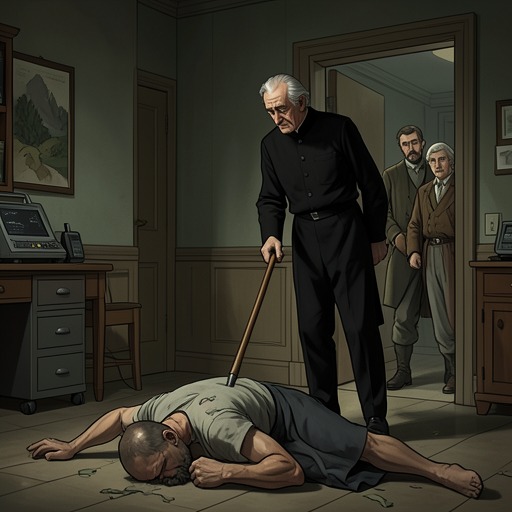
That possibility collapses when Gregor’s father drives him back toward the bedroom. Gregor cannot move backward in a straight line and is terrified of the stick and the hissing noises behind him. His body is too broad for the doorway, and his father does not open the other half of the double door or give him time to stand upright. Instead, he forces Gregor forward. Gregor’s flank scrapes painfully against the white door and leaves brown flecks on it; he becomes stuck, with the legs on one side quivering in the air and those on the other pressed against the ground. A heavy shove finally frees him and sends him, bleeding, deep into his room. The door is slammed shut with the stick, completing the transformation of a domestic threshold into an instrument of exclusion.
The expulsion establishes the consequence of the revelation: Gregor’s attempt to be seen does not restore dialogue but authorizes confinement. His family can no longer treat the locked door as a temporary inconvenience, because the open door has shown them what lies behind it. The room becomes both shelter and prison, and the family’s wish to protect the apartment increasingly depends on keeping Gregor’s body out of shared space.
Narrative Significance
The bedroom-door revelation is the central scene in which Gregor’s self-understanding and other people’s classifications visibly diverge. He acts with the intentions of a dutiful worker and family member: he wants to explain himself, avoid causing trouble, attend to his employment, and prevent others from bearing the consequences of his absence. His body, however, communicates through scraping, fluid, awkward movement, altered sound, and the sight of an animal-like form. The scene gives priority to bodily evidence over verbal intention, making the failure of communication a material event rather than a mere misunderstanding.
The door also gathers the story’s systems of control into one narrow passage. Behind it are the alarm clock, the train schedule, the employer’s report, the family’s demands, and Gregor’s internalized obligation to prove that he is not lazy or dishonest. In front of it stand the Chief Clerk, his parents, and the institutional possibilities of a doctor and locksmith. Gregor must physically injure himself to cross the boundary, while his father can restore the boundary with a stick. The household thus becomes a place where care and coercion are inseparable: the family calls for medical help, but once Gregor appears, it treats his return to the bedroom as the necessary solution.
The later course of Gregor’s life confirms the revelation’s lasting damage. His father’s shove leaves him with an apple lodged in his flesh for more than a month and with severely reduced mobility. Although the family continues to regard him for a time as a family member who should not be treated entirely as an enemy, patience becomes conditional and increasingly exhausted. His sister eventually insists that the creature must be removed, arguing that the family has harmed itself by continuing to believe that it is Gregor. When Gregor dies after concluding that he should go away for the family’s sake, the family gives thanks, and Grete observes how thin and dried up his body has become. The open door therefore marks not only the first public exposure of his transformation but also the beginning of the process by which his human identity is displaced by the household’s need to restore order.