Gregor's expulsion into his room
The MetamorphosisGregor's expulsion into his room is the first decisive act of physical exclusion in The Metamorphosis. It follows the failed attempt to preserve his employment after Gregor Samsa wakes transformed into a horrible vermin, misses the five o'clock train, and becomes the object of suspicion from the Chief Clerk. Once Gregor opens the door and exposes his altered body, the family's apartment ceases to be a shared domestic space: Mr. Samsa treats Gregor as a danger to be driven back, while Gregor still understands himself as a son whose family's future depends on his job.
Causes and Background
Gregor's immediate objective is not escape from the family but the preservation of his place within it. At half past six and then quarter to seven, he remains preoccupied with trains, samples, the employer's anger, and the debt owed by his parents. He has worked for fifteen years without taking sick leave, and he imagines that reporting illness would bring the employer, a medical-insurance doctor, and accusations that his parents have raised a lazy son. Even after his transformation, he tells himself that his altered voice is probably the first sign of a serious cold and insists on getting up, dressing, and having breakfast before deciding what to do.
The Chief Clerk's arrival turns this private bodily crisis into a public employment crisis. He comes to the Samsa family apartment because Gregor has missed work, and he speaks through the closed door in the name of both Gregor's parents and his employer. He reproaches Gregor for barricading himself in his room, answering only yes or no, failing in his business duties, and producing unsatisfactory turnover. He also raises the possibility that money recently entrusted to Gregor may explain his absence. The language of immediate explanation, reports, suspicion, and business performance makes the apartment an extension of the workplace, while Gregor's locked door becomes evidence against him rather than protection for him.
Gregor responds by trying to restore the old order through speech and explanation. He believes that if he can open the door, the Chief Clerk will understand that he is only temporarily unwell and that his parents should not suffer because of accusations against him. His speech, however, has become a painful squeaking that other people cannot understand, although it sounds clear to him. The communication failure leaves him unable to defend either his body or his employment, and it prepares the way for his physical removal to replace verbal negotiation.
What Happens
Gregor first uses a chair to reach the door, braces himself against it with the adhesive tips of his legs, and turns the key with his powerful jaw. The effort causes brown fluid to flow from his mouth over the key and onto the floor, but he succeeds in unlocking the door without the locksmith he had expected to need. The door opens fully before the people outside can see him. The Chief Clerk recoils with his hand over his mouth and retreats; Mrs. Samsa collapses onto the floor; and the sight of Gregor transforms the family's anxious waiting into open panic.
Gregor nevertheless pursues the Chief Clerk because he believes that allowing him to leave in terror will place his position at the firm in extreme danger. He thinks that his parents have misunderstood how much the job matters and that the family's future depends on calming, convincing, and winning over this representative of the employer. He even wishes for Grete Samsa's help, imagining that her intelligence and ability to influence the Chief Clerk might repair the situation. When she is absent, Gregor attempts the task himself, still acting according to the duties and loyalties of his former human life.
His first movement across the floor briefly feels like a discovery rather than a defeat. After falling from the doorway, he finds that his numerous little legs have solid ground beneath them and move according to his commands. He begins to believe that his sorrows may end, but Mrs. Samsa's terror interrupts this fragile confidence. She backs into the breakfast table, knocks over the coffee pot, and cries for help. Gregor gently addresses her, yet the sight of the coffee spilling causes him to snap his jaws in the air, which intensifies her fear. The Chief Clerk reaches the stairs and escapes, his shouts echoing through the stairway.
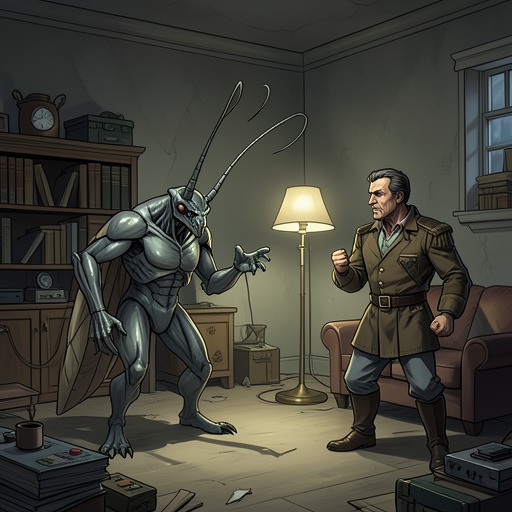
Mr. Samsa then takes command of the scene. Rather than pursuing the Chief Clerk or allowing Gregor to follow him, he seizes the Chief Clerk's stick from a chair and picks up a large newspaper. With these objects he drives Gregor toward Gregor Samsa's room, stamping his foot and making hissing noises. Gregor's appeals are not understood, and his father's gestures reduce him to an animal that must be directed, repelled, and contained. The father does not strike him immediately, but the stick carries the threat of a lethal blow to Gregor's back or head and turns the passage through the apartment into a forced retreat.
The retreat is made especially difficult by the architecture of the doorway and by Gregor's unfamiliar body. He has no practice moving backward and cannot go straight, while the doorway is too narrow for his broad body. Mr. Samsa does not open the second door to give him more room or allow him time to stand upright. Instead, he presses Gregor forward more forcefully. Gregor turns with difficulty, scrapes one flank against the white door, and leaves brown flecks on it. His body becomes stuck; the legs on one side quiver in the air while those on the other are painfully pressed against the floor. Finally, Mr. Samsa gives him a heavy shove from behind, freeing him from the doorway and sending him, heavily bleeding, deep into the room. The door is slammed shut with the stick, and the apartment falls silent.
Immediate Consequences
The expulsion makes Gregor's room the place where his body can be hidden from the family and from the outside world. It is not a chosen retreat. He is forced into it by the combined pressures of employment surveillance, familial panic, and the father's authority over the apartment's doors. The room therefore becomes both shelter from direct violence and the material form of his confinement.
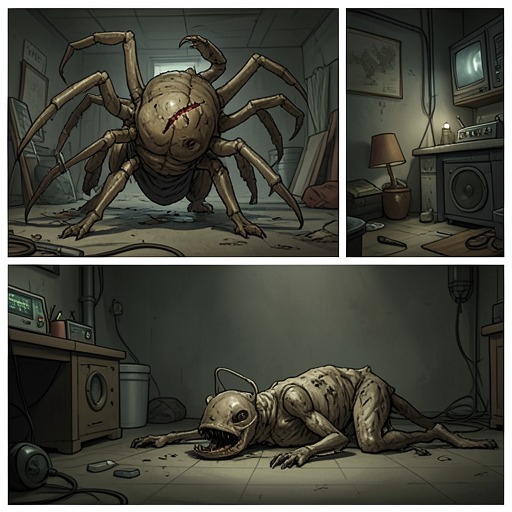
The violence has lasting physical consequences. When Gregor wakes that evening from a deep, coma-like sleep, his entire left side feels like one stretched scar. He limps on two rows of legs, and one leg, badly injured during the morning's events, drags lifelessly. More than a month later, the apple lodged in his flesh remains in place because no one dares remove it. The injury reduces his mobility, probably permanently, and turns the father's attempt to restore domestic order into a source of prolonged bodily deterioration.
The family does not immediately treat Gregor as wholly foreign. The apple's continued presence reminds even Mr. Samsa that Gregor, despite his revolting form, remains a family member and cannot simply be treated as an enemy. Yet this recognition is inseparable from exclusion. Gregor is kept inside his room, separated from ordinary conversation, food, and movement; the family can acknowledge a duty to be patient while still organizing the apartment around his isolation.
Spatial and Familial Significance
The scene establishes a recurring system of doors, thresholds, and controlled visibility. Gregor's old habit of locking every door at night once expressed professional caution and personal privacy; after his transformation, the locked door delays recognition but also traps him. The Chief Clerk's inspection, the family's listening from outside, the opening of the bedroom door, and Mr. Samsa's forced closure of it create a chain of surveillance in which Gregor is repeatedly required to prove that he is still employable, intelligible, and safe.
The father's authority is also visibly reorganized through clothing and objects. At this stage Mr. Samsa drives Gregor with the Chief Clerk's stick and a newspaper; later, he stubbornly wears his work uniform even at home, as if still awaiting the voice of a superior. The uniform's polished gold buttons and accumulating stains embody a household structured by service and discipline. Mr. Samsa's treatment of Gregor is not merely a private outburst: it reproduces the command structure that has governed the family economically, transferring the logic of supervision from the workplace into the domestic interior.
Gregor's later position at the edge of the living room confirms what the expulsion has begun. After the apple attack and the loss of mobility, the living-room door is left open in the evenings, allowing him to watch the family from darkness while remaining unseen. He observes Mr. Samsa sleeping in his uniform, Mrs. Samsa sewing, and Grete studying shorthand and French after taking a sales job. The family's labor is redistributed after Gregor can no longer work, but Gregor's access to family life is reduced to permitted observation through a doorway. When Grete eventually shuts and locks his door after he has returned to his room, the earlier expulsion has become a routine of deliberate containment.
Narrative and Thematic Significance
Gregor's expulsion marks the collapse of the last possible appeal to his former social identity. He tries to preserve his job, reassure his parents, and persuade the Chief Clerk, but his words cannot cross the boundary created by his new voice and body. Once speech fails, the family interprets his movement as an attack and answers with force. The scene thus presents communication breakdown not as a neutral misunderstanding but as a condition that permits another person to define Gregor's intentions for him.
The episode also makes visible the connection between economic dependence and familial obligation. Gregor believes that the future of the entire family depends on his position, yet the representative of that position abandons him as soon as his body becomes incomprehensible. Mr. Samsa's violence protects the household from the immediate scandal of Gregor's exposure, but it also marks the moment when Gregor's value as a worker no longer protects his status as a son. He is simultaneously needed as the lost provider, feared as an alien body, and confined as a problem.
The forced passage through the narrow doorway condenses this contradiction into a physical image. Gregor's body is too broad for the opening, while his father insists that he pass quickly and without accommodation. The injury on the white door records the violence of the fit, and the shove that finally sends Gregor into the room turns a family home into a border controlled by force. Afterward, Gregor still thinks of his family with love, but the apartment has already taught him that belonging can survive as feeling after it has disappeared as access.